
What the Future: Success
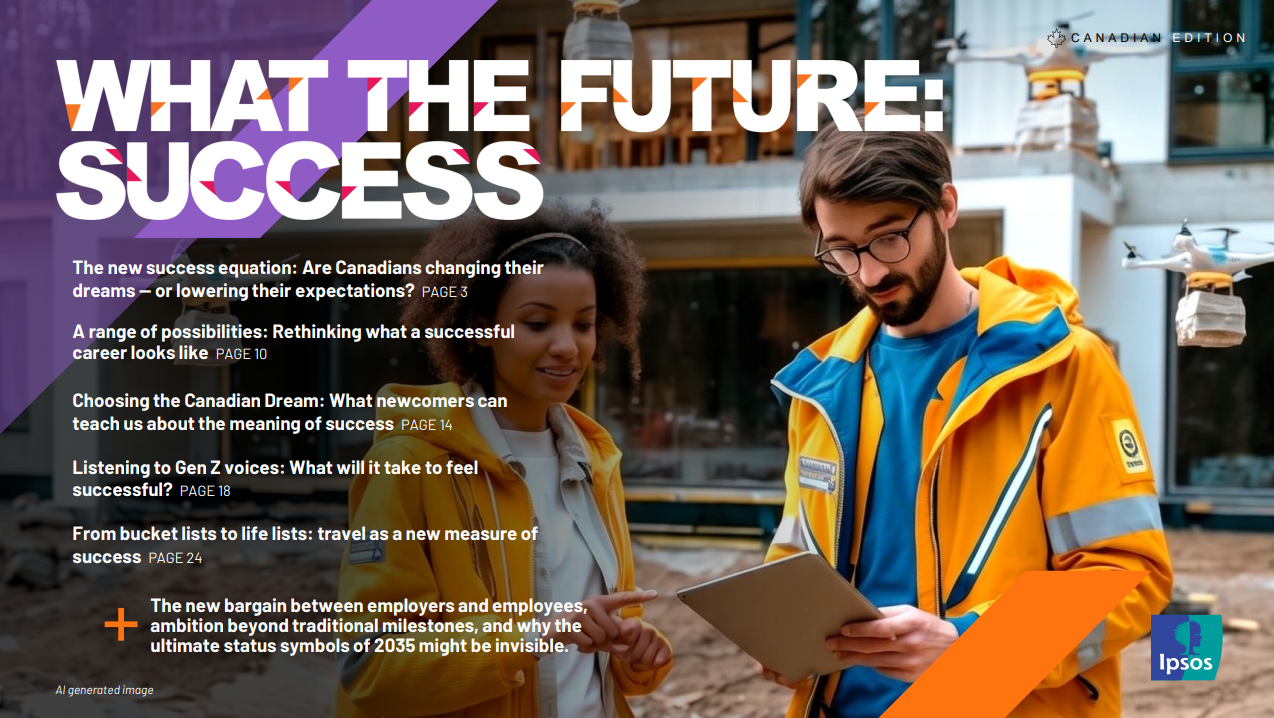 Read the full What the Future: Success issue
Canadians haven't necessarily stopped wanting the good life. But as the old rules of getting ahead become less reliable, they’re rethinking what success looks like — and what they're willing to sacrifice to achieve it.
The Canadian Dream used to come with a simple set of instructions. Get an education. Find a good job. Buy a home. Work hard, play by the rules, and eventually enjoy the rewards. Nobody promised it would be easy. But there was at least a reasonable expectation that following the instructions would get you somewhere.
These days, with housing affordability testing the limits of household budgets, careers becoming less predictable and retirement feeling increasingly expensive, Canadians might be forgiven for wondering whether somebody changed the rules without telling them.
Ipsos’ new What The Future: Success research finds that nearly seven in ten Canadians still believe Canada is a place where people can build a better life for themselves and their families.
Yet just 53% believe the Canadian Dream is achievable for people like them. And here's a rather uncomfortable finding: 69% believe you can do everything right and still not get ahead financially. So much for the idea that hard work is all it takes.
It's tempting to conclude that Canadians are abandoning traditional definitions of success. After all, 87% say success is more about having the life they want than impressing others. And nearly three-quarters would rather have freedom and control over their time than a high-status job.
But perhaps we're asking the wrong question.
Are Canadians redefining success because their aspirations have changed? Or are they adjusting their expectations because the things they've always wanted have become harder to achieve?
The good life, on different terms
Ask Canadians what makes them feel successful, and the answers aren't especially extravagant. A safe, comfortable home tops the list, followed by enough money to live the way they want, close relationships and a comfortable retirement. It's not exactly a wish list of yachts and private jets.
But look a little closer. While having a safe, comfortable place to live tops the list, owning that home ranks considerably lower. Canadians are more likely to identify close relationships, control over their time, and the freedom to pursue hobbies and travel as measures of success. In a country where homeownership has long been a defining milestone of adulthood, that's a distinction worth paying attention to. Perhaps success is becoming less about what we own and more about how we live.
For many Canadians, success isn't necessarily about accumulating more. It's about having enough — enough security, enough freedom, enough time to enjoy the life they're building. But there's a difference between deciding that money and status aren't everything and concluding that certain financial milestones are simply out of reach.
Nearly one in three Canadians want financial peace of mind but don't expect to achieve it. A similar proportion aspire to a comfortable retirement but doubt they'll get there. Perhaps they haven't decided that traditional success no longer matters. They've simply had to reconsider what's realistic. What looks like a cultural redefinition of success may also be a practical renegotiation of expectations.
Young, ambitious and not giving up
If anyone is supposed to be rewriting the rules of success, it's younger Canadians. We're told they're rejecting the corporate ladder, prioritizing experiences over possessions and refusing to organize their lives around their parents' milestones. But the picture is more complicated.
Among Canadians aged 18–34, the leading measure of success is earning enough money to live the way they want (43%). Loving relationships, work-life balance, a comfortable home and control over their time follow closely behind. That's hardly a rejection of financial ambition. It's a desire to make sure ambition serves a life worth living.
Despite housing affordability challenges and economic uncertainty, nearly two-thirds (64%) are optimistic about building the life they want. Yet 58% already feel behind where they expected to be, and the same proportion say financial pressures have changed what success means to them.
Maybe they're not abandoning the Canadian Dream. Maybe they're trying to make it work on their own terms. But the more surprising story may lie elsewhere.
The midlife squeeze
Canadians aged 35–54 are supposed to be hitting their stride. Careers established. Financial foundations taking shape. Retirement beginning to look plausible. Yet in our snapshot of Canada today, they're the least convinced that the Canadian Dream is within reach.
Just 46% believe the Canadian Dream is achievable for people like them, compared with 54% of younger Canadians and 59% of those aged 55–75. More than half (57%) feel behind where they expected to be. And 36% want financial peace of mind but don't expect to achieve it. The same proportion aspire to a comfortable retirement but doubt they'll get there.
It's one thing to discover the ladder is harder to climb. It's another to realize, halfway up, that it might not reach where you thought it did.
For those in midlife, the stakes are different. Careers, families, mortgages and financial obligations aren't hypothetical future considerations. They're already part of the equation. And changing course comes with complications. Perhaps the most unsettling crisis of expectations isn't happening at the beginning of adult life, but somewhere in the middle.
When the destination changes, so does the journey
If the old rules no longer guarantee the old rewards, perhaps it's time to question the rules themselves. Is a university degree still the golden ticket? Or might a skilled trade offer greater security? Is climbing the corporate ladder worth the climb? And is the point of working hard to accumulate more things, or to have the freedom to enjoy life?
These aren't simply questions about education or employment. They're questions about what makes a life successful — and how much we're willing to sacrifice to achieve it.
The trade-offs get trickier when the future feels uncertain. How much should we save for retirement when there are places to see and experiences to have today? How long should we keep putting off the good stuff in the hope that someday we'll have earned it?
Meanwhile, AI is changing the equation again. The skills that once offered a dependable path to success may not carry the same weight tomorrow.
Canadians want security, but they also want freedom. They want to build for the future without postponing living indefinitely. Perhaps the future of success won't be about
rejecting traditional milestones but finding new ways to balance competing aspirations — and having the freedom to make those choices.
The future of getting ahead
Three-quarters of Canadians believe the path to success will become less predictable for the next generation. The Canadian Dream may not be disappearing, but the assumption that there's a single, reliable route to achieving it is increasingly open to question.
Perhaps Canadians aren't dreaming smaller. Perhaps they're simply questioning whether the old rules can still deliver the lives they want.
The question isn't simply what success will look like in the future. It's who will have the freedom to define it — and the opportunity to achieve it.
For more insights, join us for our deep-dive webinar.
INSIDE THIS EDITION
My parents believed in the Canadian Dream. Will my children?
Ipsos' Mike Colledge reflects on why younger Canadians are losing confidence that hard work and sacrifice will lead to a better future.
A range of possibilities: Rethinking what a successful career looks like
Noel Baldwin,Executive Director of the Future Skills Centre, explores how evolving education and skills pathways are opening up new possibilities for career success.
Choosing the Canadian Dream: What newcomers can teach us about success
Daniel Bernhard, CEO of the Institute for Canadian Citizenship, explores how newcomers' ambitions are reshaping the meaning of success in Canada.
Listening to Gen Z voices: What will it take to feel successful?
Young Canadians confront the gap between their aspirations and the realities of getting ahead.
From bucket lists to life lists: Travel as a new measure of success
Karine Gagnon, General Manager of Transat Distribution Canada, explores how travel is becoming a marker of success as Canadians rethink when and how to enjoy life's rewards.
The changing currency of status
Craig Patterson, Founder and Publisher of Retail Insider, explores how changing aspirations are reshaping the meaning of luxury and the symbols of success.
Renegotiating the employer-employee bargain
Nora Jenkins Townson, Founder of HR consulting firm Bright + Early explores how employees are redefining career success — and what the changing expectations mean for employers.
From Ambition to reality: Helping Canadians navigate new paths to success
Andrew Greenlaw, SVP of Brand, Community and Client Experience at CIBC, discusses how Canadians' ambitions are evolving and how brands can connect with what matters most to them.
.
- Download our full 45-page report here
 | If you’d like to explore what these shifts mean for your brand strategy, workforce, customers, or policy environment, we’d be glad to connect. Reach out to Diane Ridgway-Cross to schedule a tailored discussion or bespoke presentation with our team. |