
Bursting Into The Canadian Housing Bubble: How Homeowners and Non-Homeowners Differ In The 2019 Federal Election
Toronto, ON, October 11, 2019 — Canada is home to some of the most expensive real estate markets in the world. In the 2019 campaign, it has been widely acknowledged that the cost of housing in Canada has contributed to a lack of affordability, which is the #3 issue according to earlier Ipsos polling. In an effort to chase votes, big campaign promises have been made, many of which revolve around day-to-day affordability and housing. Among other commitments, the NDP for example has promised to build 500,000 affordable housing units, while the Conservatives are planning to make surplus federal land available for housing development, and the Liberals have promised to expand the First-Time Home Buyer Incentive.
While most Canadians across all provinces report that they own their house or condo/co-op, proportions of homeownership are significantly higher in Saskatchewan/Manitoba (63%), Atlantic Canada (60%), Ontario (59%), and BC (59%), when compared to Alberta (55%) and Quebec (51%). Ipsos, on behalf of Global News, has examined Canadian homeowners in comparison to their non-homeowning counterparts to see just how much concerns of affordability, taxes, and housing distinguish these two groups in the 2019 Federal Election.
What Are They Voting For?
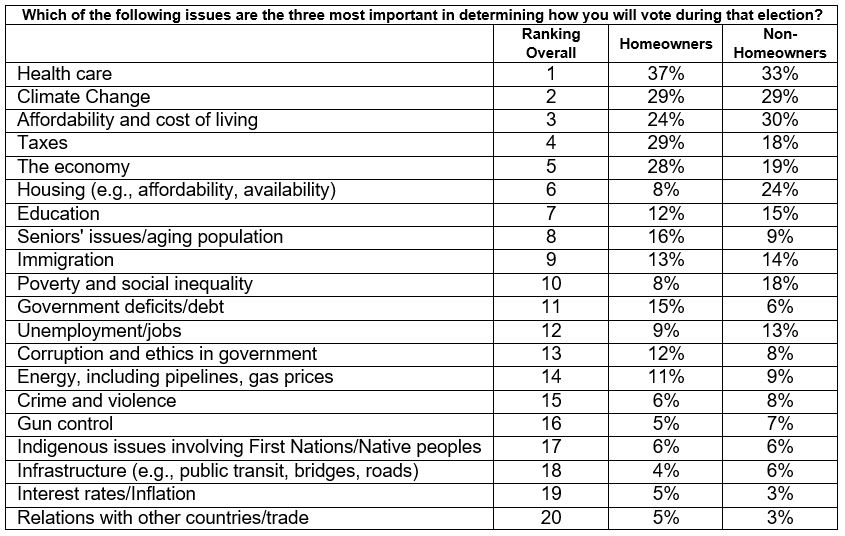
Homeowners and non-homeowners are unanimous in their top voting issue - health care. However, there is significant variation among the order that they rank other issues. Homeowners are significantly more likely than non-homeowners to indicate that taxes and the economy are issues that will dictate their vote choice, while non-homeowners report in a significantly higher proportion that affordability and cost of living are important to determining who they will vote for.
Notably and perhaps unsurprisingly, non-homeowners are three times more likely than homeowners to report that housing, including affordability and availability, is a top voting issue for them. One in four non-homeowners cites this as a top voting issue for them, while fewer than one in ten homeowners indicate that this is a priority of theirs.
Homeowners Would Likely Elect Conservative Majority
In terms of vote, homeowners and non-homeowners differ in their vote choice. Four in ten homeowners prefer the Conservatives (39%), followed by 32% who say they will be voting Liberal, which would likely result in a majority government for the Conservatives. This compares to 13% who will vote NDP, 7% Green, 6% Bloc Québécois, 2% People’s Party, and 1% for some other party. One in ten homeowners (12%) would either not vote or has not yet decided who they would vote for – this number rises to two in ten (20%) among non-homeowners.
Conversely, non-homeowners would likely elect a Liberal majority as their top party of choice (38%), followed by the Conservatives (28%), with smaller proportions indicating that they would vote for the NDP (17%), the Bloc (7%), the Green Party (7%), the People’s Party (2%) or some other party (1%).
Interestingly, seven in ten (71%) homeowners say that they are completely certain they will vote in the upcoming federal election, whereas just half (52%) of non-homeowners report that they are sure they’ll turn out either on October 21 or through advance/special ballots.
Homeowners Also Less Supportive Of Trudeau
Given that homeowners are significantly less likely to vote Liberal than non-homeowners, it is unsurprising that they too are less likely to say that they approve of the Liberal government’s performance under the leadership of Justin Trudeau. Four in ten (39%) of homeowners say that they approve of the Trudeau government’s performance, compared to nearly half (46%) of non-homeowners.
Further to this, homeowners indicate Andrew Scheer (36%) would make the best Prime Minister of Canada, followed by Justin Trudeau (33%), Jagmeet Singh (13%), Elizabeth May (11%), Maxime Bernier (4%), and Yves-François Blanchet (3%). Non-homeowners believe that Trudeau (36%) is the top pick, ahead of Scheer (26%), Singh (15%), May (12%), Bernier (7%), and Blanchet (3%).
Despite differences in approval ratings and picks for best Prime Minister, homeowners (37%) and non-homeowners (39%) are equally likely to report that the Trudeau government has done a good job and deserves re-election. Majorities of both groups report that it is time for another federal party to take over (63% of homeowners vs. 61% of non-homeowners).
So, who are the homeowners of Canada?
Understanding who makes up Canada’s homeowner population is important to understanding why they differ from non-homeowners. But is having ownership of a home what makes these Canadians ideologically different from one another? The likely answer is no. In comparison to non-homeowners, homeowners are older in age, with half falling into the baby boomer category, while just one in four (26%) non-homeowners report being over the age of 55. We also know that homeowners lean higher in income, with one-quarter (24%) reporting that they earn at least $100K annually, while just 7% of non-homeowners report falling into this income bracket.
Given that there are certain demographic characteristics that homeowners in Canada portray, it is logical that their political views align with other Canadians who share a similar demographic profile. We know that older Canadians, regardless of homeownership or not, tend to skew Conservative in their voting preferences, and are generally more committed to showing up on election day. Typically, Conservative voters also skew higher in their incomes, while younger Canadians logically have lower incomes and are generally less sure that they will turn out on election day.
About the Study
These are some of the findings of a series of Ipsos polls conducted between September 20 and October 7, 2019, on behalf of Global News. Samples of n=1500 (September 20-23), n = 1489 (September 27-30), and n = 1502 (October 4-7) Canadians aged 18+ was interviewed online via the Ipsos I-Say panel and non-panel sources, yielding a sub-sample of n = 1800 homeowners and n = 1179 non-homeowners. Respondents earn a nominal incentive for their participation. Quotas and weighting were employed to balance demographics to ensure that the sample's composition reflects that of the adult population according to Census data and to provide results intended to approximate the sample universe. The precision of Ipsos polls which include non-probability sampling is measured using a credibility interval. In this case, each individual poll is accurate to within ± 2.9 percentage points, 19 times out of 20, had all Canadians been polled. The credibility interval for n = 1800 homeowners is ± 2.6 percentage points, and for n = 1179 non-homeowners, it is ± 3.3 percentage points. The credibility interval will be wider among subsets of the population. All sample surveys and polls may be subject to other sources of error, including, but not limited to coverage error, and measurement error. Ipsos abides by the disclosure standards established by the CRIC, found here: https://canadianresearchinsightscouncil.ca/standards/
© 2019, Ipsos Limited Partnership
This polling release and the data contained in it are the sole and exclusive property of Ipsos. They are NOT designed to support any election outcome or prediction model and no license to use the polling release or the data is either granted or implied by their publication. Ipsos does not endorse, and has no responsibility for the accuracy of, the result of any predictive model that incorporates this polling data. Furthermore, any use of this information to produce polling aggregations or election models without Ipsos’ written permission will be considered a violation of our intellectual property, and Ipsos reserves the right to take appropriate legal action. Detailed tabular data tables can be found here: https://ipsosintelligence.ca/canadiancontext/
For more information on this news release, please contact:
Darrell Bricker, PhD
CEO, Ipsos Global Public Affairs
416-324-2001
About Ipsos
Ipsos is the world’s third largest market research company, present in 90 markets and employing more than 18,000 people. Our passionately curious research professionals, analysts and scientists have built unique multi-specialist capabilities that provide true understanding and powerful insights into the actions, opinions and motivations of citizens, consumers, patients, customers or employees. We serve more than 5000 clients across the world with 75 business solutions. Founded in France in 1975, Ipsos is listed on the Euronext Paris since July 1st, 1999. The company is part of the SBF 120 and the Mid-60 index and is eligible for the Deferred Settlement Service (SRD). ISIN code FR0000073298, Reuters ISOS.PA, Bloomberg IPS:FP www.ipsos.com


