Younger Working Canadians More Likely to Value Virtual Healthcare as Employee Benefit, and to Use it for Mental Health Services
Toronto, ON, January 21, 2020 — Currently, younger working Canadians are most likely to value healthcare support offered by their employer in the form of virtual care or telemedicine, according to a new Ipsos poll conducted on behalf of RBC insurance. Nine in ten (94%) of working Canadians are more likely to work for an employer that cares about their overall health and wellbeing. Three-quarters (72%) of working Canadians indicate that they would perceive their employer in a more positive light if they offered virtual care/telemedicine, which would eliminate the need to leave work or home. This is mostly driven by younger working Canadians (18-34 78%, 35-54 74% vs. 55+ 60%) who are most likely to indicate that being offered this virtual care would improve opinions of their employer. This is particularly important because younger working Canadians currently indicate lower ratings of their employer (18-34 56% vs. 55+ 66%) and lower job satisfaction (18-34 52%, 35-54 59% vs. 55+70%).
The value of digital tools extends beyond health care delivery to managing insurance benefits as two-thirds (66%) of working Canadians indicate that they prefer a mobile app to manage and access their insurance benefits as opposed to using paper mail, telephone, or even online services. Once again, this preference is highest among younger Canadians, particularly Millennials, as less than half of Baby Boomers echo this sentiment (18-34 77%, 35-54 66% vs. 55+ 48%).
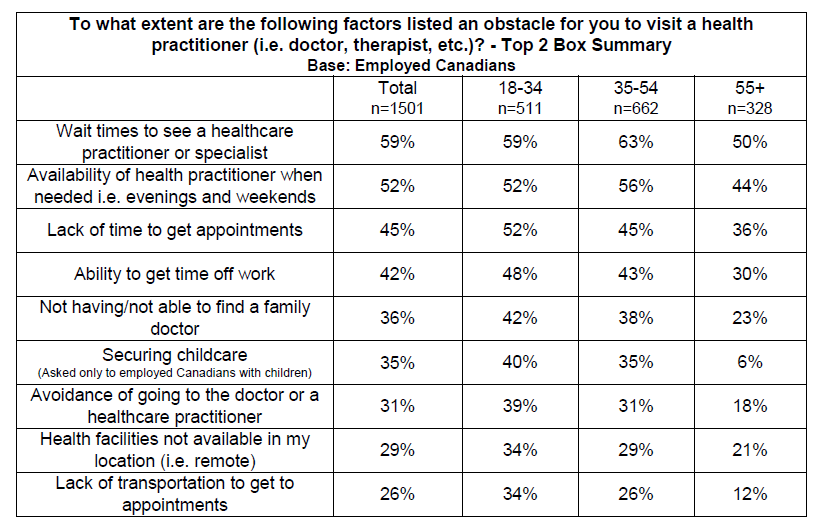
The top obstacles for working Canadians when visiting a health practitioner are related to time constraints such as wait times (59%), availability of a healthcare practitioner during evenings and weekends (52%), lack of time to get an appointment (45%), and ability to get time off work (42%). Younger Canadians’ preference for virtual care should be understood in light of the finding that they are more likely to cite these time pressures, as well as lack of transportation (18-34 34%, 35-54 26%, 55+ 12%) as obstacles in visiting a healthcare practitioner. While a third of working Canadians (36%) indicate that not having a family doctor acts as an obstacle for them, this too is driven by younger Canadians as it is least likely to be a hindrance for Baby Boomers (18-34 42%, 35-54 38%, 55+ 23%).
Majority of working Canadians (80%) indicate that a tailored personalized wellness program would positively impact their overall well-being. Over three-quarters of working Canadians indicate that they would be likely to use virtual care to get a prescription refill (77%) and six in 10 (58%) would use it to consult a doctor for an acute problem like a virus or rash. Half would use it to consult with a mental health practitioner about their current challenges (50%) or use video/telephone mental health counselling (45%). The use of virtual care for mental health services is highest among younger Canadians who are more likely to use it to:
- consult mental health practitioners (18-34 53%, 35-54 52%, 55+ 39%), and
- avail video/telephone mental health counselling (18-34 51%, 35-54 46%, 55+ 33%)
This is in line with the finding that younger Canadians report lower levels of overall wellbeing (18-34 62% vs. 55+ 74%) and mental health (18-34 57%, 35-54 67%, vs 55+ 79%) in particular.
About the Study
These are some of the findings of an Ipsos poll conducted between May 7th and May 10th, 2019, on behalf of RBC Insurance. For this survey, a sample of 1501 employed Canadians aged 18+ was interviewed. Weighting was then employed to balance demographics to ensure that the sample's composition reflects that of the adult population according to Census data and to provide results intended to approximate the sample universe. The precision of Ipsos online polls is measured using a credibility interval. In this case, the poll is accurate to within ± 2.9 percentage points, 19 times out of 20, had all employed Canadians aged 18+ been polled. The credibility interval will be wider among subsets of the population. All sample surveys and polls may be subject to other sources of error, including, but not limited to coverage error, and measurement error.
For more information on this news release, please contact:
Sean Simpson
Vice President, Ipsos Public Affairs
+1 416 324-2002
[email protected]
About Ipsos
Ipsos is the world’s third largest market research company, present in 90 markets and employing more than 18,000 people.
Our passionately curious research professionals, analysts and scientists have built unique multi-specialist capabilities that provide true understanding and powerful insights into the actions, opinions and motivations of citizens, consumers, patients, customers or employees. We serve more than 5000 clients across the world with 75 business solutions.
Founded in France in 1975, Ipsos is listed on the Euronext Paris since July 1st, 1999. The company is part of the SBF 120 and the Mid-60 index and is eligible for the Deferred Settlement Service (SRD).
ISIN code FR0000073298, Reuters ISOS.PA, Bloomberg IPS:FP