75% of Canadians say they’d have more respect for global institutions if democratic nations had more influence
Toronto, ON, December 2, 2021 – In recent years, global politics have seen dramatic shifts in terms of democratic and authoritarian leadership. As governments across the world adopt in response to multiple international crises, including an ongoing pandemic, many have raised concerns around the backsliding of democracy across the globe. In contemplating these shifts, Canadians, among other nations, have shared their preference towards democratic decision-making. According to a recent Ipsos poll for Halifax International Security Forum, three quarters (75%) of Canadians agree that they would have more respect for global institutions or agreements if democratic nations had more influence over them than authoritarian nations. Further, a majority of Canadians (75%) agree that economic power holds higher importance in world affairs than military power.
These are some of the findings of a survey of more than 22,000 adults conducted on Ipsos’ Global Advisor online platform between September 24 and October 8, 2021.
Strong support for democratically influenced institutions
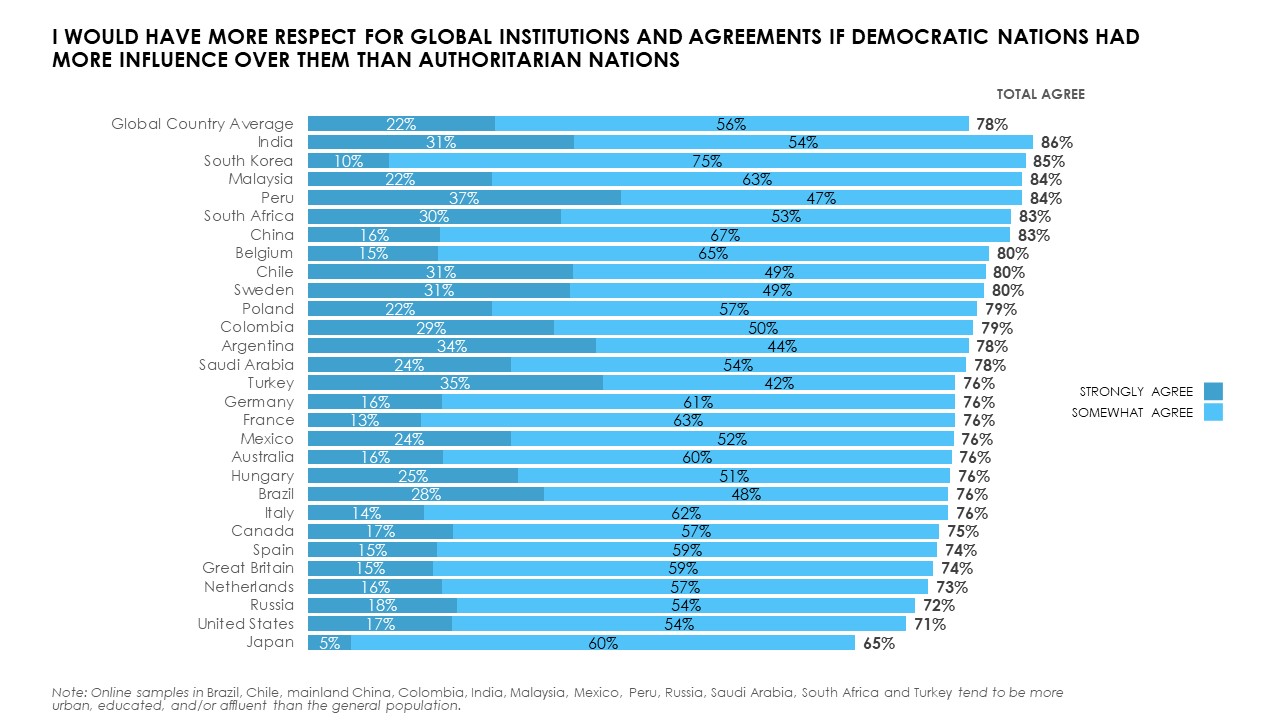
Across 28 countries recently surveyed, an average of 78% of citizens agree that they would have more respect for global institutions or agreements if democratic nations had more influence over them than authoritarian nations. Canadians’ opinion on the matter closely aligns with the overall opinion with three-fourths agreeing.
Greater respect for democratic nation-led institutions and agreements is expressed by a large majority of adults in every country surveyed: from 86% in India to 65% in Japan.
Not only is the support high, but has also increased since last year in 19 of the 28 countries surveyed, with gains of ten points or more in 11 of them. Countries showing the largest increases in agreement from last year are Sweden (+33 points to 80%), the Netherlands (+29 to 73%), Belgium (+28 to 80%), South Korea (+27 to 85%), and Germany (+26 to 76%).
Canada is one of the only three countries showing decreases from last year (-7 to 75%), joined by Australia (-7 to 76%) and Malaysia (-7 to 84%). Despite the decline, a majority of Canadians still support the opinion.
All other countries show changes of no more than +/- 3 points.
Canada perceived as trustworthy in its compliance with international institutions and agreements to deal with challenging global issues
There is a stronger desire for something new with a global country average of 83% endorsing the view that the world needs new international agreements and institutions led by democratic countries. Canadians extend their support for the creation of such new institutions to help deal with big challenges facing the world today with 80% agreeing.
However, when it comes to predicting the outcome, should such new institutions and agreements be created, many remain skeptical about across-the-globe compliance.
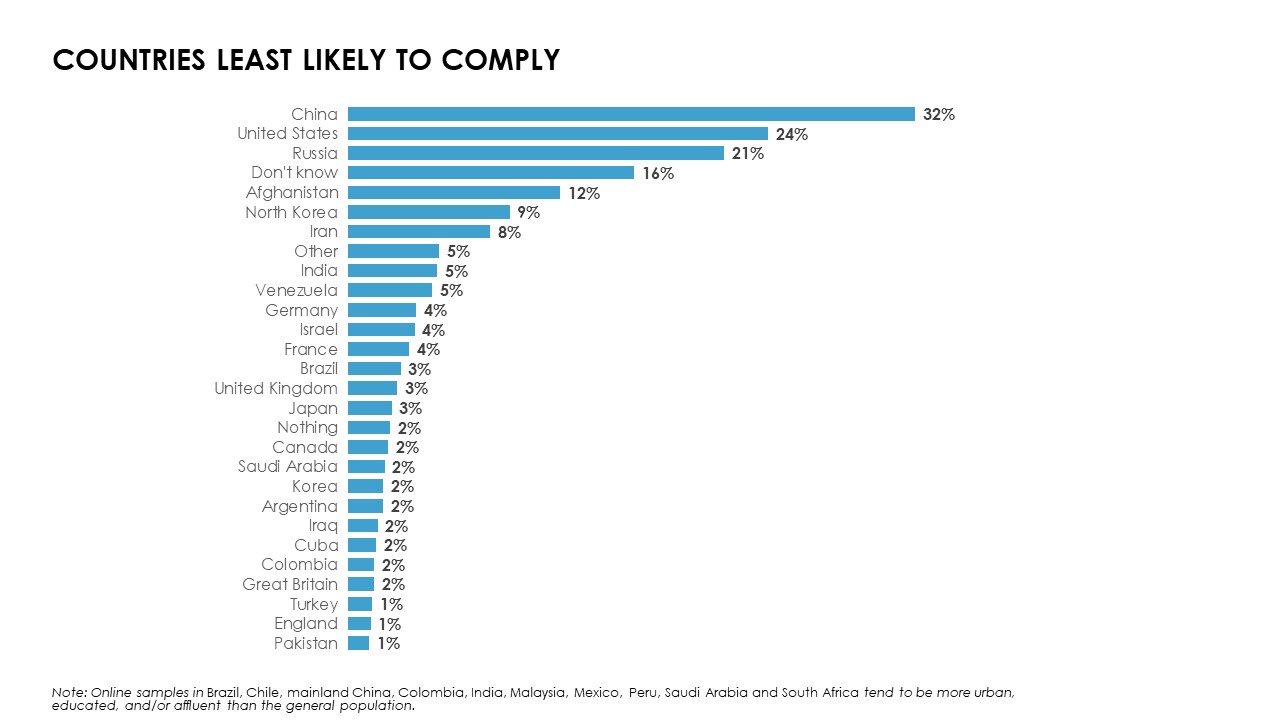
While the skepticism is largely pinned on China (cited by a global country average of 32%), the U.S. (24%), Russia (21%), Afghanistan (12%), North Korea (9%), and Iran (8%), much of the other countries as expected to comply.
Canada (along with Saudi Arabia, South Korea, Argentina, Iraq, Cuba, Colombia, Great Britain, Turkey, England and Pakistan), emerges as trustworthy in its commitment as very few place any doubts in the country’s likelihood to comply in developing new international institutions and agreements to deal with big challenges facing the world today.
Canadians give more importance to economic power than military power in global affairs
When asked about the importance of economic and military power in world affairs, all countries favoured economic power over military strength, reaching a global country average of 78%, a slight decrease by two points from last year’s survey.
Canadians are on par with the global average in favouring economic power over military might in matters of world affairs (75% agree, -6 points vs 2020). Other countries, including Great Britain, Australia, Peru, Saudi Arabia, Mexico, Brazil and Japan, also share a similar sentiment with Canada on this issue.
Citizens of South Africa are most likely to hold this view, topping the list at 84%, closely followed by Belgium at 83%, and Sweden and Argentina at 82% each. Conversely, while the majority of Americans support the view (64%, -6 points vs. 2020), in comparison to all other countries, Americans are the least likely to attach higher importance to economic might over military power. Citizens of the Netherlands also join Americans with a lower likelihood to agree (69%, -5 pts from 2020).
About the Study
These are the results of a 28-market survey conducted by Ipsos on its Global Advisor online platform. Ipsos interviewed a total of 22,016 adults aged 18-74 in the United States, Canada, Malaysia, South Africa, and Turkey, and adults aged 16-74 in 23 other markets between Friday, September 24 and Friday, October 8, 2021.
The sample consists of approximately 1,000 individuals in each of Australia, Belgium, Brazil, Canada, mainland China, France, Germany, Great Britain, Italy, Japan, Spain, and the U.S., and 500 individuals in each of Argentina, Chile, Colombia, Hungary, India, Malaysia, Mexico, the Netherlands, Peru, Poland, Russia, Saudi Arabia, South Africa, South Korea, Sweden, and Turkey.
The samples in Argentina, Australia, Belgium, Canada, France, Germany, Great Britain, Hungary, Italy, Japan, the Netherlands, Poland, South Korea, Spain, Sweden, and the U.S. can be taken as representative of their general adult population under the age of 75.
The samples in Brazil, Chile, mainland China, Colombia, India, Malaysia, Mexico, Peru, Russia, Saudi Arabia, South Africa, and Turkey are more urban, more educated, and/or more affluent than the general population. The survey results for these countries should be viewed as reflecting the views of the more “connected” segment of their population.
The data is weighted so that each country’s sample composition best reflects the demographic profile of the adult population according to the most recent census data.
“The Global Country Average” reflects the average result for all the countries and markets where the survey was conducted. It has not been adjusted to the population size of each country or market and is not intended to suggest a total result.
Where results do not sum to 100 or the ‘difference’ appears to be +/-1 more/less than the actual, this may be due to rounding, multiple responses, or the exclusion of “don't know” or not stated responses.
The precision of Ipsos online polls is calculated using a credibility interval with a poll of 1,000 accurate to +/- 3.5 percentage points and of 500 accurate to +/- 5.0 percentage points. For more information on Ipsos' use of credibility intervals, please visit the Ipsos website.
The publication of these findings abides by local rules and regulations.
For more information on this news release, please contact:
Sanyam Sethi
Vice President, Ipsos Public Affairs
[email protected]
About Ipsos
Ipsos is the world’s third largest market research company, present in 90 markets and employing more than 18,000 people.
Our passionately curious research professionals, analysts and scientists have built unique multi-specialist capabilities that provide true understanding and powerful insights into the actions, opinions and motivations of citizens, consumers, patients, customers or employees. We serve more than 5000 clients across the world with 75 business solutions.
Founded in France in 1975, Ipsos is listed on the Euronext Paris since July 1st, 1999. The company is part of the SBF 120 and the Mid-60 index and is eligible for the Deferred Settlement Service (SRD).
ISIN code FR0000073298, Reuters ISOS.PA, Bloomberg IPS:FP