

Support for Independence in Alberta Reaches Levels Similar to Quebec

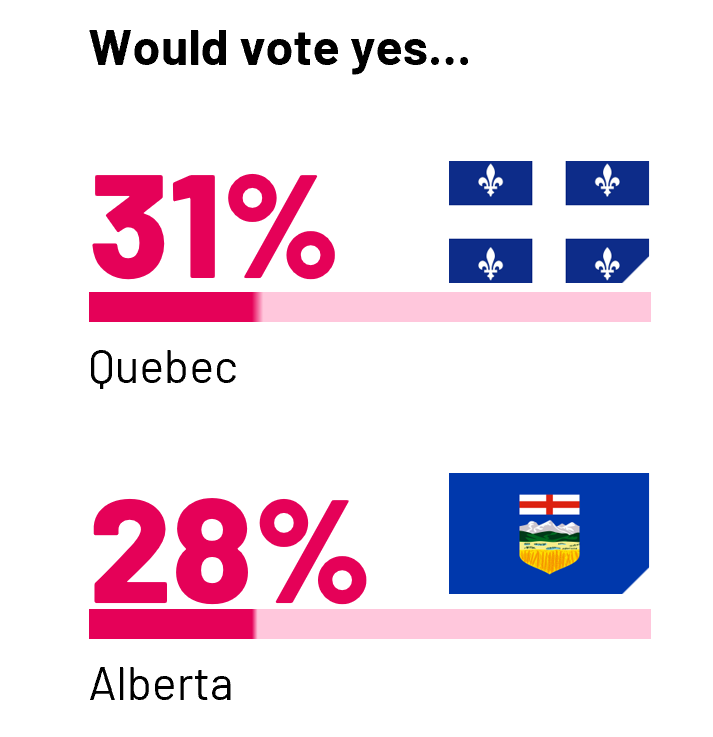
When asked if they would vote for their province to begin the process of separating from Canada and seeking a new agreement to define its future relationship with the country, approximately three in 10 residents of both Alberta (28%) and Quebec (31%) say yes. This includes those who say they would definitely or probably vote yes, and those who say they would lean toward voting yes.
However, new Ipsos research which "stress-tested" these sentiments by introducing real-world consequences reveals that actual committed support for separation is roughly half these levels in both provinces, with only 15 to 16% of Albertans and Quebecers maintaining their support after considering possible costs. This means that for roughly half of separatist supporters in both provinces, independence is more a political message than a plan they are prepared to endure costs to achieve.

Among those who would vote "yes" for independence...

Committed: Maintain support despite costs | Conditional: Support wavers with some conditions | Symbolic: Support collapses when costs appear
The stress test methodology, which asked separatist supporters whether they would maintain their position under five different challenging conditions unique to each province, reveals nearly identical patterns.
In Alberta, 55% of initial separatist supporters are "committed,” willing to pay serious economic and social costs for independence. Another 25% are "conditional," maintaining support under some but not all conditions, while 20% are "symbolic," using the independence threat primarily to express frustration rather than genuine intent to leave.
Quebec shows a similar distribution (49% committed, 28% conditional, 23% symbolic), suggesting that the psychology of separatism operates similarly regardless of language, culture, or specific grievances.
The finding that only about half of self-declared separatists in each province remain committed when asked to consider costs such as standard of living declines, pension losses, or trade renegotiations suggests confederation is dealing with a core of genuinely committed separatists representing 15 to 16% of each province's population, surrounded by another cohort using the threat of separation to signal alienation and demand attention from Ottawa.

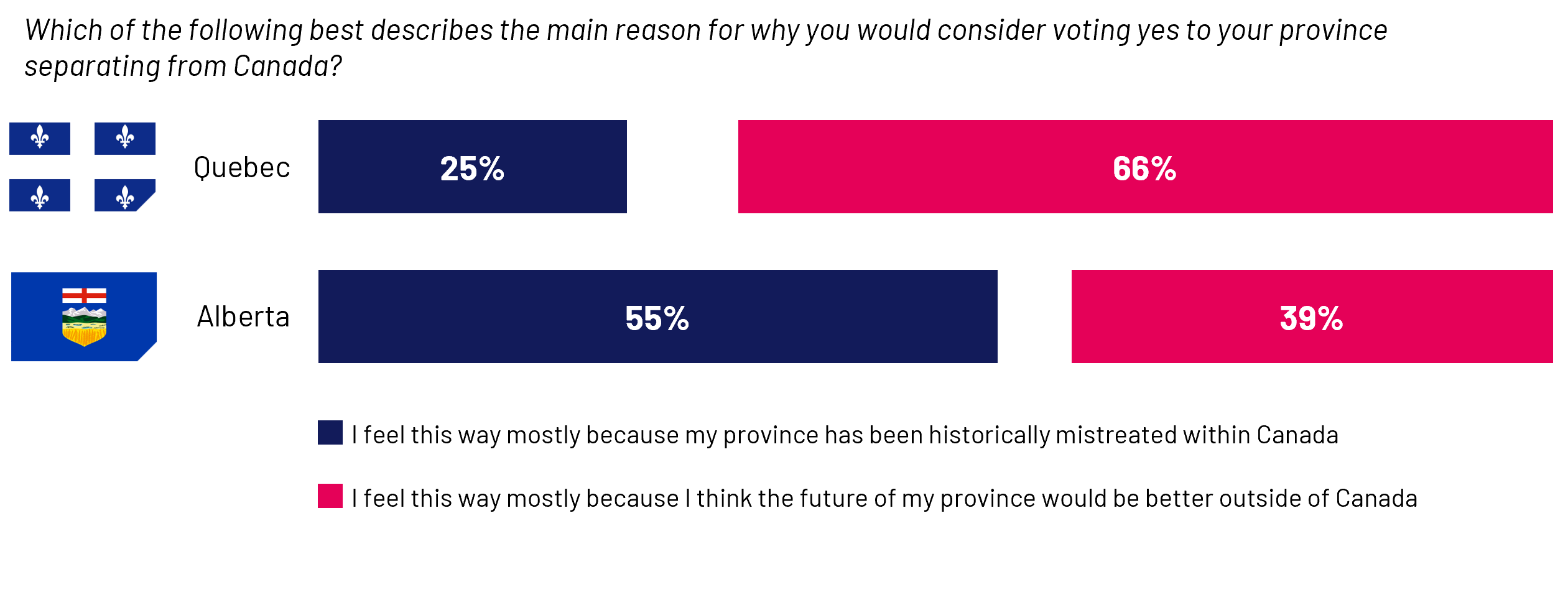
Albertan and Quebecer separatists cite different reasons for wanting to vote for independence. Quebecers are more likely to say their reason for voting “yes” is that Quebec’s future would be served better outside of Canada, while Albertans are more likely to say that their reason for voting “yes” is that Alberta has historically been mistreated within confederation.
However, in both cases, belief that the province would be better off in the future outside of Canada grows the more committed the respondent is to voting “yes.” Committed separatists in both provinces were more likely to refer to future prosperity as their reason for being a “yes” voter than conditional or symbolic separatists.
What it means
As Canada confronts issues high on Canadians’ priority list such as affordability, housing, and crime, while also charting a response to global events, the question of national unity will remain at the forefront of discussion in 2026. Groups in Alberta are currently trying to gather enough signatures to trigger a referendum on the province’s future in Canada, while in Quebec the Parti Quebecois has promised to hold a third referendum on separation in their first term should they win the provincial election expected in the fall of 2026.
Ipsos’ research reveals that those seeking independence in both Alberta and Quebec are not a homogeneous group, and a single policy response from governments is unlikely to be effective at changing support for independence. Further, this research suggests different motivations for supporting independence, and that those most strongly committed to it believe the future of their province is better off outside of Canada, while those less committed cite past treatment as their reason.
These different motivations will demand different responses from governments who seek to unite the country and make the case for both Alberta and Quebec’s future in Canada.

These are some of the findings of an Ipsos poll conducted between January 9 and 14, 2026, as part the Confederation Stress Test study. For this survey, a sample of n=2,000 Canadians aged 18+ was interviewed online via the Ipsos omnibus using our proprietary iSay panel. The survey included samples of n=500 each in Alberta and Quebec. Separatist supporters constituted n=153 of the Alberta sample and n=171 of the Quebec sample, unweighted. Quotas and weighting were employed to balance demographics to ensure that the sample's composition reflects that of the Canadian population according to Census data and to provide results intended to approximate the sample universe. The precision of Ipsos polls which include non-probability sampling is measured using a credibility interval. In this case, the national poll is accurate to within ± 2.7 percentage points, 19 times out of 20, had all Canadians aged 18+ been polled. The Alberta and Quebec samples are accurate to within ± 5.4 percentage points. The credibility interval will be wider among subsets of the population. All sample surveys and polls may be subject to other sources of error, including, but not limited to coverage error, and measurement error. Ipsos abides by the disclosure standards established by the CRIC, found here: https://canadianresearchinsightscouncil.ca/standards/
For more information on this news release, please contact:
Darrell Bricker, PhD
CEO, Ipsos Global Public Affairs
+1 416 324 2001
[email protected]

Our passionately curious research professionals, analysts and scientists have built unique multi-specialist capabilities that provide true understanding and powerful insights into the actions, opinions and motivations of citizens, consumers, patients, customers, or employees. Our 75 business solutions are based on primary data from our surveys, social media monitoring, and qualitative or observational techniques.
“Game Changers” – our tagline – summarizes our ambition to help our 5,000 clients navigate with confidence our rapidly changing world.
Founded in France in 1975, Ipsos has been listed on the Euronext Paris since July 1, 1999. The company is part of the SBF 120, Mid-60 indices, STOXX Europe 600 and is eligible for the Deferred Settlement Service (SRD).


