

What the Future: Family
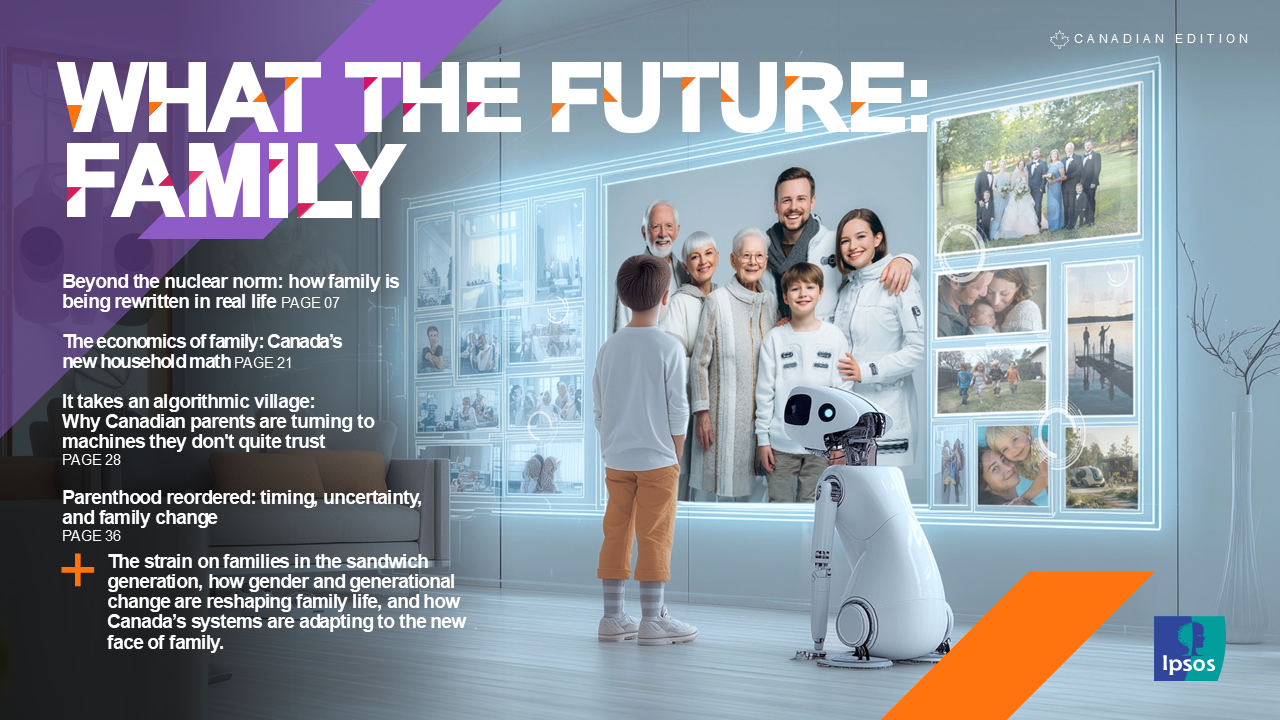
The meaning of family in Canada is shifting in real time. Canadians are living longer, having fewer children, forming families later, and building households that extend beyond bloodlines and traditional legal definitions. Gender roles that once felt fixed are being renegotiated. Same-sex parents, blended families, multi-generational households, and chosen kin networks are no longer edge cases — they are everyday realities. The once-dominant nuclear family has moved from cultural default to one model among many.
At the same time, the economic contract underpinning family life is under strain. The cost of housing, childcare, food, and education is forcing families to rethink what “middle class” means and to make harder trade-offs about work, caregiving, and long-term security. Parenthood is delayed. Caregiving lasts longer. Families are leaning more heavily on employers, retailers, technology platforms, and public systems to bridge widening gaps — often without clarity on whether those systems were designed for this new reality.
This is not a sudden rupture. It is a structural reordering of roles, relationships, and responsibility. And it raises a critical question: are Canada’s markets, policies, and organizations built for the families we have now — or the families we once assumed?
Download the Canadian edition of What the Future: Family.
This edition combines exclusive Ipsos research with insights from leading experts across academia, retail, technology, finance, and public policy — offering a forward-looking view of how family life is evolving, and what that means for organizations serving Canadians.
Be sure to also revisit our on demand webinar, contextualizing the insights highlighted in our report.
INSIDE THIS EDITION
The future of family is here — are we keeping up?The future of family will not arrive all at once. It is emerging through steady shifts — in who lives together, who cares for whom, and how responsibility is shared over time. This opening essay explores the structural forces reshaping Canadian households and the implications for brands and organizations built around older assumptions. Diane Ridgway-Cross |  |
Beyond the nuclear norm: how family is being rewritten in real lifeFamily change is no longer theoretical — it is visible in how Canadians organize care, responsibility, and belonging. This piece examines the widening gap between lived family realities and the legal and policy systems that continue to privilege a narrower model. Fernando Aloise |  |
Rethinking family, identity, and belonging: the LGBTQ+ familyWhat does family look like when identity, belonging, and legitimacy have historically been contested? Drawing on decades of experience in gender and sexual diversity, Bill Ryan explores how LGBTQ+ families are reshaping cultural and institutional definitions of kinship. Bill Ryan |  |
The reorganization of family around caregivingLongevity, affordability pressures, and shifting life timelines are changing not just who provides care in Canada, but how families are structured. As caregiving grows in both scale and duration, it is no longer a temporary responsibility layered onto family life — it is becoming one of its organizing principles. Rama Zuñiga |  |
From traditional to today: Financial planning for modern familiesAs families become more diverse and multi-generational, financial planning models built around predictable life stages are under strain. Carolina Henao reflects on how evolving family structures are reshaping retirement planning, dependency, insurance, and long-term financial security. Carolina Henao |  |
The economics of family: Canada’s new household mathAs the cost of raising a child surpasses a quarter-million dollars, parenting is becoming one of the most consequential — and increasingly unaffordable — financial decisions Canadians will make. This piece examines how families are recalculating risk, stability, and long-term security. Mike Colledge |  |
When saving feels smart, not sacrificialIn an era where affordability no longer feels temporary, the weekly grocery shop has become a barometer of household stress and resilience. This conversation explores how families are redefining value — and what the evolution of hard discount signals about the future of Canadian family life. Julie Unsworth |  |
It takes an algorithmic village: why Canadian parents are turning to machines they don’t quite trustJust a year ago, few parents would have imagined turning to a machine for advice about their child — let alone relying on it in moments of stress or uncertainty. Today, AI is entering the parenting ecosystem at speed. What does that mean for trust, authority, and family decision-making? Paul Acerbi |  |
Growing up online: how YouTube balances youth discovery and learning with safetyAs digital platforms become central to childhood, the balance between exploration and protection grows more complex. In this conversation, Alex Paterson discusses how YouTube supports learning and creativity while building safeguards for young users and giving parents meaningful control. Alex Paterson |  |
Parenthood reordered: timing, uncertainty, and family changeMarriage and parenthood no longer define adulthood in the way they once did. McGill Professor and Demographer Shelley Clark examines how economic uncertainty, shifting life-course expectations, and changing social norms are reshaping when — and whether — Canadians choose to become parents. Shelley Clark |  |
Expanding access to family buildingAs fertility pathways expand beyond traditional biological models, family building is becoming more intentional, more visible, and more complex. Jackie Hanson explores the gaps in Canada’s fertility support systems and what a more inclusive, post-biological future of family could look like. Jackie Hanson |  |
How different Gen Beta personas could define the futureWhat will childhood look like for the first fully AI-native generation? Futurists Joana Lenkova and Alexandra Whittington imagine six possible Gen Beta personas — from the Smart City Kid to the first post-nation child — offering a provocative lens on the future of youth. Joana Lenkova & Alexandra Whittington |
|
Continue the conversationFamily change affects every sector, and no organization is immune to its impact. As roles, responsibilities, and expectations evolve, the implications ripple across markets, workplaces, and public systems. If you’d like to explore what these shifts mean for your brand strategy, workforce, customers, or policy environment, we’d be glad to connect. Reach out to Diane Ridgway-Cross to schedule a tailored discussion or bespoke presentation with our team. |


![[WEBINAR] The Consumption Audit: Consumer Truths Behind Changing Consumption](/sites/default/files/styles/list_item_image/public/ct/event/2026-10/thumbnail-consumption-audit.png?itok=at-K7NBC)

![[WEBINAR] TOAST 2026: Under Pressure - Fewer Fragmented Fought-For](/sites/default/files/styles/list_item_image/public/ct/event/2026-07/thumbnail-templates_1.png?itok=zNnzsWzQ)