

When Climate Action Becomes Everyone’s Problem - and No One’s Responsibility
Every Earth Day, conversations around climate change grow louder—yet something subtler is happening beneath the surface. While awareness of climate change in India remains high and its impacts are increasingly visible to all, the sense of personal responsibility to act appears to be quietly receding.
The last 11 years have been the warmest in the modern era, according to the UN Weather Agency. Despite the rising temperatures, the need for individuals to act towards climate change is lower than at the start of the decade, globally.
Based on the Ipsos People and Climate Change Survey, in the last five years, all countries surveyed in this report have seen declines in the proportion who agree that individuals would fail future generations by not acting against climate change, in both 2021 and 2026. This is reflected in India's numbers as well, where, in 2021, individual responsibility was higher than that of the government or business. But now the ranking of responsibility has reversed.
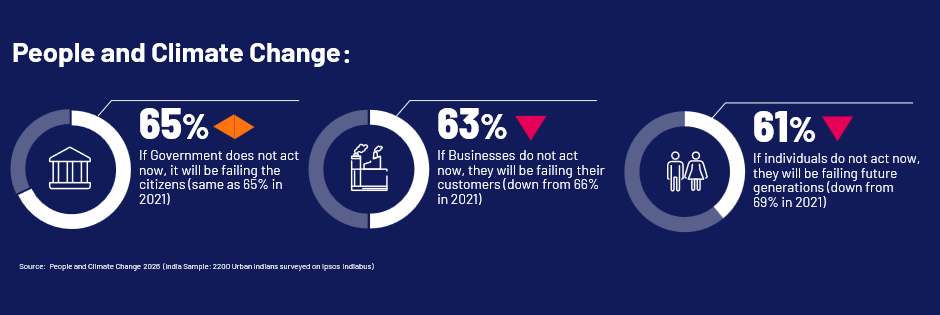
There has been an increase in individuals saying that there is no point in changing their own behaviour to tackle climate change, as it won't make any difference anyway (from 62% in 2023 to 64% in 2026). This points to a potential fatigue—or resignation—around personal agency. As climate risks intensify and their scale becomes clearer, individuals may increasingly feel that their actions are insignificant in the face of systemic challenges. And the onus shifts to the Government, and even businesses, to act urgently. Responsibility is gradually being delegated upward—to governments to regulate, and to businesses to innovate—while individual action is seen as symbolic rather than meaningful.
When individuals disengage, even subtly, the social mandate for ambitious climate action weakens. Sustainable products flourish when consumers choose them. Behavioural change may be incremental—but at a population scale like India’s, it becomes transformative.
The challenge ahead is not awareness, but re‑engagement: restoring a sense of shared responsibility where individual choices reinforce institutional action, rather than deferring entirely to it.


