The fifth edition of the Ipsos World Mental Health Day report is a 31-country study looking at the people’s perceptions of mental health and how they think their healthcare systems treat mental health.
Key findings include:
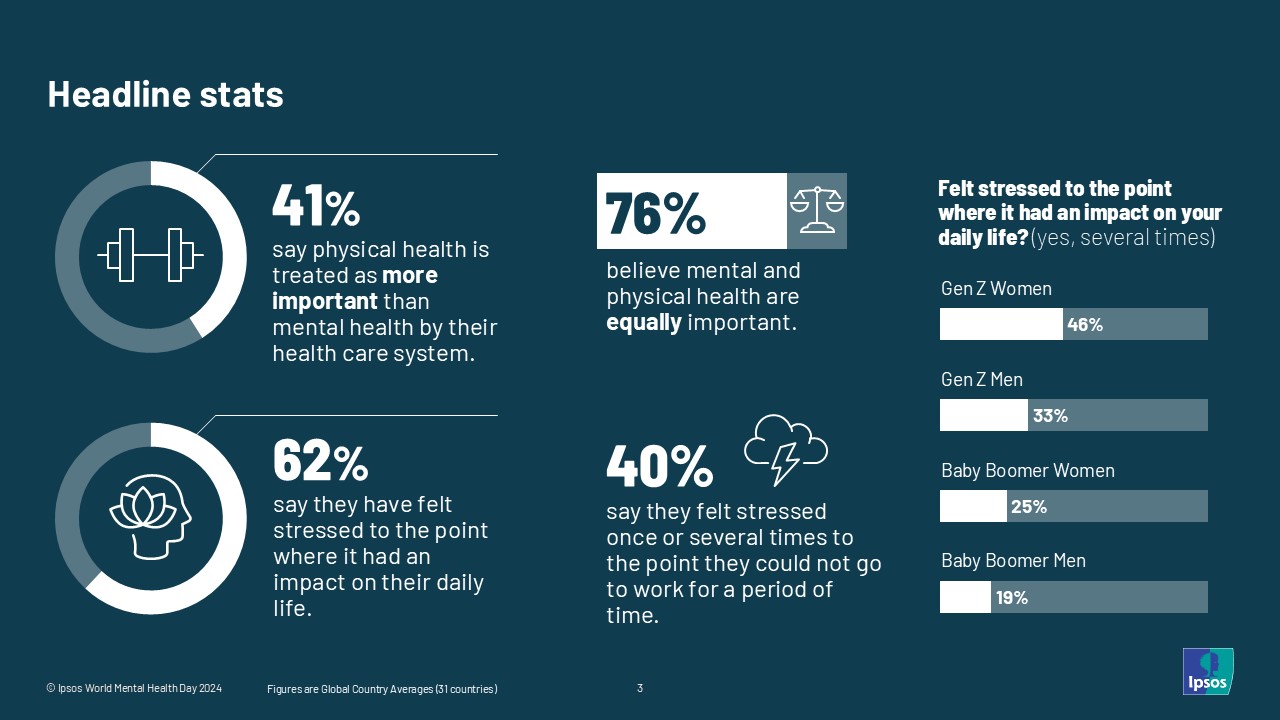
- Globally most people have been feeling stressed. Just over three in five, 62% on average across 31 countries, say they have felt stressed to the point where it had an impact on their daily life at least once. Levels of stress range from a high of 76% in Türkiye to a low of 44% in Japan. Overall, a slightly higher proportion of women (66%) are stressed than men (58%).
- Gen Z women continue to struggle. Gen Z females are once again the most likely to experience low points, with 40% at a global level saying they have felt depressed to the point that they felt sad or hopeless almost every day for a couple of weeks or more several times.
- Mental health is still the number one concern. Our latest Health Service Report finds 45% cite mental health as one of the main health issues facing their nation. Cancer is second with 38% and stress follows with 31% mentioning it across 31 countries.
- Younger generations missing work due to stress. A majority (54%, Global Country Average) of Gen Z say they have felt stressed to the point that they could not go to work during the past year; the figure for Millennials is slightly lower (47%). More generally, older people are less likely to report feeling stressed on each element asked about in our survey.
- Health of mind and body seen as equal. Just over three in four (76%, global country average) say mental and physical health are equally important, with a majority in all 31 countries saying this is the case. While mind and body are seen as equal people are more likely to say they often think about their physical (72%) than their mental wellbeing (60%).
- Healthcare systems prioritise physical issues. The public believe the emphasis by healthcare professionals is often still on the body. On average across 31 countries, 41% say physical health is treated as more important than mental health by their country’s current healthcare system, 13% say mental health is treated as more important and 31% say both are treated equally.
Technical note
Ipsos interviewed 24,668 people online in the following countries between July 26 and August 9, 2024. Quotas were set to ensure representativeness and data have been weighted to the known population profile of each country. The sample consists of approximately 1,500 individuals each in Germany and Brazil, and 1,000 individuals each in Australia, Canada, France, Great Britain, Italy, Japan, New Zealand, Spain, and the U.S., and 500 individuals each in Argentina, Belgium, Chile, Colombia, Hungary, Indonesia, Ireland, Malaysia, Mexico, the Netherlands, Peru, Poland, Singapore, South Africa, South Korea, Sweden, Switzerland, Thailand, and Türkiye. The sample in India consists of approximately 2,200 individuals, of whom approximately 1,800 were interviewed face-to-face and 400 were interviewed online.