
Menopause Remains a Taboo: Women Perceive a Greater Impact Than Men
Greater Awareness Among Women
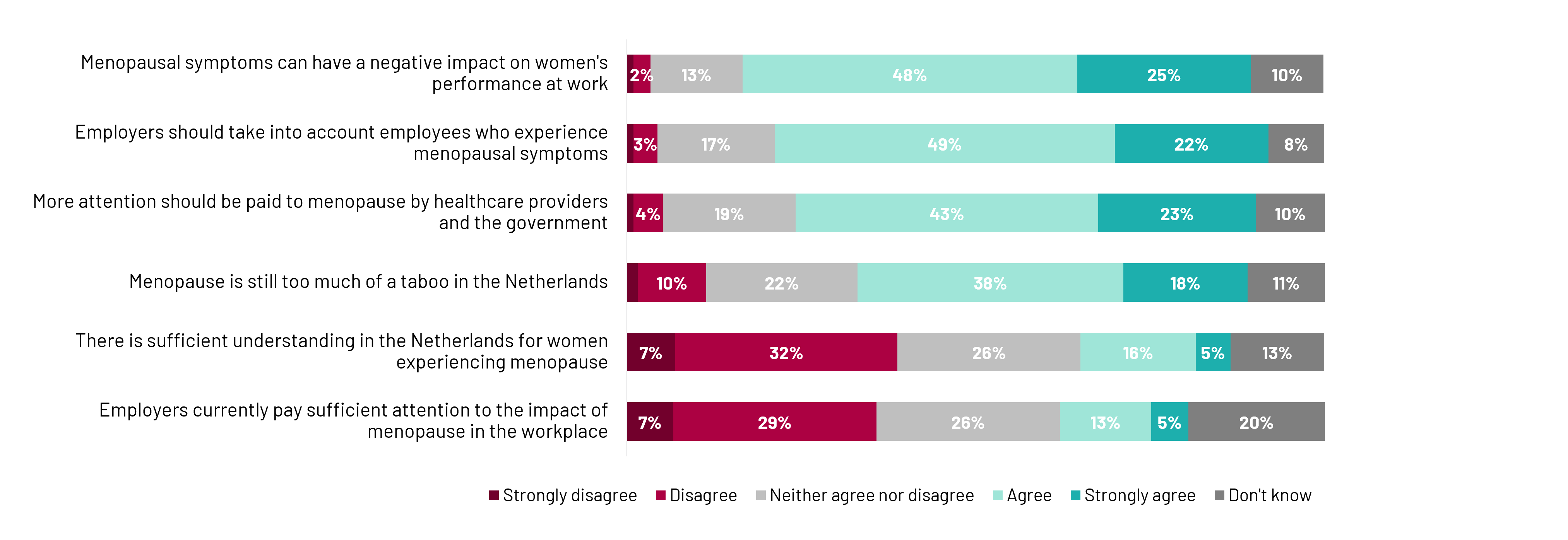
The majority of Dutch people acknowledge that menopausal symptoms can affect performance at work. However, while 79% of women agree with this statement, the figure is 67% among men. Women are also more likely to believe that employers should take the needs of employees experiencing menopausal symptoms into account (76% versus 66%).
In addition, women are more likely than men to see a role for the government and healthcare providers. Nearly three-quarters of women (74%) believe these institutions should pay more attention to menopause, compared with 57% of men.
Attitudes Towards Menopause
The Taboo Has Not Disappeared
One notable finding is that two-thirds of women (66%) believe menopause is still too much of a taboo in the Netherlands. Among men, fewer than half (46%) share this view.
These differences suggest that men may be less aware of, or less likely to recognise, the broader societal impact of menopause than women. At the same time, the research shows widespread support for greater awareness and understanding.
More Understanding Needed in the Workplace
Only 18% of Dutch people believe that employers currently pay sufficient attention to the impact of menopause in the workplace. This percentage is low among both women and men.
The findings indicate that menopause is increasingly becoming a topic of discussion, but that many people still see room for greater awareness, understanding and support, both in healthcare and in the workplace.
Research Methodology
The findings are based on the October monthly survey conducted by Ipsos I&O among Dutch residents aged 18 and over (n=5,741). The sample consisted of 2,653 men and 3,088 women. The results were weighted by gender, age, education level and region to ensure they are representative of the Dutch population aged 18 and over.