

AI in Asia: Use is running ahead of trust
Across Asia, AI is generating both excitement and unease. The clearest signal is the gap between use and trust.
Majorities in every APEC market surveyed say they do not always trust AI tools, but use them anyway. This is highest in China at 79%, Indonesia at 76% and Malaysia at 72%. Even in Australia, the lowest APEC market on this measure, 52% say the same.
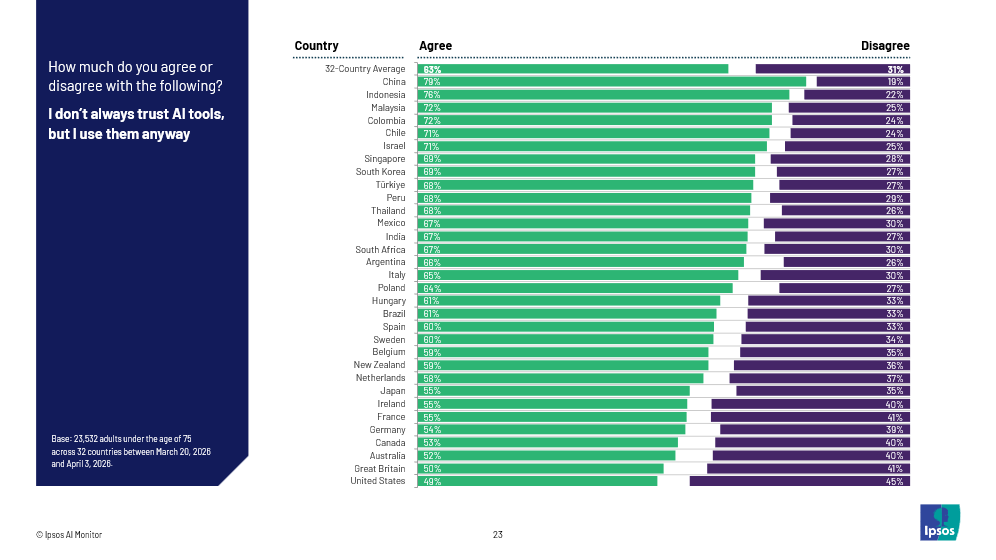
Across APEC, AI use persists despite a lack of trust
Source: Ipsos AI Monitor 2026
For brands, the point is simple: use does not equal trust.
APEC is also not moving in one direction. China, Indonesia and South Korea are highly enthusiastic about AI, with excitement at 83%, 76% and 74% respectively. India and Thailand are just as positive, but much more nervous. In India, 79% are excited and 63% nervous. In Thailand, the figures are 77% and 61%.
A similar tension appears in Malaysia, where 71% are excited and 53% nervous, and Singapore, where the figures are 61% and 58%.
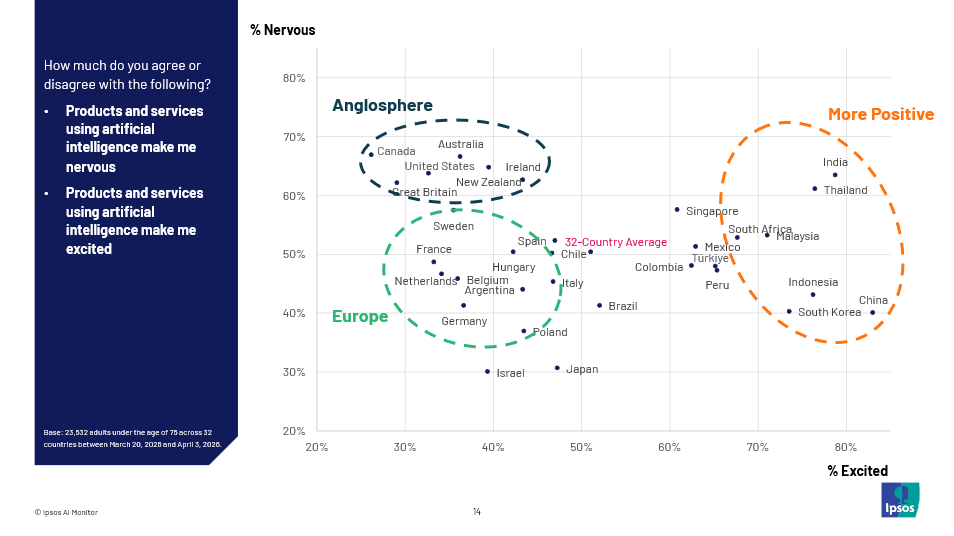
APEC’s different AI realities: excitement and unease coexist
Source: Ipsos AI Monitor 2026
Australia and New Zealand sit at the other end. In Australia, 36% are excited and 67% nervous. In New Zealand, 40% are excited and 65% nervous. Japan is different again, with lower levels of both excitement and nervousness.
Views on the economic impact of AI also vary sharply across the region. In China, 77% expect increased use of AI to improve the economy, followed by 65% in India. Australia and New Zealand are more cautious, with more people expecting AI to have a negative rather than positive effect on their economies.
The same divide shows up in how people assess AI’s value. Most consumers in China, India, Indonesia and Thailand believe the benefits outweigh the drawbacks. Australia and New Zealand are far less convinced.
Environmental attitudes follow a similar pattern. Across much of APEC, consumers believe AI’s societal benefits outweigh its environmental costs, while Australia and New Zealand remain the most sceptical.
Jobs are where the differences become more obvious. In China, India and Thailand, people are more positive about what AI could mean for their own work than for the wider labour market. In Singapore and South Korea, concern about the wider jobs picture is much stronger.
South Korea is the clearest example. While 74% are excited about AI, only 14% believe it will improve the wider job market, while 55% expect it to make things worse.
Even in Australia and New Zealand, where only 23% of workers expect AI to replace their current role, more than half still expect it to change how they work.
The takeaway for brands is not that APEC is ready for AI. It is that readiness looks different across markets. In some, the challenge is trust. In others, it is value. Elsewhere, it is concern about what AI could mean for jobs.
Brands will need to understand which issues matter most in each market before assuming that adoption means acceptance.
The author(s)
-
 Gillian GuerinRegional Director, Marcom APAC


