Different rules for different technologies: How Asia Pacific is thinking about education, AI and the future
The Ipsos Education Monitor 2026 finds lower support for banning AI in schools across Asian markets examined, even as support for restricting children’s social media use remains high. Australia and New Zealand, however, record higher support for banning AI in schools.
Across the nine Asia Pacific markets examined, namely Australia, India, Indonesia, Japan, Malaysia, New Zealand, Singapore, South Korea and Thailand, one point of difference from the global picture emerges around attitudes towards AI in schools.
Globally, 73% support banning children under 14 from using social media, while 39% think AI should be banned in schools. Strong support for restricting children’s social media use is therefore not unique to Asia Pacific. What stands out is the lower support for banning AI in schools across the Asian markets in the study.
Support for banning AI in schools ranges from 23% in Indonesia to 31% in South Korea. India stands at 26%, Thailand 25%, Singapore 28%, and Japan and Malaysia both at 29%. Australia and New Zealand sit apart from this pattern, with 52% and 47% respectively supporting a ban.
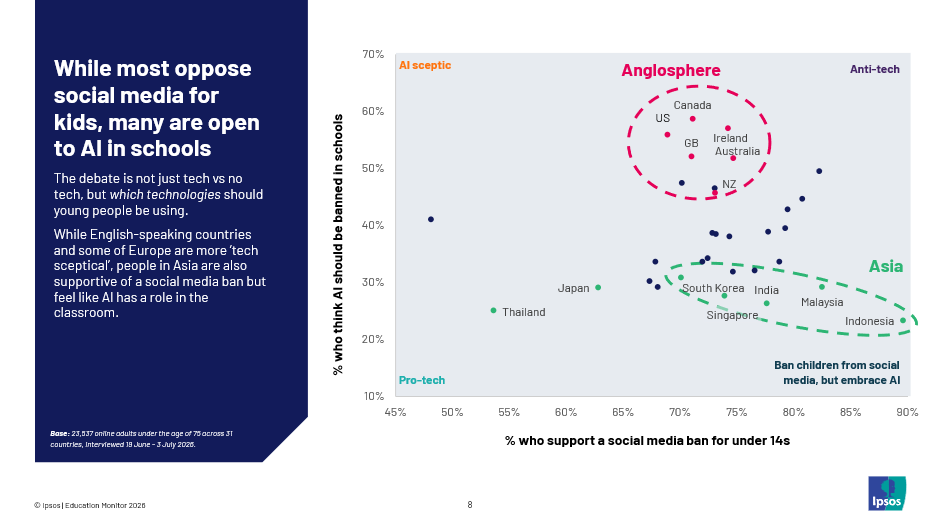
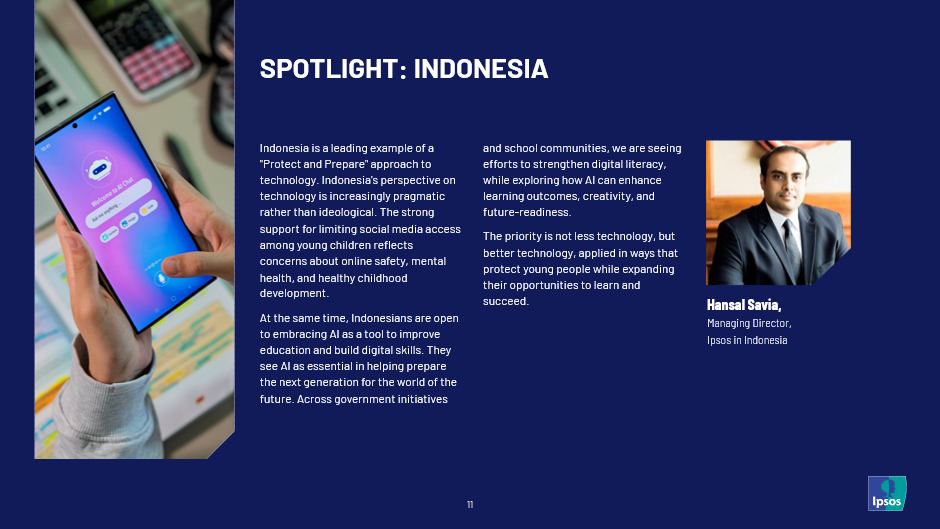
The Education Monitor suggests people are distinguishing between technologies they perceive as potentially harmful and those they see as having a role in learning and opportunity. The Indonesia spotlight describes this as a “Protect and Prepare” approach, combining restrictions on children’s social media use with openness to AI in education and digital skills. This interpretation is specific to Indonesia, but raises a question for the region more broadly.
Attitudes are moving in different directions
The year-on-year data adds another layer. Singapore moved from 65% to 74% on social media restrictions, while support for an AI ban fell from 37% to 28%. Indonesia also saw support for an AI ban fall from 30% to 23%.
The direction is not consistent across Asia Pacific. Support for banning AI increased from 21% to 29% in Japan, from 47% to 52% in Australia and from 27% to 31% in South Korea, pointing to different attitudes towards the role of AI in education across markets.
Confidence in education varies across the region
Technology is only one part of the picture. Confidence in education systems varies across the region. Against a 31-country average of 33%, 74% in Singapore rate their education system as good, compared with 51% in India, 44% in Malaysia, 31% in Indonesia, 24% in Japan and 21% in South Korea.
Perceptions do not always align with student outcomes. The OECD Programme for International Student Assessment, or PISA, assesses the knowledge and skills of 15-year-old students across participating countries and economies. PISA 2025 places Singapore, Japan and South Korea among the ten highest performing education systems in science, mathematics and reading. While Singapore also records high public confidence in its education system, ratings are much lower in Japan and South Korea.
Views of university also differ. Globally, 66% say a degree helps people go further in their career and 53% say degrees are good value for money. Malaysia, Singapore, India and Thailand sit above both benchmarks, while Japan, South Korea and Indonesia sit below them.
When asked what they believe are the greatest challenges facing young people in their country, responses vary by market . Housing is the most commonly cited in Australia and Singapore; mental health in Malaysia, New Zealand and South Korea; the economy in Indonesia, Japan and Thailand; and education and training not matching labour market demands in India.
Taken together, the findings show that Asia Pacific is not approaching technology or education through one regional lens. The question across markets is how education systems balance protection from potential harm with preparation for technologies and labour markets that continue to change.