What Worries Thailand? May 2026
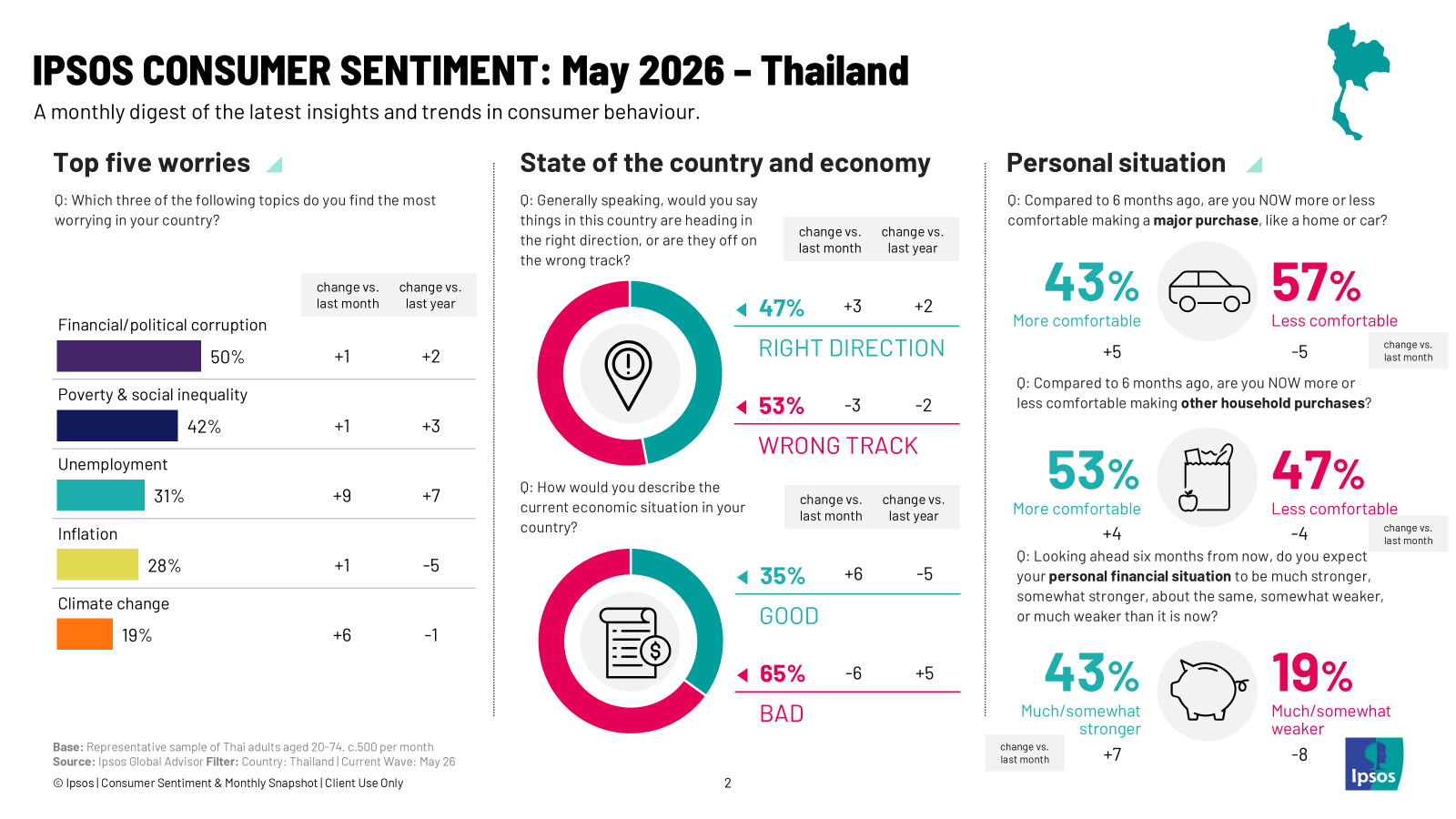
The latest Ipsos What Worries the World survey highlights an evolving landscape of public anxieties. While concerns around corruption, inequality and inflation continue to dominate, Ipsos data suggests that Thai consumers may be slowly regaining confidence after a difficult month.
Notably, for the first time since border tensions with Cambodia heightened security concerns, Military Conflict Between Nations has dropped out of Thailand’s top five worries. In its place, Climate Change has returned as a growing concern — highlighting how Thai consumers are once again shifting attention toward long-term environmental and societal challenges.
At the same time, uncertainty around employment and the broader economy continues to weigh heavily on people’s minds.
Corruption remains Thailand’s number one concern
Financial and political corruption remains the country's leading worry, cited by 50% of Thais. This continues to significantly outweigh other concerns and reinforces long-standing public frustrations around trust, governance and accountability.
The second largest concern remains Poverty and Social Inequality (42%), reflecting ongoing pressure from uneven economic recovery and household financial strain.
The persistence of these concerns suggests that beyond economic indicators, structural and social issues continue to shape perceptions of national wellbeing.
Unemployment anxiety rises sharply
One of the biggest shifts this month is the rise in concern over Unemployment, now at 31%, increasing substantially versus both last month and last year.
Recent reports around rising unemployment figures and workforce reductions have likely amplified public concern. News surrounding labour market softness and increasing layoffs appears to be translating directly into consumer sentiment, reinforcing anxiety around financial stability and job security.
When employment concerns rise, the impact often extends beyond affected workers themselves. It can trigger broader caution across households as consumers become more conservative with spending and future planning.
Inflation pressures continue to linger
Inflation remains among Thailand’s top worries, with 28% citing it as a major concern.
Although inflation concern itself has eased slightly compared with previous peaks, cost-of-living pressures remain deeply embedded in consumer sentiment. Ongoing geopolitical uncertainty surrounding the US–Iran conflict and concerns over energy prices continue to create uncertainty around fuel, transport and utility costs. Global tensions have contributed to fears around oil and energy supply disruptions, with spillover effects reaching Thai households.
Climate Change returns to the top five
Climate Change (19%) entered Thailand’s top five worries, replacing concerns around military conflict between nations.
Climate-related issues have increasingly become part of everyday conversation in Thailand, driven by heatwaves, environmental events and changing weather patterns. The re-emergence of climate concern suggests that once immediate geopolitical fears begin to soften, consumers return their focus toward longer-term societal risks.
Consumers show subtle signs of financial optimism
Despite persistent economic concerns, May also shows several encouraging shifts in consumer outlook.
Looking ahead six months, 43% of Thais expect their personal financial situation to become stronger, increasing from 36% last month.
One possible contributor may be expectations surrounding the government's Thai Chuay Thai (Thais Help Thais) campaign and related stimulus measures designed to support purchasing power and reduce cost-of-living pressures. Government initiatives under the programme include subsidies and spending support aimed at helping households manage rising expenses.
While optimism remains cautious, it signals a meaningful improvement after April’s heightened concerns around inflation and energy costs.
Spending caution remains, but has eased
While there are signs of modest improvement in spending sentiment this month, Thai consumers continue to approach purchases with caution. Those feeling less comfortable making a major purchase remain elevated at 57%, although this has eased from 62% last month. Similarly, the proportion feeling less comfortable making other household purchases declined to 47%, down from 51% previously.
The movement suggests that some of the heightened financial pressure seen in the previous month may be softening. However, caution still clearly outweighs confidence. A majority of consumers remain hesitant when it comes to larger spending decisions, indicating that financial uncertainty continues to shape behaviour.
Rather than signalling a return to stronger consumer confidence, these shifts may reflect a gradual easing of immediate pressures. Thai households are still prioritising value, making more deliberate purchase choices, and remaining selective around discretionary spending — a pattern businesses should continue to watch closely.
The country outlook remains challenging
Despite improving personal sentiment indicators, broader perceptions of Thailand remain weak.
- 53% of Thais believe the country is heading in the wrong direction
- 65% continue to describe the current economy as bad
This gap between personal optimism and broader national pessimism is an important signal.
Consumers may be feeling slightly more hopeful about their own household situation, yet remain unconvinced about the country's wider economic trajectory.