

Signals from Asia Pacific: Worry, Confidence, and AI Trust and Use
Across Australia, India, Indonesia, Japan, Malaysia, Singapore, South Korea and Thailand, the leading concerns differ, as do levels of confidence and attitudes towards AI. In several markets, concern sits alongside relatively strong confidence, while enthusiasm for AI coexists with unease.
Looking across Ipsos data available through August 2026, including shifts since the start of the year, helps show how these signals have evolved and why they need to be read together.
Three leading worries, eight market realities
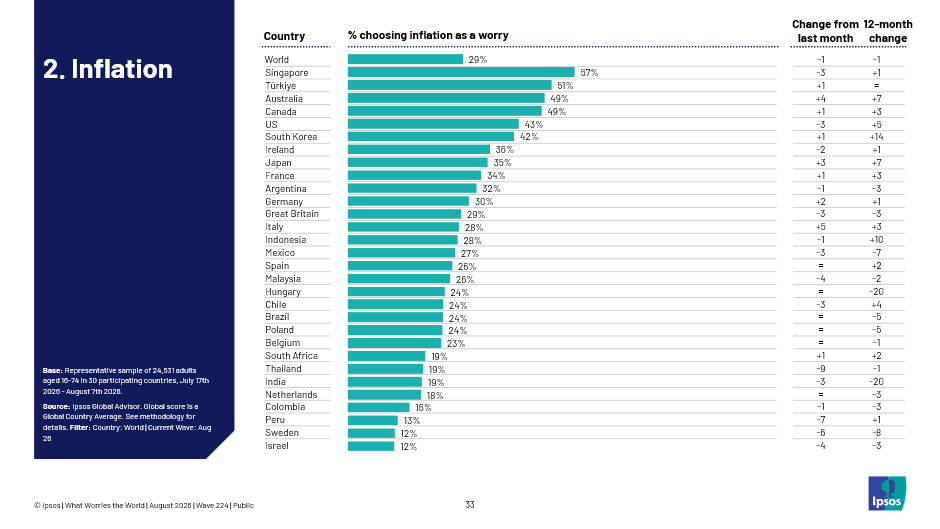
In August 2026, there is no single “Asia Pacific worry” across these eight markets. Inflation leads in Australia and Japan, while unemployment leads in Singapore, South Korea and India.
But even within those shared categories, the intensity and trajectory differ. Inflation concern has strengthened in Australia over the course of the year, while in Japan it has remained relatively stable.
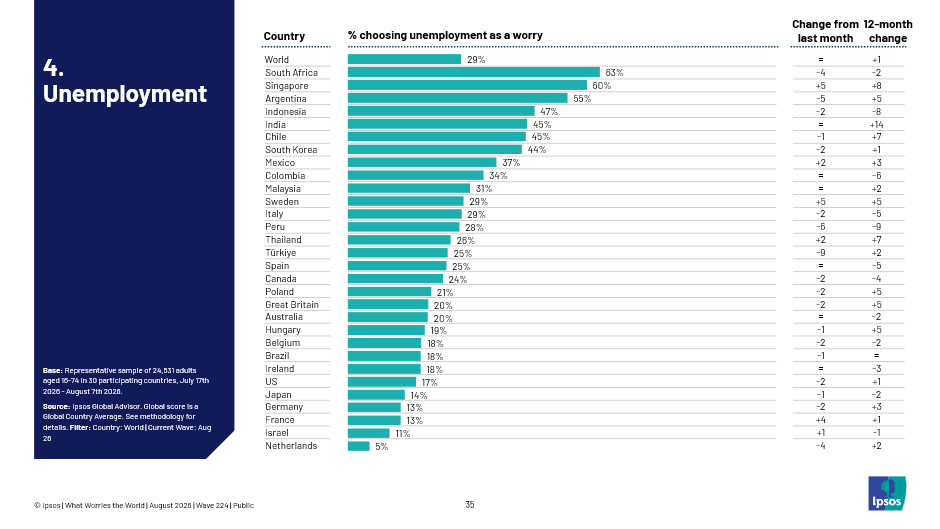
Unemployment is the leading concern in Singapore, South Korea and India. In August, 60% cite it as a worry in Singapore, compared with 45% in India and 44% in South Korea. In Singapore, it has overtaken inflation as the leading concern.
Concern about financial and political corruption leads in Indonesia, Thailand and Malaysia. Indonesia records the highest level among the eight, with 74% citing it as a worry.
Looking back to the start of the year shows some concerns have been building, while others remain persistently high.
In Australia, the share citing inflation as a worry has also risen, from 41% in January to 49% in August.
Elsewhere, the story is more about persistence than escalation. In Japan, 35% cite inflation as a worry in August, little changed from 34% in January. South Korea shows a similar pattern for unemployment, cited by 44% in August compared with 46% at the start of the year.
Singapore is different again. Inflation and unemployment have both remained prominent worries through 2026. Both were cited by 56% in January. Inflation moved ahead during the first half of the year, but by August unemployment had become the leading concern, cited by 60%.
The What Worries the World August data also points to pressures emerging alongside these headline worries. In Thailand, financial and political corruption remains the leading concern at 51%, while concern about crime and violence has risen to 33%, its highest level since February 2024. In South Korea, concern about climate change rose eight percentage points in August.
Concern can sit alongside confidence
Singapore is one of the clearest examples. Unemployment is now its leading concern, cited by 60%, yet 76% describe the economy as good, the highest proportion across all 30 countries measured in August. Its Consumer Confidence National Index stands at 52.9. This is 1.3 points lower than July, a movement that is not statistically significant.
This comes against a softer global confidence backdrop. The Global Consumer Confidence Index fell 0.7 points to 48.4 in August, its first decline since April after three consecutive monthly increases. Across the 30 economies measured, only three recorded a statistically significant increase in confidence, while seven recorded significant declines.
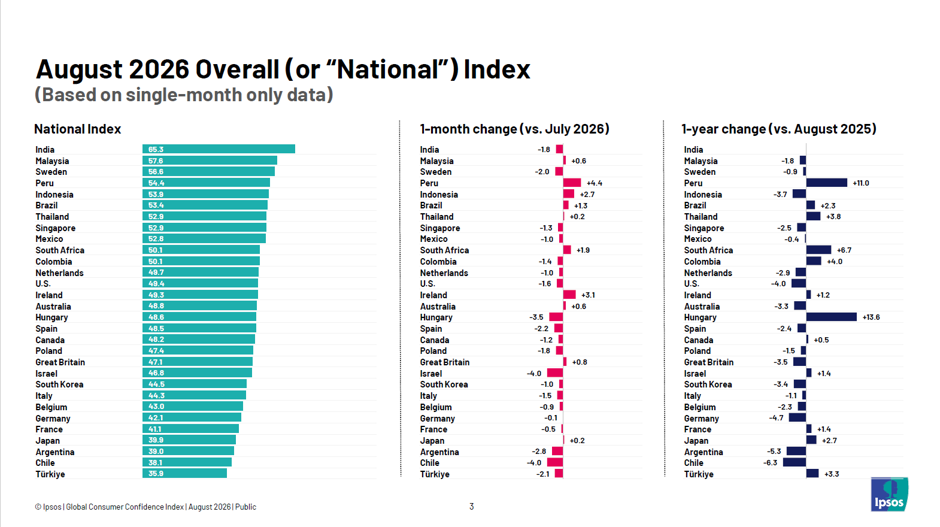
Meanwhile, India presents another relatively positive confidence picture. Unemployment remains its leading concern at 45%, while its Consumer Confidence National Index stands at 65.3, the highest among all 30 countries measured.
Malaysia also combines a prominent concern with relatively strong confidence. Financial and political corruption is its leading worry, cited by 53%, up from 49% in July, while its Consumer Confidence Index stands at 57.6, the second highest among the 30 countries measured.
Indonesia presents a particularly interesting August picture. The proportion mentioning financial and political corruption as a key issue has risen from 71% to 74%, while its Consumer Confidence Index has increased significantly by 2.7 points to 53.9. It is the only one of these eight markets, and one of just three across all 30 economies measured, to record a statistically significant increase in consumer confidence in August.
Japan sits at the other end of the confidence picture. Inflation remains its leading concern, cited by 35%, while its Consumer Confidence Index stands at 39.9, the fourth lowest among the 30 countries measured and the lowest among the G7.
The August data reinforces the point that prominent concerns do not necessarily coincide with low consumer confidence. India and Malaysia remain among the highest confidence markets measured despite clear pressure points. Indonesia has recorded a significant improvement in confidence even as concern about corruption has increased. Japan, by contrast, remains at the lower end of the confidence rankings.
The distinction matters because a market’s leading worry alone does not tell us how confident consumers feel.
The same tension appears in how people respond to AI
Ipsos AI Monitor 2026 shows another form of coexistence between optimism and unease. In every one of the eight markets, a majority say they do not always trust AI tools but use them anyway. In Australia, that figure is 52%. In Indonesia, it reaches 76%.
Excitement and nervousness can also sit alongside each other. In India, 79% are excited about AI and 63% nervous. In Thailand, the figures are 77% and 61%; in Malaysia, 71% and 53%; and in Singapore, 61% and 58%.
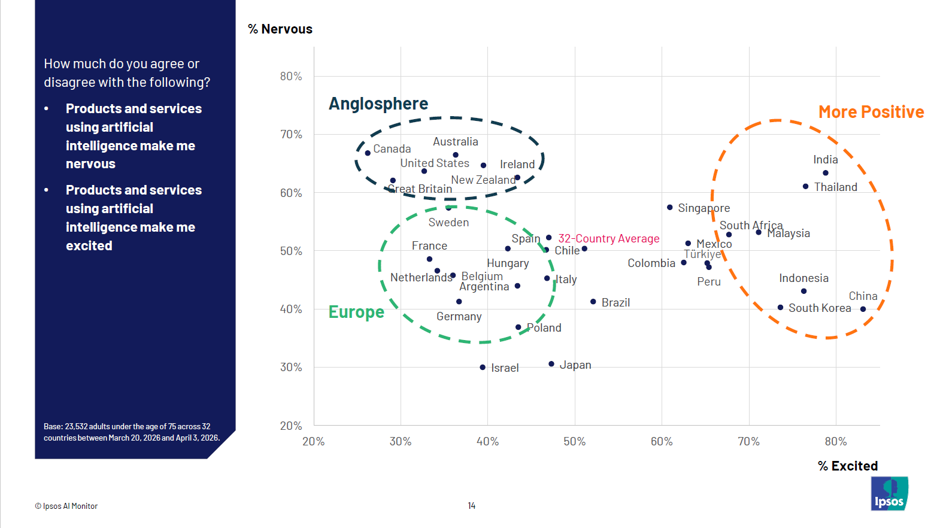
Australia shows a different picture, with 36% excited and 67% nervous. Japan is more muted on both measures, at 47% and 31%.
South Korea adds another layer. Some 74% are excited about AI, yet only 14% expect increased use of AI to improve the wider job market, while 55% expect it to make things worse. Separately, unemployment remains South Korea’s leading concern in the August What Worries the World study, at 44%.
These findings do not show that one is causing the other. They do show that enthusiasm for AI can coexist with concern about its wider implications.
As Manuel Garcia Garcia, Ipsos Global Lead Science Activation, Research and Strategy, writes in The Human Side of AI Adoption in Asia:
For organizations operating across Asia, the next challenge is designing experiences that people trust, understand, and want to use. That means considering how AI affects human agency, emotional reassurance, confidence, and local cultural expectations. In a region as diverse as Asia, cultural attunement becomes a competitive advantage rather than a nice-to-have.
- Manuel Garcia Garcia, Ipsos Global Lead Science Activation, Research and Strategy
Why the market context changes the business read
Taken together, the findings do not point to one shared consumer mood across these eight markets. A prominent concern does not automatically signal weak confidence overall. Relatively strong consumer confidence does not mean people are free from significant concerns. Enthusiasm for AI does not mean trust or confidence in its wider impact.
For businesses, the implication is to avoid using one headline signal as a proxy for the whole market. Unemployment may be the leading concern in both Singapore and South Korea, but the wider confidence environment is very different. Singapore’s Consumer Confidence Index stands at 52.9, compared with 44.5 in South Korea. Likewise, strong enthusiasm for AI can sit alongside very different levels of nervousness, trust and concern about its consequences.
Reading these signals together gives businesses a more useful view of the environment they are operating in, and a stronger basis for decisions around communication, value, innovation and AI. The regional headline tells you what is happening. The market context helps you understand what that signal actually means.
Resources:
The author(s)
-

-
 Jamie StinsonIpsos Knowledge Centre


