Thailand and AI in 2026: Excitement, Optimism and Growing Expectations
The latest Ipsos AI Monitor 2026 reveals that Thailand remains one of the world's most optimistic markets about Artificial Intelligence. While people around the globe continue to balance excitement with concern, Thais are more likely than the global average to believe AI will improve their lives, enhance productivity, and create benefits that outweigh its risks.
The findings suggest that AI is no longer viewed as a distant technology. For many Thais, it is already influencing everyday life, and its impact is expected to grow even further over the next few years.
AI is Already Transforming Daily Life in Thailand
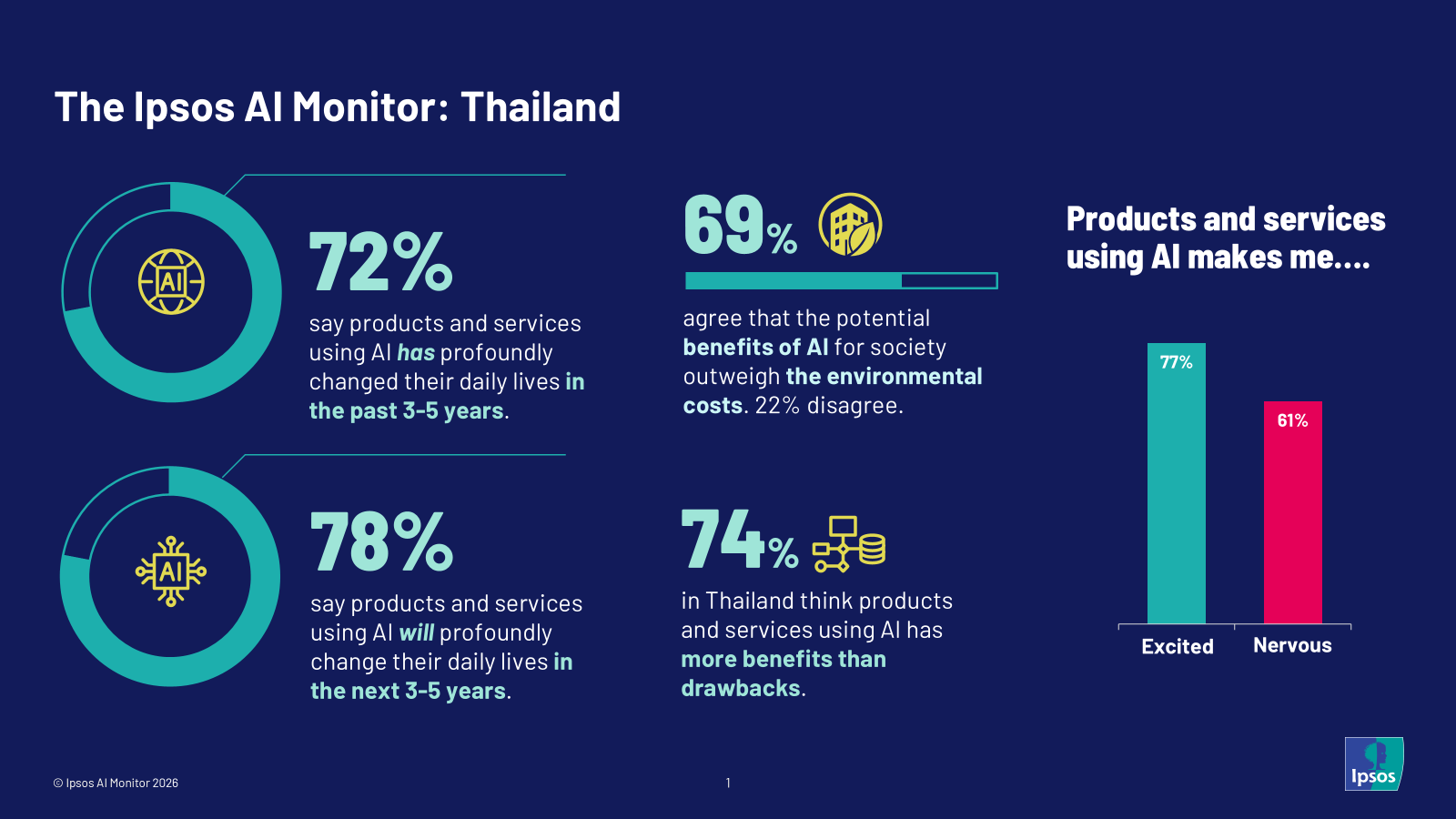
Nearly three in four Thais (72%) say products and services using AI have profoundly changed their daily lives over the past three to five years, significantly higher than the 32-country average of 54%. Looking ahead, 78% believe AI will profoundly change their lives in the next three to five years, compared with a global average of 66%.
This places Thailand among the countries most likely to recognise AI's current impact and anticipate even greater change in the future. The findings also reflect how AI-powered services have become increasingly integrated into consumers' daily experiences, from search, content recommendations and customer service to shopping, banking and workplace productivity.
Benefits Outweigh the Drawbacks
Thai consumers generally see AI as a force for positive change. Almost three-quarters (74%) believe products and services using AI have more benefits than drawbacks, compared with 55% globally. Meanwhile, 74% also agree that AI-powered products and services offer more benefits than drawbacks overall.
Thailand also ranks among the most positive countries when considering AI's broader societal impact. Seven in ten (69%) agree that the potential benefits of AI for society outweigh its environmental costs, well above the global average of 49%.
These findings align with a broader trend identified in the global study: countries across Asia-Pacific tend to be more optimistic about AI's potential than many countries in Europe and North America.
Excitement and Nervousness Coexist
Despite strong optimism, attitudes toward AI are not one-dimensional. More than three-quarters of Thais (77%) say AI-powered products and services make them excited, one of the highest levels recorded globally. At the same time, 61% say these same technologies make them nervous.
This reflects a broader global pattern identified in the Ipsos AI Monitor: people increasingly experience both "wonder" and "worry" about AI simultaneously. The technology is seen as promising and transformative, but also uncertain and disruptive.
For businesses, this means adoption alone is not enough. Consumers also expect transparency, safeguards and responsible implementation.
AI is Delivering Real Productivity Gains
One of the clearest benefits reported by Thai workers is improved efficiency. Four in five employed Thais (80%) say AI tools have saved them time at work during the past year, substantially above the global average of 62%.
In addition, 65% believe AI will change how they do their current job within the next five years.
At the same time, concerns about workforce disruption remain significant. Six in ten Thai workers (64%) believe AI could replace their current job within the next five years, making Thailand one of the countries where job displacement concerns are most pronounced. One critical challenge for organisations is helping employees understand how AI can augment human capabilities while ensuring workers are equipped with the skills needed for an AI-enabled future.
Trust Remains a Critical Issue
While enthusiasm is high, trust remains an area requiring attention. Only 47% of Thais trust companies that use AI to protect their personal data. Similarly, 57% trust AI not to discriminate or show bias towards different groups of people. Confidence in AI's potential does not automatically translate into confidence in how organisations deploy it. Consumers are increasingly evaluating AI not only on what it can do, but on whether it is used responsibly, transparently and ethically.
Consumers Want Greater Transparency Around AI
There is also strong support for clearer disclosure when AI is involved. Eight in ten Thais (85%) believe products and services should be required to disclose when AI is being used, higher than the global average of 80%. For brands, transparency may become an increasingly important trust-building tool. Rather than hiding AI involvement, organisations may benefit from clearly communicating where AI is used and how human oversight remains in place.
Looking Ahead: A Nation Ready for AI, but Expecting Responsibility
Thais are among the world's strongest believers in AI's ability to improve lives, drive productivity and create positive economic outcomes. They are more likely than the global average to see benefits in AI and to expect significant future change. Yet enthusiasm exists alongside concerns about job displacement, bias, privacy and governance. As AI becomes increasingly embedded in everyday life, success will depend not only on innovation, but also on building trust. For organisations operating in Thailand, the message is clear: consumers are ready to embrace AI—but they expect it to be transparent, responsible and human-centred.