

Understanding Asia | Inflation has steadied, but Asia’s markets diverge on prices, jobs and economic confidence
Ipsos’ What Worries the World June 2026 data shows that global inflation concern has stabilised after rising in April in the wake of the early weeks of the Iran conflict. Across Asia, however, the more useful signal is not one regional mood. Inflation concern, unemployment concern and economic assessment are appearing in different combinations across markets.
This builds on our last Understanding Asia report, Brand Shifts in Asia Pacific Amid the Iran Conflict, which examined the conflict’s potential implications for the region, including energy volatility, inflation risk and consumer confidence.
The key signal is not that Asia is simply becoming more worried. It is that economic concern is appearing in different combinations across markets. Inflation, unemployment and economic assessment are not moving as one regional pattern, which means businesses should be careful about applying a single “pressure” narrative across Asia.
Across the Asian markets reviewed, inflation concern is highest in Singapore at 63%, followed by Australia at 46%, South Korea at 40% and Japan at 34%. Thailand stands at 32%, Indonesia at 31%, Malaysia at 30% and India at 24%. The market picture is mixed, with inflation concern rising in Singapore, Thailand, Indonesia and India, easing in Australia, South Korea and Malaysia, and unchanged in Japan.
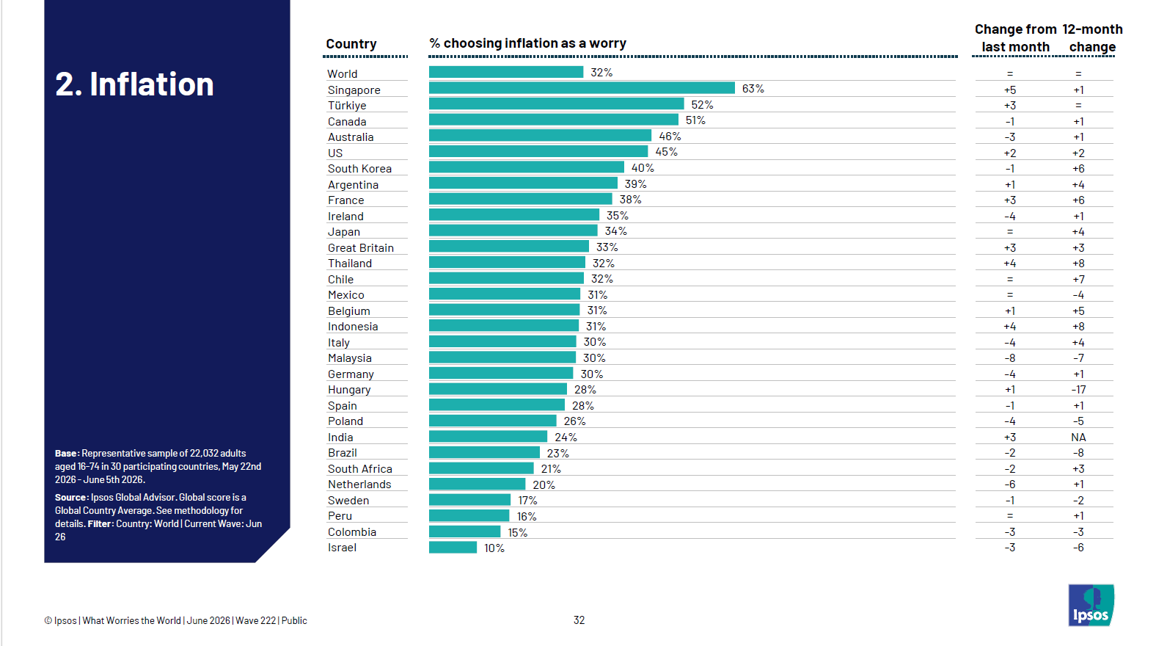
Global inflation concern has stabilised after rising in April in the wake of the early weeks of the Iran conflict.
Source: Ipsos | What Worries the World | June 2026
Unemployment concern shows a different pattern. Among the markets reviewed, it is highest in Singapore at 56%, followed by Indonesia at 50%, India at 46% and South Korea at 43%. Malaysia stands at 29%, in line with the 30 country average, while Thailand has fallen six points to 25%. Concern is lower in Australia at 22% and Japan at 14%.
Economic assessment adds another layer. The proportion rating their economy as good stands at 75% in India, 74% in Singapore and 70% in Malaysia. Australia is at 40%, while South Korea stands at 35%, Indonesia at 32% and Thailand at 31%. Japan remains the lowest among the Asian markets surveyed, at 15%.
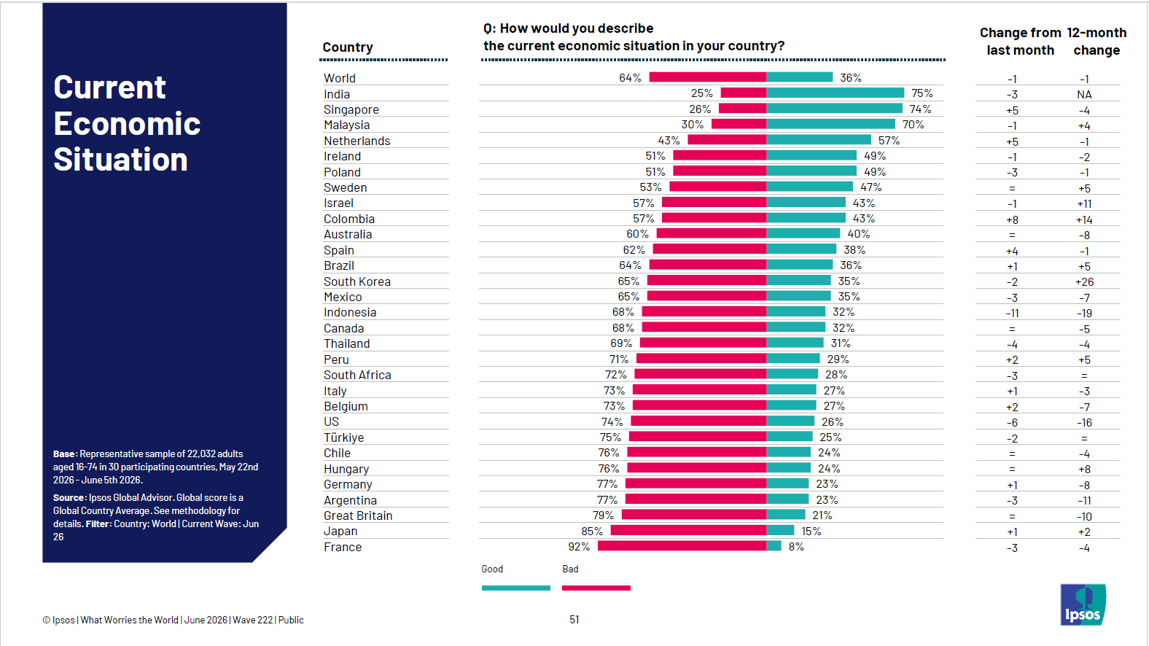
Economic assessment varies sharply across Asia, reinforcing the need to read market context rather than one regional mood.
Source: Ipsos | What Worries the World | June 2026
Japan also shows why the conflict should not be read as the only lens for economic concern. Concern about military conflict between nations stands at 21%, down two points from the previous month. Inflation remains the country’s top concern at 34%, followed by climate change at 30%, while taxation and poverty and social inequality both stand at 29%.
For businesses, the June data points to a clear implication: Asia should not be read as a single consumer mood. The same regional backdrop is producing different issue mixes by market. In some places, price concern is more prominent; in others, job concern or weaker economic assessment shapes the context. Regional strategy needs that market level reading before deciding what the message needs to do.
Resources from Ipsos
- For all the latest research on the conflict and its implications, check out our dedicated web page
- Ipsos' What Worries the World


