Myth Busted: Boomers are no more likely than younger generations to have been knowingly victimized by online fraud and/or scams
Toronto, Ontario, March 1, 2024 — A new Ipsos poll conducted on behalf of HomeEquity Bank reveals that a majority (54%) of Canadians have never been knowingly victimized by fraud and/or scams, a figure which remains relatively consistent across the generations and suggests any contention that Boomers are more susceptible to fraud and/or scams than their younger counterparts is misguided. However, as many as three in five (59%) claim to have known someone who has been knowingly victimized by fraud and/or scams with this figure similarly being flat across the generations.
The survey results indicate that the older generations (Boomers, in particular) are equally, if not more, vigilant than their younger counterparts, when it comes to online fraud and/or scams. Four in five (79%) Canadians are constantly concerned about fraud when using the Internet, a figure which rises to well over eight in ten (85%) among Boomers. By comparison, around three in four (76%) across the other generations say they are constantly concerned about this, figures which point to significantly heightened cybersecurity concerns among Boomers.
Despite their marked concerns regarding online fraud and/or scams, Boomers are perceived as being by far the most likely to fall victim to an online scam (66% – by comparison, only 14% feel this way about Gen X, which is the next most-commonly cited generation). Additionally, the highest proportion of Canadians view Boomers as being the most likely generation to click on unsafe links (49%), shop on unsafe websites (44%), share financial information online (39%), and/or have autofill passwords (32%). Notably, on all four counts, the youngest generation – Gen Z – is perceived as being the second most likely generation (after Boomers) to engage in each of these negative online safety behaviours. It perhaps follows that Millennials (40%) and Gen X (31%) are seen as being most likely to have online-safety software on their device (vs. 15% of Boomers and 14% of Gen Z).
The vast majority (84%) of Canadians are confident they can identify Internet scams. Notably, Millennials are twice as likely to express high levels of confidence, when it comes to identifying Internet scams (very confident: 36% vs. 18% across all other generations), though overall confidence (very/somewhat confident) is mostly consistent across the generations. When asked what makes them most vulnerable to online fraud, the highest proportion of Canadians cite financial scams (38%) and leaking private information (38%). Considerably lower proportions mention fake news (13%), deepfakes (6%), and catfishing (3%). Once again, the results are mostly flat across the generations.
Canadians take cybersecurity seriously, yet many engage in unsafe online behaviours
Canadians take cybersecurity seriously, as evidenced by the fact that most are open to learning more about how to stay safe online (89%), express concerns about new AI technologies (83%), and/or would be open to taking a cybersecurity course to protect their data (77%). Around four in five think they are better prepared than others – both older (82%) and younger (72%) than they are – to handle a scam – with little to no variation across the generations on both metrics. Despite these sentiments, however, only about one in four (27%) report having cybersecurity software on their device(s) and even fewer (14%) own an RFID wallet to protect unauthorized taps on their credit/debit cards.
Even though most claim to take cybersecurity seriously, considerable proportions may not be engaging in safe online behaviours. Almost three in ten admit to using the same password for multiple accounts (28%) and/or getting their news from social media (28%). Around one in six have public social media accounts (17%) and/or use autofill when entering their credit card information (15%). As many as one in ten (11%) say they use social media to meet new people.
The vast majority (84%) report engaging in at least some form of potentially unsafe online behaviour, within the past week, with Boomers being least likely to report having done this (71% vs. 90% across all other generations). Most notably, a majority (56%) say they have made an online purchase in the past week, a figure which rises to almost two-thirds among Millennials (64%) and Gen X (62%) compared to less than half of Gen Z (46%) and Boomers (46%). Around one in three have visited a website that requires reading a privacy policy (36%), multi-tasked between devices (33%), and/or downloaded a new app (32%). Gen Z is by far the most likely to have downloaded a new app, specifically (60% vs. 29% across all other generations). Almost three in ten (28%) have connected to public Wi-Fi whereas two in ten (20%) have saved personal information online. Gen Z is once again most likely to have connected to public Wi-Fi (48% vs. 25% across all other generations). Closer to one in six have reused an old password for a new account or logged into more than 5 social media accounts, figures which are statistically higher among Gen Z and Millennials, on both counts.
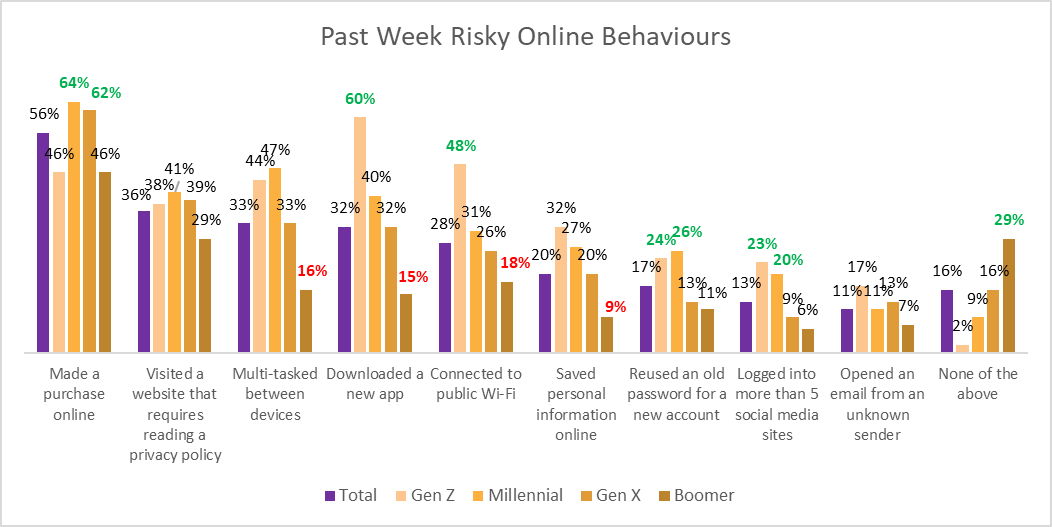
Statistically lower Statistically higher
About the Study
These are some of the findings of an Ipsos poll conducted between Jan 30 and Feb 1, 2024 on behalf of HomeEquity Bank. For this survey, a sample of 1,000 Canadians aged 18+ were interviewed. Weighting was then employed to balance demographics to ensure that the sample's composition reflects that of the adult population according to Census data and to provide results intended to approximate the sample universe. The precision of Ipsos online polls is measured using a credibility interval. In this case, the poll is accurate to within ±3.8 percentage points, 19 times out of 20, had all Canadians aged 18+ been polled. The credibility interval will be wider among subsets of the population. All sample surveys and polls may be subject to other sources of error, including, but not limited to coverage error, and measurement error. All figures cited in this release are based on those who have formed an opinion on the matter and exclude ‘don’t know’ responses.
For the purposes of this study, the generation columns in the data tables are defined as follows:
- Gen Z: born 1997-2006
- Millennial: born 1981-1996
- Gen X: born 1965-1980
- Boomer: born 1964 or earlier
For more information on this Factum, please contact:
Sean Simpson
Senior Vice President, Ipsos Public Affairs
[email protected]
James Cottrill
Senior Account Manager, Ipsos Public Affairs
[email protected]
About Ipsos
Ipsos is the world’s third largest market research company, present in 90 markets and employing more than 18,000 people.
Our passionately curious research professionals, analysts and scientists have built unique multi-specialist capabilities that provide true understanding and powerful insights into the actions, opinions and motivations of citizens, consumers, patients, customers or employees. We serve more than 5000 clients across the world with 75 business solutions.
Founded in France in 1975, Ipsos is listed on the Euronext Paris since July 1st, 1999. The company is part of the SBF 120 and the Mid-60 index and is eligible for the Deferred Settlement Service (SRD).
ISIN code FR0000073298, Reuters ISOS.PA, Bloomberg IPS:FP