
Ontarians willing to trade off investment in economic growth and recovery for investment in health — at least until the backlog of care is cleared.
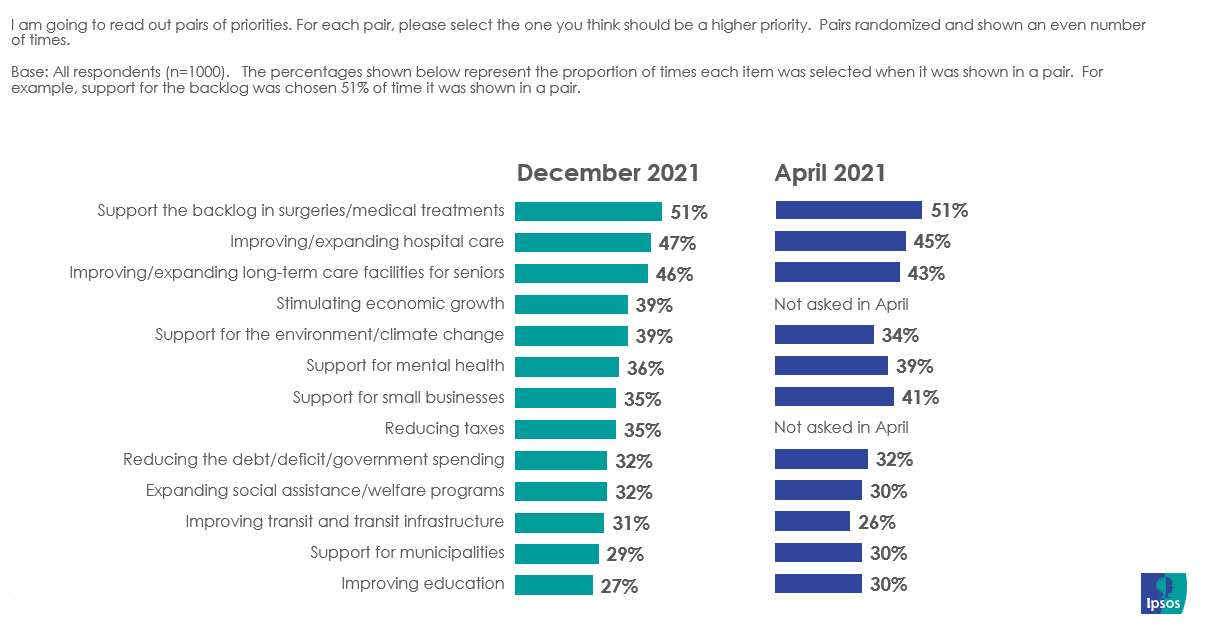
Toronto, ON, January 19, 2022 – When asked to consider a series of priorities, Ontarians prioritize the backlog in surgeries/medical treatments 51% of the time. This is followed by improving and expanding hospital care, which was chosen 47% of the time. Both of these were chosen more often than stimulating economic growth which was chosen 39% of the time.
While down from 63% in April 2021, COVID-19 continues to be the top issue for Ontarians with 40% saying it should receive the greatest attention of the provincial government. This is followed by access to health care services/long wait times/understaffed hospitals (10%), housing affordability (9%) and economic growth/increased revenue (7%).
When asked to choose the greater priority from a series of pairs, backlog in surgeries/medical treatments was chosen most often as the greater priority (51% of the time it was shown). This is consistent with data from April 2021 when it was also chosen most often (also 51%). Improving/expanding hospital care (47% of the time) and improving/expanding long-term care facilities for seniors (46%) follow with stimulating economic growth chosen 39 per cent of the time. Climate change (39%), mental health (36%), support for small businesses (35%) and reducing taxes (35%) are the next most often chosen.
Chart 1: Provincial Priorities
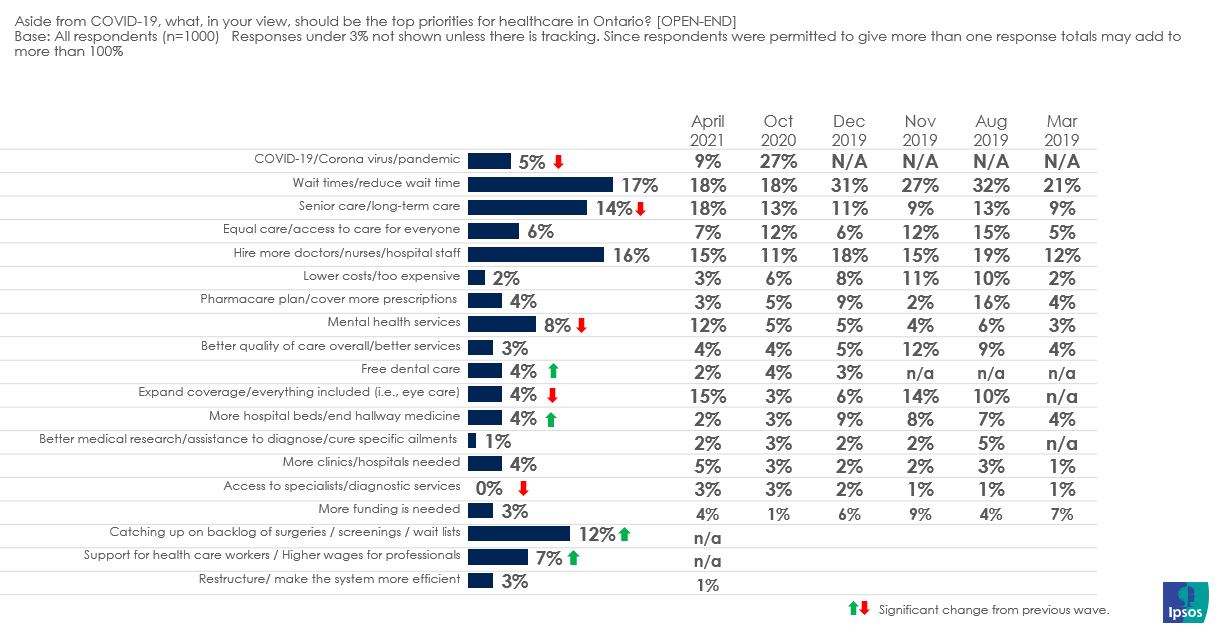
 When it comes to specific health care priorities, aside from Covid-19, wait times for health care services (17%) and specifically the backlog for surgeries and medical treatments (12%) are mentioned often. Hiring more doctors/nurses/hospital staff (16%) and caring for seniors/long-term (14%) care are also mentioned often.
Chart 2: Health Care Priorities
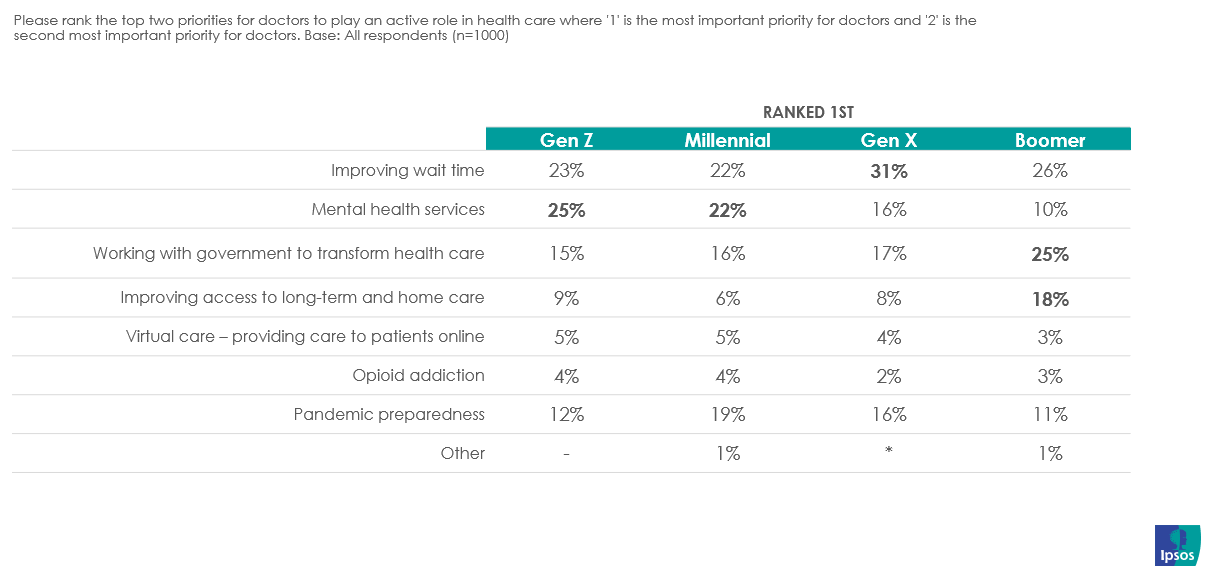
 Notably, mental health services as mentioned less frequently than compared with April 2021. However, it continues to be priority, particularly for younger Ontarians. When offered the following choices (see Chart 3), mental health is shown to be more of a priority for those who are Gen Z (25%) and Millennial (22%) than older Ontarians (Gen X 16%, Boomers 10%), whereas improving wait times is a greater priority for Gen X (31%) and for Boomers transforming health care (25%) and long-term/home care (18%) are greater priorities.
Chart 3: Ranking of Specific Health Care Issues
 The survey found strong support for the five pillars of the OMA’s Prescription for Ontario: Doctors’ 5-Point Plan for Better Health Care with 96% of Ontarians agreeing these are the 5 most pressing issues in health care in Ontario:
• Reduce wait times and the backlog of services for patients needing a test or treatment, waiting for any type of surgery or procedure, or living with a chronic disease.
• Expand mental health and addiction services in the community so professional help is there for anyone who needs it.
• Improve and expand home care and other community care so hospital and long-term care admissions might be avoided, and stable patients can leave hospital sooner with more choice about where they receive follow-up care.
• Strengthen public health and pandemic preparedness so our communities are protected every day and especially in public health emergencies.
• Give every patient a team of health-care providers and link them digitally so patients can receive the different types of care they need faster, and care providers – doctors’ offices, emergency departments, pharmacies, hospitals and home and long-term care – can share information more quickly and efficiently.
Of these five pillars, Ontarians rank reduced wait times and the backlog of services most pressing (44% ranking it first) followed by digital links for patient teams (16%), strengthening pandemic preparedness (16%), expanding mental health and addiction services (14%), and improving/expanding home care and other community care (10%).
On the topic of Covid-19 vaccines, the survey found that roughly one in ten Ontarians report they have not been vaccinated against COVID-19 (9%) or have received only one dose (2%), including 7% who do not plan to get vaccinated. Those unlikely to get vaccinated are directionally more likely to be Millennial (9%) or Gen X (9%) compared with Gen Z (7%) and Boomers (3%), and more likely to be women (8%) than men (5%).
Of those who have not been vaccinated, fear of the side effects (24%) and lack of trust in information from the government (24%) are the main reasons for delaying or avoiding vaccination. Other reasons include: a personal choice to wait (13%), don’t believe the vaccine is effective (11%), not interested (7%), dislike needles (4%), have medical reasons (3%), or not sufficiently concerned about getting COVID-19 to get their shots (2%).
About the Study
These are some of the findings of an Ipsos survey conducted between December 7-13, 2021, on behalf of the Ontario Medical Association. For this survey, a sample of 1,000 Ontarians aged 18+ was interviewed online via the Ipsos I-Say Panel and non-panel sources. Quotas and weighting were employed to ensure that the sample’s composition reflects that of the Ontario population according to census parameters. The precision of Ipsos online surveys is measured using a credibility interval. In this case, the survey is accurate to within ± 3.5 percentage points, 19 times out of 20, had all Ontarians aged 18+ been surveyed. The credibility interval will be wider among subsets of the population. All sample surveys and polls may be subject to other sources of error, including, but not limited to coverage error, and measurement error.
For more information on this news release, please contact:
Sandra Guiry
Senior Vice President, Ipsos Public Affairs
About Ipsos
Ipsos is the world’s third largest market research company, present in 90 markets and employing more than 18,000 people. Our passionately curious research professionals, analysts and scientists have built unique multi-specialist capabilities that provide true understanding and powerful insights into the actions, opinions and motivations of citizens, consumers, patients, customers or employees. We serve more than 5000 clients across the world with 75 business solutions. Founded in France in 1975, Ipsos is listed on the Euronext Paris since July 1st, 1999. The company is part of the SBF 120 and the Mid-60 index and is eligible for the Deferred Settlement Service (SRD). ISIN code FR0000073298, Reuters ISOS.PA, Bloomberg IPS:FP www.ipsos.com


