One year on, most Canadians don’t see an end to the pandemic before the end of 2021 – if at all
Toronto, ON, March 10th, 2021 – As the world marks one year of living with COVID-19, an analysis of Ipsos tracking data in Canada and seven other countries examines how perceptions of the virus have changed since the beginning of the pandemic. After one year of grappling with the ebbs and flows of the virus, Canadians tend to see COVID-19 as a greater threat to their country than to their jobs or to their safety, something that's remained constant for much of the pandemic.
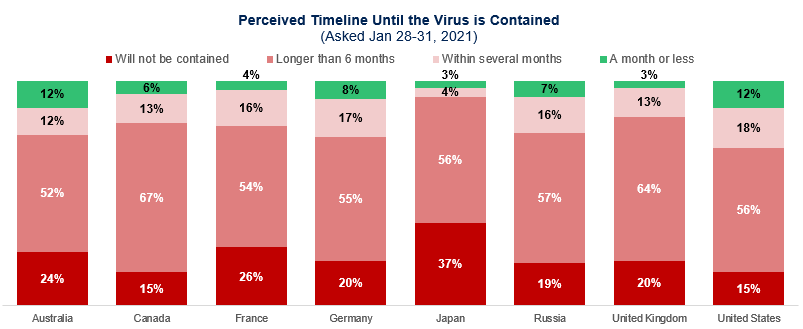
Looking ahead, few believe they are out of the woods yet; most expect the virus will not be contained until the second half of 2021, if ever.
COVID-19 as a national threat
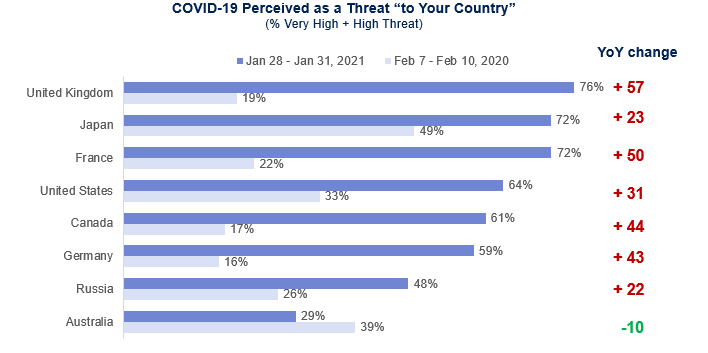
Six in ten Canadians (61%) think of COVID-19 as a “high” or “very high” threat to their country. This is in sharp contrast to the same time last year when the virus had not yet been declared a pandemic and less than two in ten Canadians acknowledged the gravity of the threat (17%).
Out of the eight countries surveyed, Canada (61%) closely shares the perception of threat with its North American counterpart, the United States (64%) and trails behind the United Kingdom (76%), Japan (72%), and France (72%) – the three countries whose citizens are most concerned about the threat COVID-19 poses to their nation. However, when it comes to the year-over-year change in the views, Canada (+44 percentage points) ranks third in terms of countries that gained the most ground in the assessment that the pandemic is endangering one’s country after the U.K (+57) and France (+50).
COVID-19 as a personal threat
One in four (26%) Canadians feel personally threatened by COVID-19 today. This marks a 20 percentage point increase in comparison to one year ago when only 6% of Canadians viewed the pandemic as a “high” or “very high” threat to themselves.
With the exception of Australians (15%), the fear among Canadians (26%) is not as strong as the threat postulated by citizens of all the other countries surveyed, the highest being among the residents of Japan (43%), followed by the United Kingdom (34%) and the United States (31%).
Though in almost all countries, citizen concern over one’s personal safety is higher today than it was one year ago, citizens viewing the pandemic as a threat to themselves do not make up a majority in any of the eight countries surveyed.

COVID-19 as a threat to one’s job or business
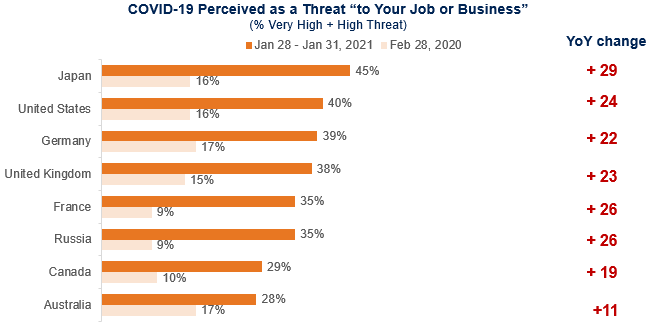
As the pandemic widens, the accompanying containment measures and business closures have led to the disappearance of millions of jobs across Canada. One year into the pandemic, concerns about losing one’s livelihood to the pandemic have consequently grown and crystallized - three in ten Canadians (29%) feel that COVID-19 poses a “high” or “very high” threat to their jobs or business, a 19 point growth since last year.
Perceptions of COVID-19 as a threat to one’s job or business are more prevalent today in every single country than they were a year ago. An increase of 19 to 29 points has been registered in all countries surveyed except Australia (+11). Likely comforted by the government-induced emergency relief and other stimulus packages, the fear among Canadians is not as strong as most of the other countries surveyed.
The perception that COVID is a threat to one’s job or business peaked in Spring 2020 and for a brief duration in early April, even became the majority opinion shared by 52% of Canadians. Compared to its pandemic high, the perception of threat among Canadians has now reduced by 23 percentage points. In this regard, while Australians (-26) are leading the way ahead of Canada, France (-21) follows closely. In all other countries surveyed, the perception of threat is now only 10 to 15 points lower compared to its peak last year.
Expectations for the future
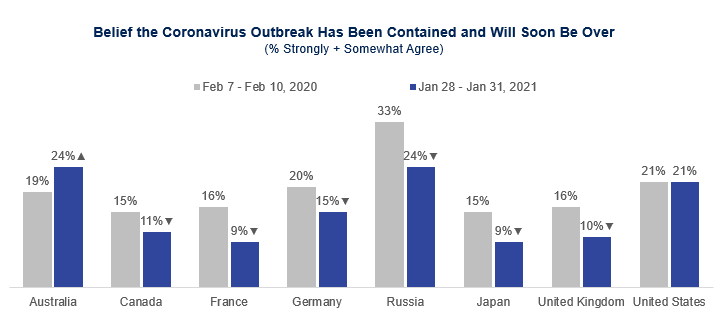
Though Canadians’ concerns about COVID-19’s impact on their personal safety and to their jobs eased in the Spring of 2020 and have levelled off since, perceptions that it is a threat to the country have grown back to nearly the same level as in March-April. A slim one in ten Canadians (11%) believe that the COVID-19 outbreak has been contained and will soon be over. Further evidencing the dampened expectations among Canadians, the share of citizens who believe the coronavirus pandemic will soon be over is lower now than a year ago (-4 points).
Canada mirrors the trend of worsening citizen expectations observed for all other countries surveyed, except for the southern neighbour, the United States, where the predicament remains unchanged and Australia, where more people now believe the pandemic will be over soon.
Looking ahead, as the vaccine rollout continues to lag, the light at the end of the tunnel is a long way ahead for Canadians. Just two in ten (19%) expect the pandemic to be contained within the next few months. The vast majority of Canadians are less hopeful: 67% place their bets on a timeline of 6 months or longer and 15% are even more pessimistic in their prediction and believe that the COVID-19 virus will never be contained.
In fact, in line with the prediction by Canadians, large majorities in all the other countries also feel it will be at least until the second half of 2021 before it’s contained – if ever.
About the Study
The survey is conducted on Ipsos’ Global Advisor online platform among adults aged 18-74 in Canada and the United States, and 16-74 in Australia, France, Germany, Japan, Russia, and the United Kingdom.
The first wave was conducted between February 7-10, 2020. The 33rd and most recent wave reported in this document was conducted January 28-31, 2021.
For each of Australia, Canada, France, Germany, Japan, the U.K., and the U.S., the samples of each survey wave have a size of 1,000 and can be taken as representative of the country’s general adult population aged 16-74 or, for the US and Canada, aged 18-74.
For Russia, the samples of all survey waves conducted between February and July 2020 size have a size of approximately 1,000 while those of waves conducted since August 2020 have a size of approximately 500. The samples in Russia are more urban, more educated, and/or more affluent than the general population and should be viewed as reflecting the views of the more “connected” segment of the population.
The data is weighted so that each country’s sample composition best reflects the demographic profile of the adult population according to the most recent census data.
Where results do not sum up to 100 or the ‘difference’ appears to be +/-1 more/less than the actual, this may be due to rounding, multiple responses, or the exclusion of “don't know” or not stated responses.
The precision of Ipsos online polls is calculated using a credibility interval with a poll of 1,000 accurate to +/- 3.5 percentage points and of 500 accurate to +/- 4.8 percentage points.
For more information on Ipsos’ use of credibility intervals, please visit the Ipsos website (www.ipsos.com).
The publication of these findings abides by local rules and regulations.
For more information on this news release, please contact:
Mitra Thompson
Senior Account Manager, Ipsos Public Affairs
+1 514 904 4329
[email protected]
Sanyam Sethi
Director, Ipsos Public Affairs
416-324-2307
[email protected]
About Ipsos
Ipsos is the world’s third largest market research company, present in 90 markets and employing more than 18,000 people.
Our passionately curious research professionals, analysts and scientists have built unique multi-specialist capabilities that provide true understanding and powerful insights into the actions, opinions and motivations of citizens, consumers, patients, customers or employees. We serve more than 5000 clients across the world with 75 business solutions.
Founded in France in 1975, Ipsos is listed on the Euronext Paris since July 1st, 1999. The company is part of the SBF 120 and the Mid-60 index and is eligible for the Deferred Settlement Service (SRD).
ISIN code FR0000073298, Reuters ISOS.PA, Bloomberg IPS:FP