Canadians Optimistic Over the Role Technology Will Play in the Health Care System of the Future
Toronto, Ontario, August 8, 2019 — Canadians are divided on whether they feel their health system will improve (29%), worsen (33%), or stay the same (30%) in the next 10 years, according to a recent Ipsos poll conducted on behalf of the Canadian Medical Association (CMA). The top reason for optimism around the health system improving is based on advancing technology/innovation (28%) which is well ahead of next highest mention more funding/support/policies/attention/efforts from the government (16%).
In fact, many Canadians are already reporting a positive impact of technology, whether it is improving the flow of information between them and their physician (68%) or improving their health care experience overall (63%). There is also optimism technology will continue to improve health care in the future, with seven in ten or more believing technology can help health care providers be more efficient and see more patients (76%), that it will help remove the administrative burden on physicians (70%) and drive better health outcomes (69%).
Canadians Predictions on the Future of Health Care
When it comes to their health, Canadians anticipate being even more connected in the next 10 years, and a majority believing these will make their lives better. In the next 10 years, Canadians think it is likely…
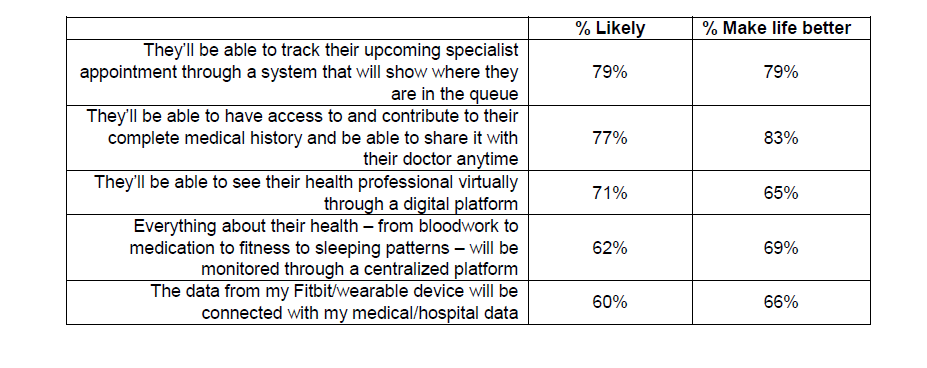
Canadians also recognize the role Artificial Intelligence (AI) can play in the future of health care. Nearly six in ten (58%) think it is likely that in the next 10 years Artificial Intelligence (AI) programs or robots will be able to provide real health care services, such as robot assisted surgery, early diagnosis, etc. and over half (55%) think it is likely that AI programs will able to accurately diagnosis various diseases and conditions. Over two-thirds believe these advancements in AI technology will have a positive impact on their lives (69% accurately diagnosis diseases/conditions, 67% provide real health care services).
The Future of Virtual Care
Canadians are ready for a more connected approach to health care. A majority of Canadians are interested in virtual care, with roughly two-thirds interested in consulting with various health care providers through a virtual platform – pharmacists (68% very/somewhat interested), any physician (67% very/somewhat interested), their physician (66% very/somewhat interested). While younger Canadians show greater interest, six in ten of Canadians 55+ are interested:

Over half (54%) believe virtual care is a step in the right direction for the health care system, which is double that of those who believe it is a step in the wrong direction (23%) – a quarter (24%) said they don’t know. A majority of Canadians believe that virtual care will: improve access (73%), lead to more timely care (71%) and lead to better overall health care (63%). Two-thirds (67%) also believe it is more convenient than visiting in person. While there is much optimism around virtual care, Canadians are concerned about losing the human connection of health care (77% agree), privacy risks (75%) and opening the door to private health care (71%).
While the interest in virtual care is there, a majority of Canadians (72%) believe the country has been slow to adopt virtual care and eight in ten (77%) believe governments are not prepared to fund access through virtual care. However, there is a belief that it is not just governments slowing adoption, as many believe both physicians (70%) and patients (68%) are not ready for virtual care. This slow adoption is reflected in the very low number of Canadians utilizing virtual care as only 1% of Canadians say they have or are consulting with health care professionals through virtual platforms.
The Demand for Connected Patient Portals
While Canadians are waiting for the benefits of virtual care to arrive, it seems they are also ready for connected patient portals and it seems to matter little whether these are offered by our public health system, or private companies the like of Google or Apple. Over eight in ten (84%) Canadians are interested in the ability to access all their health information from one platform, including four in ten (42%) who are very interested – with no differences across generations, further suggesting this is something Canadians of all ages want and are ready for.
Close to half of Canadians are also willing to both input their health data into a program like Google, Alexa, Siri, etc. to have it shared with their health care provider to report any issues (46% very/somewhat willing), and to allow such a program to track and monitor their health (44% very/somewhat willing). Willingness jumps to nearly six in ten among those under 35 to input their data (58% vs. 48% 35-54, 36% 55+) and to allow a program to track and monitor their health (57% vs. 46% 35-54, 33% 55+).
Furthermore, four in ten (43%) Canadians would subscribe to a paid virtual service offered by a private company like Google or Apple that offered 24-7 access to their family physician or a group of health professionals they had experience with. Over half of those 18-34 say they would subscribe to such a service (55% vs. 45% 35-54, 31% 55+). A third (34%) say they’d subscribe to such a service if it offered access to a range of licensed health professionals and continuous monitoring of their health through a wearable device. Again, younger Canadians are the most likely to say they’d subscribe, with half saying they would (49% 18-34 vs. 34% 35-54, 25% 55+).
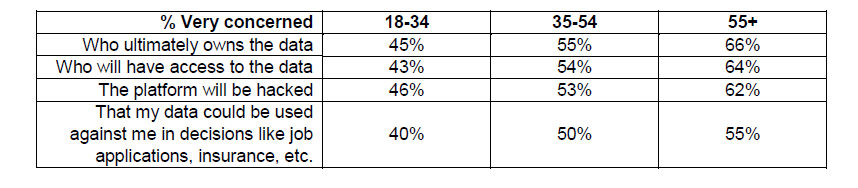
This openness to more connected health care comes with concerns, as the majority of Canadians express angst over who will have access to their data (87% concerned – 55% very concerned/32% somewhat concerned), who ultimately owns it (85% concerned – 56% very concerned/29% somewhat concerned), that the platform will be hacked (85% concerned – 54% very concerned/31% somewhat concerned), and that it could be used against them in decisions like job applications and insurance (82% concerned – 49% very concerned/33% somewhat concerned). These concerns increase with age, with Canadians 55+ expressing the most concern:
Canadians want control over their personal health data and believe they should get to approve who receives access to their health data (95% agree – 73% strongly agree/22% somewhat agree), and that they, not the government or technology platforms, own their health data (91% agree – 62% strongly agree/29% somewhat agree).
About the Study
These are some of the findings of an Ipsos poll conducted between June 26th and July 2nd, 2019, on behalf of the Canadian Medical Association (CMA). For this survey, a sample of 2,005 Canadians aged 18+ were interviewed. Weighting was then employed to balance demographics to ensure that the sample's composition reflects that of the adult population according to Census data and to provide results intended to approximate the sample universe. The precision of Ipsos online polls is measured using a credibility interval. In this case, the poll is accurate to within ±2.5 percentage points, 19 times out of 20, had all Canadians aged 18+ been polled. The credibility interval will be wider among subsets of the population. All sample surveys and polls may be subject to other sources of error, including, but not limited to coverage error, and measurement error.
For more information on this Factum, please contact:
Sean Simpson
Vice President, Canada, Ipsos Public Affairs
+1 416 324 2002
About Ipsos
Ipsos is the world’s third largest market research company, present in 90 markets and employing more than 18,000 people.
Our passionately curious research professionals, analysts and scientists have built unique multi-specialist capabilities that provide true understanding and powerful insights into the actions, opinions and motivations of citizens, consumers, patients, customers or employees. We serve more than 5000 clients across the world with 75 business solutions.
Founded in France in 1975, Ipsos is listed on the Euronext Paris since July 1st, 1999. The company is part of the SBF 120 and the Mid-60 index and is eligible for the Deferred Settlement Service (SRD).
ISIN code FR0000073298, Reuters ISOS.PA, Bloomberg IPS:FP
www.ipsos.com