Canadians and Americans Already Feeling the Pinch of Inflation
Toronto, ON, December 14, 2021 – Many pundits and economists exalted that we would experience the roaring 20s once we got the pandemic under control. Month after month, prognostications were that consumer spending was about to take off. But spending has remained volatile and inconsistent.
No wonder. Our “Ipsos Context” tracking has shown that during the pandemic, up until now, what Canadians said they were experiencing and thinking was not as rosy as some pundits and experts were saying (or hoping).
Compounding this, moving into 2022 is increasing concern about inflation/interest rates. While there is a debate about whether the significant uptick in the inflation rate is short or longer-term, the rubber actually hits the road based on what citizens/consumers think. Historically, increasing inflation has always put a damper on consumer behaviour.
Specifically from among 20 issues, our recent polling shows that concern about inflation/interest rates has increased significantly over the last 6 months in both the US and Canada. It has jumped 6 percentage points in Canada, and 9 percentage points in the US.
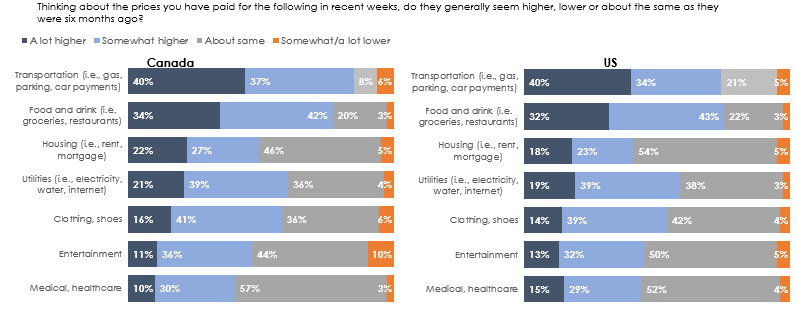
No surprise as Canadians and Americans say that they are already paying more for the products and services they use. In both Canada and the US, this is most pronounced in spending on transportation and food/drink but extends throughout the spending categories.
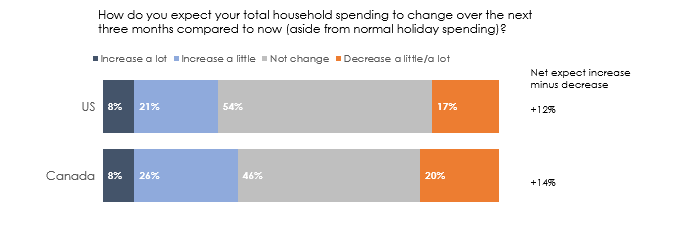
Furthermore, many Americans (29%) and Canadians (34%) expect to experience increases in their household spending over the next three months, led by men and younger citizens/consumers. And in Canada, at the very least, this expectation will be met on food/drink since Canada’s Food Price Guide estimates that food price inflation is likely to increase by 5-7% in 2022 (or an extra $1,000 per family on their grocery bill).
Compounding all of this, our ongoing Context tracking shows that overall financial health is an increasing challenge in Canada, less so in the US. The -8% rating in Canada means that more Canadians are negative than positive on their financial health (down from -2% in September 2021). The situation in the US is more positive and steady (+14%).
The bottom line is that while concern about inflation has not (yet) reached a fever pitch it is increasing among Canadians and Americans. And citizens/consumers report that they are already experiencing its effects and many expect this to continue into the future. If, as many project, inflation will take a stronger hold in 2022, citizens/consumers will necessarily reign in their purchasing behaviour and increasingly demand that government and businesses act.
About the Study
These are the results of a 30-country survey conducted by Ipsos on its Global Advisor online platform. Ipsos interviewed a total of 20,504 adults aged 18-74 in the United States, Canada, Malaysia, South Africa, and Turkey, 21-74 in Singapore, and 16-74 in 25 other countries, between November 19 and December 3, 2021.
The sample consists of approximately 1,000 individuals in each of Australia, Brazil, Canada, mainland China, France, Germany, Great Britain, Italy, Japan, Spain, and the U.S., and 500 individuals in each of Argentina, Belgium, Chile, Colombia, Hungary, India, Malaysia, Mexico, the Netherlands, Peru, Poland, Romania, Russia, Saudi Arabia, Singapore, South Africa, South Korea, Sweden, and Turkey.
The samples in Argentina, Australia, Belgium, Canada, France, Germany, Great Britain, Hungary, Italy, Japan, the Netherlands, Poland, South Korea, Spain, Sweden, and the U.S. can be taken as representative of these countries’ general adult population under the age of 75.
The samples in Brazil, Chile, mainland China, Colombia, India, Malaysia, Mexico, Peru, Romania, Russia, Saudi Arabia, Singapore South Africa, and Turkey are more urban, more educated, and/or more affluent than the general population. The survey results for these countries should be viewed as reflecting the views of the more “connected” segment of their population.
The data is weighted so that each country’s sample composition best reflects the demographic profile of the adult population according to the most recent census data.
The “Global Country Average” reflects the average results for all the countries where the survey was conducted. It has not been adjusted to the population size of each country and is not intended to suggest a total result.
Where results do not sum to 100 or the ‘difference’ appears to be +/-1 more/less than the actual, this may be due to rounding, multiple responses, or the exclusion of “don't know,” or not-stated responses.
The precision of Ipsos online polls is calculated using a credibility interval with a poll of 1,000 accurate to +/- 3.5 percentage points and of 500 accurate to +/- 5.0 percentage points. For more information on the Ipsos use of credibility intervals, please visit the Ipsos website.
The publication of these findings abides by local rules and regulations.
For more information on this news release, please contact:
Sanyam Sethi
Vice President, Ipsos Public Affairs
[email protected]
About Ipsos
Ipsos is the world’s third largest market research company, present in 90 markets and employing more than 18,000 people.
Our passionately curious research professionals, analysts and scientists have built unique multi-specialist capabilities that provide true understanding and powerful insights into the actions, opinions and motivations of citizens, consumers, patients, customers or employees. We serve more than 5000 clients across the world with 75 business solutions.
Founded in France in 1975, Ipsos is listed on the Euronext Paris since July 1st, 1999. The company is part of the SBF 120 and the Mid-60 index and is eligible for the Deferred Settlement Service (SRD).
ISIN code FR0000073298, Reuters ISOS.PA, Bloomberg IPS:FP