Almost 7 in 10 Indians satisfied with country’s infrastructure
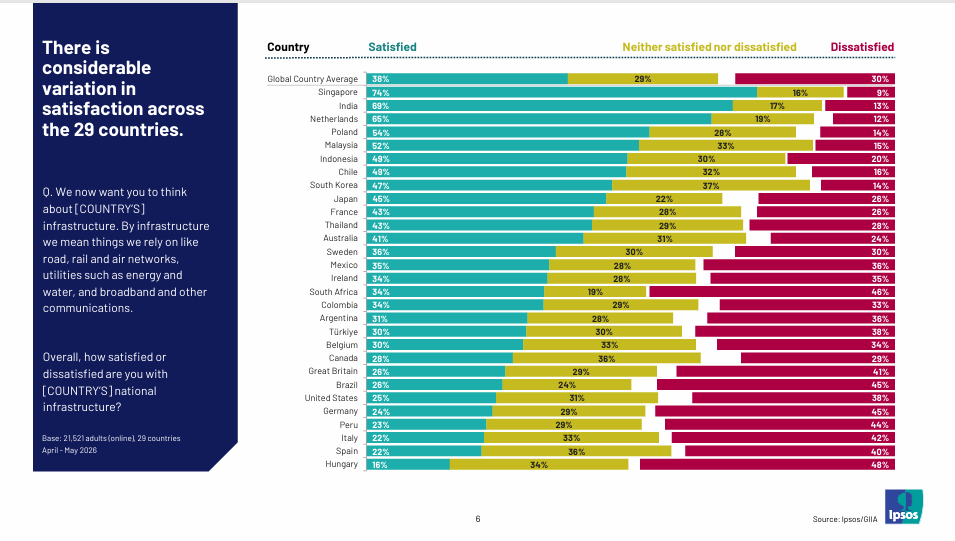
69% of Indians polled claim to be satisfied with India’s infrastructure, placing India 2nd in pecking order after Singapore (74%) on infra satisfaction. The latest Ipsos Global Infrastructure Index 2026 suggests public priorities are evolving.
Water supply and sewerage infrastructure (54%) and solar energy infrastructure (54%) emerge as the country's top investment priorities, followed by EV charging infrastructure (44%), local roads (44%), digital infrastructure including broadband, 5G and data centres (43%), rail infrastructure (40%) and nuclear energy infrastructure (33%).
These are the findings of the Ipsos-GIIA Global Infrastructure Index 2026 and point to a notable shift in public thinking. Infrastructure is no longer viewed solely through the lens of physical connectivity. Increasingly, citizens are prioritising systems that support resource security, clean energy, technological advancement and long-term resilience.
For much of the past two decades, India's infrastructure story has been defined by roads, airports, metro systems and bridges.
Indians continue to support infrastructure investment, but increasingly favour investments that strengthen water security, energy transition and digital capability.
And one of the study's clearest findings is the growing alignment between citizen expectations and India's development agenda.
Areas attracting the strongest public support, including renewable energy, EV infrastructure, digital connectivity, data centres and modern utility networks, are also central to the country's long-term growth strategy.
Rather than calling for a different infrastructure roadmap, Indians appear to be endorsing the direction in which the country is already moving.
Infrastructure Is Seen as an Economic Multiplier
Infrastructure is also increasingly viewed as an economic investment rather than simply a public expenditure.
More than four in five Indians (81%) believe infrastructure investment creates jobs and boosts economic growth, while 64% support higher infrastructure spending even if it results in increased costs or taxes.
At the same time, 61% say India is still not investing enough to meet its infrastructure needs.
Together, the findings indicate strong public support for accelerating infrastructure development as a driver of growth, competitiveness and investment.
Growth and Sustainability are No Longer Viewed as Trade-Offs
Indians increasingly associate infrastructure development with climate action.
Three-quarters (75%) believe infrastructure investment can play an important role in tackling climate change, reflecting strong support for clean energy and low-carbon infrastructure.
However, 63% believe the country's infrastructure is not yet sufficiently adapted to future climate risks, highlighting expectations that future investments must be designed with resilience in mind.
Build New. Maintain & Repair Existing
While citizens support new projects, they are equally focused on preserving existing assets.
Nearly eight in ten Indians (79%) agree that maintaining and repairing infrastructure is as important as building new infrastructure.
As India's infrastructure network expands, public expectations are shifting from asset creation alone to long-term performance, reliability and value.
The Ipsos Global Infrastructure Index 2026 shows that Indians are embracing a broader view of infrastructure.
Water systems, clean energy, EV networks and digital infrastructure now sit alongside roads and rail as critical enablers of national development.
The findings suggest that the next phase of India's infrastructure story will be defined not just by connectivity, but by resilience, sustainability and future economic readiness.
Suresh Ramalingam, CEO, Ipsos India said, “What stands out is how closely citizens' priorities align with India's long-term development agenda. The strongest support is for investments in water infrastructure, clean energy and digital infrastructure, areas that are increasingly shaping the country's future growth trajectory. Indians clearly see infrastructure as an economic enabler. They recognise its role in creating jobs, attracting investment, enabling new industries and strengthening India's competitiveness. The findings also show that citizens are thinking beyond today's needs. They expect infrastructure that supports energy transition, withstands climate pressures and prepares the economy for the opportunities of the next decade."
"Importantly, they are not asking policymakers to choose between building new assets and maintaining existing ones. They expect both."
Methodology
These are the findings of the Ipsos Global Infrastructure Index 2026, conducted across 29 countries between 24 April and 8 May 2026 on the Ipsos Global Advisor online platform. The study interviewed 21,521 adults globally, including approximately The survey explores public attitudes toward infrastructure satisfaction, investment priorities, delivery, funding and future needs. In India, results are representative of the country's more connected, urban and educated population segments.