

Canada: A Stressed Nation Needs to Take the Summer Off
Its mid-summer in Canada and Canadians are trying to focus on baseball, backyards and the warm outdoors. In doing so they’ll look to disconnect from politics, from the economy, and from the relentless stream of news that has dominated the first half of 2026. The surprising thing is that many appear to need a break more today than they did during the first summer of COVID. Looking back on the early days of 2020 shows us that Canadians are emotionally more challenged today than they were at the peak of the pandemic uncertainty.
It won’t be easy disconnecting today because Canadians will still be confronted by the high cost of living whether they are hosting a barbecue for neighbours or filling up the car for a weekend getaway to a friend's cottage. Added to this is a Prime Minister who seems to have found another gear when it comes to announcements and deal-making. But one would think today’s busy environment is less stressful than the early months of 2020 and the social and economic limbo that we faced due to the pandemic.
In July 2020, Canadians had been living with COVID-19 for just over three months. We were isolated from friends and family. Millions were adapting to working from home. Essential workers were navigating daily life behind masks and physical distancing measures. A vaccine remained a distant hope, and the economy was entering one of the sharpest contractions in modern history.
Yet when we compare how Canadians described their emotional state then with how they describe it today, the results are striking.
The decline in Canadians' sense of being well-prepared may be the most surprising finding in our research. At a time when we had no vaccine, limited information and no clear path forward, Canadians actually felt better equipped to face the future than they do today.
We are also just as lonely today as we were during the isolation of 2020. Despite the return of workplaces, social gatherings and everyday routines, feelings of connection have not meaningfully recovered. Levels of frustration remain remarkably similar as well. Canadians are now more likely to describe themselves as defeated and skeptical than they were during those early pandemic months. Admittedly, Canadians were more bored in 2020 than they are today. Given the pace of the 2026 news cycle, many would probably welcome a few boring days this summer.
The picture that emerges is not simply one of economic anxiety. It is one of cumulative exhaustion.
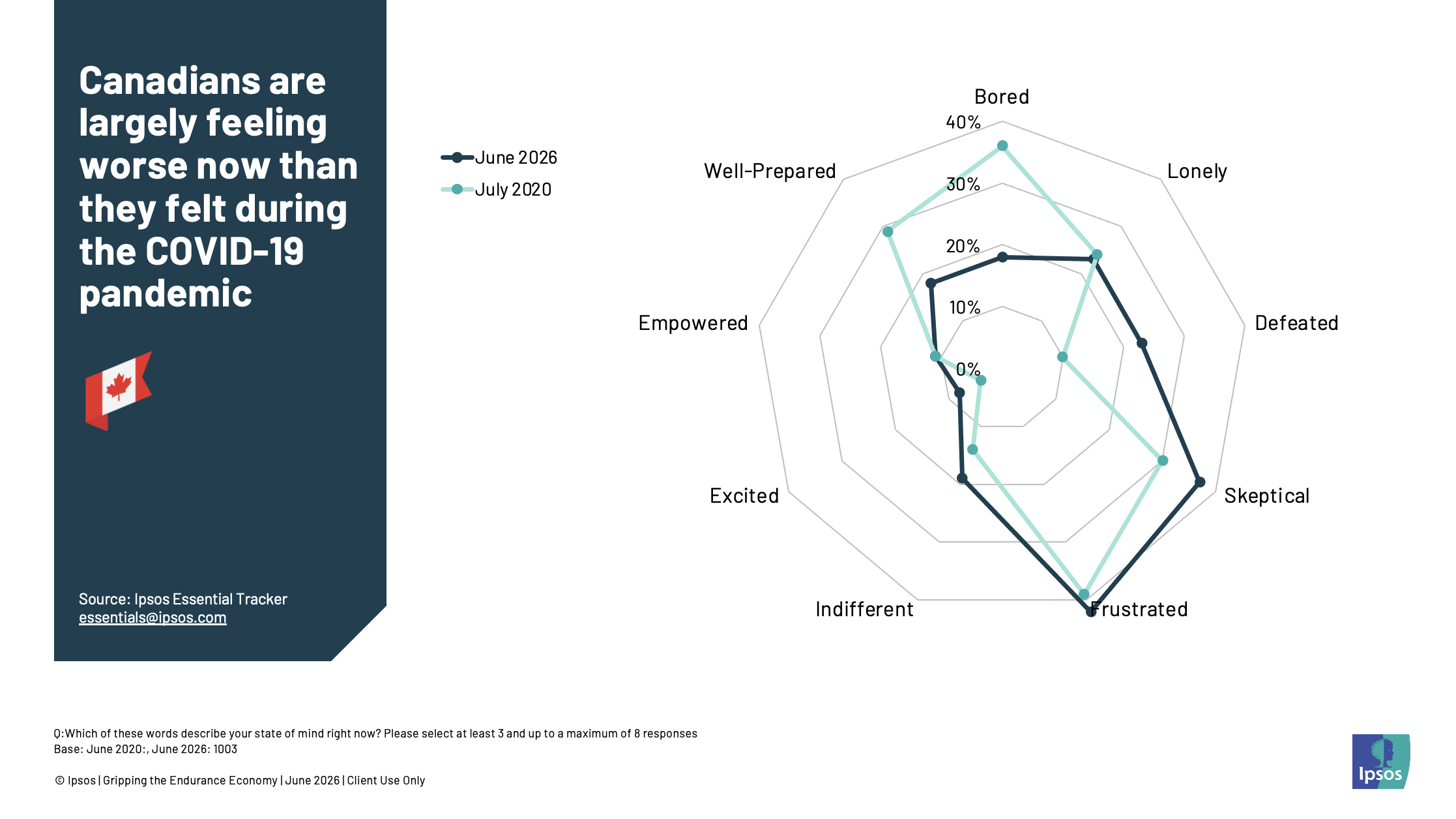
The comparison is both surprising and unsettling. Looking back, Canadians appeared more emotionally resilient in July 2020 than they do today.
So, what explains this shift?
Part of the answer lies in the nature of the challenges we face. COVID-19 was a crisis. It was severe, disruptive and frightening, but it was still a singular event (with many implications) and viewed as temporary, although the end date was unknown. Canadians could imagine an eventual resolution, even if they could not predict exactly when it would arrive.
Today's pressures feel fundamentally different. They are not events. They are structural conditions and there are many of them.
Housing affordability, productivity, geopolitical instability, demographic change, climate adaptation and global trade tensions are increasingly viewed as structural realities rather than temporary disruptions. Even when progress occurs, few Canadians believe these issues are close to being resolved.
Crises demand resilience. Structural problems demand endurance.
Canadians have now spent years adapting to overlapping pressures that rarely disappear before the next one arrives. The challenge is no longer simply enduring one crisis after another. It is sustaining that endurance without a clear sense that conditions are improving. It is the accumulation, not any single issue, which appears to be wearing people down.
Wars in Ukraine and the Middle East continue with no obvious endpoint. Affordability challenges remain intertwined with everything from demographics and housing supply to energy infrastructure, public finances and economic productivity. Despite growing urgency around the need to build, invest and modernize, few of these challenges come with
a clearly visible finish line.
The cumulative effect and the uncertain ending of these combined challenges show up in how Canadians are feeling in 2026 vs 2020.
This may explain why so many Canadians feel emotionally adrift. It is difficult to make long-term plans when the environment feels permanently unsettled and the rules themselves appear to be changing.
As we have outlined in our Endurance Economy work, people are no longer waiting for conditions to return to normal. Increasingly, they are adapting to the possibility that current conditions are the new normal.
Economic renewal remains essential. Higher productivity, stronger investment and a more competitive economy would meaningfully improve Canadians' lives. But economic improvement alone will not be enough. The challenge facing Canada is now both financial and emotional.
A population that spends years feeling defeated, disconnected and unable to influence its future eventually internalizes those feelings. Moods become mindsets. Mindsets become behaviours.
Canada's next challenge may not simply be rebuilding productivity or restoring growth. It may be rebuilding confidence that tomorrow can be meaningfully better than today.
Economies recover through investment and innovation. Nations recover when people once again believe that effort will be rewarded, that hard work will lead somewhere, and that the future is worth planning for.
Rebuilding prosperity matters. Rebuilding confidence may matter even more.


![[WEBINAR] KEYS: Ipsos Global Trends](/sites/default/files/styles/list_item_image/public/ct/event/2026-09/thumbnail-keys-0924_2.png?itok=oLb0FTuT)
![[WEBINAR] Ipsos Reputation Council 2026: Life After Predictability](/sites/default/files/styles/list_item_image/public/ct/event/2026-09/thumbnail-templates%20demo_1.png?itok=wgA7L90n)