
Finding the Colour in Grey Matter
Is this ad going to be a success? Indeed, it's a question every marketer and advertiser would like to know the answer to - and before they spend significant ad dollars. While we don't have a crystal ball to magically reveal this, we do have more advanced research solutions to guide us in predicting how an ad will perform. With a bevy of new tools out there, choosing the right one can be a bit tricky. Here are three popular neuroscience approaches that can help you uncover those advertising gems.
Facial Coding
Facial coding uses webcams to record facial expressions while consumers are exposed to stimuli. As webcams have become commonplace, this method has become especially easy to implement. There is no special equipment needed, making it very cost effective and quick to turn around. The output is also quite intuitive and can be easily integrated into traditional online survey research techniques.
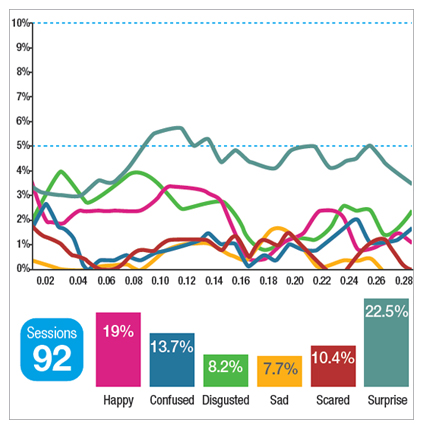
Facial coding measures engagement using both valence (direction) and specific emotions (happiness, sadness, confusion, disgust, fear, surprise). This adds a valuable layer of understanding to survey based research by providing a scene-by-scene evaluation of your creative that helps "explain" the survey data. The scalability and cost effectiveness of facial coding means this is an ideal method to quickly and easily add to your existing testing program and give you valuable insight into your creative development.
Ipsos recently used facial coding to provide important insight to a major global Olympics advertiser - emotional response was low across the board for one of their important equity spots and in fact surprisingly, negativity levels were higher than happiness as the prominent emotion. This helped explain a low level of recall in-market for the ad.
Implicit Reaction Time (IRT)
Implicit testing measures the associations that exist in your brain. It goes beyond stated responses to measure the strength of association. Implicit tests are conducted online using special software, but can be housed within traditional online survey environments.
One challenge with IRT is that it can add to study length when done in conjunction with traditional studies. That said, it can add valuable insight on brand impact measurement, is intuitive in its analysis and is scalable and cost effective.
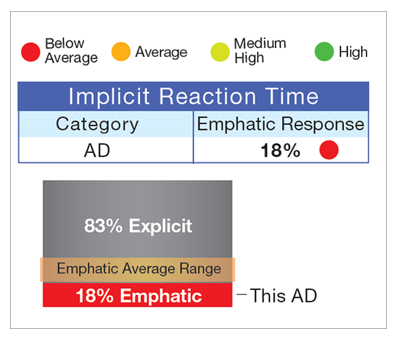
In a recent client study, Ipsos was able to identify a significant branding issue for a client and their advertising using IRT. While most respondents did identify the advertising sponsor, IRT showed that not many were very confident of who the ad sponsor was. The low level of emphatic response highlighted an important opportunity for the client that was masked by the survey response. A low level of emphatic brand identification leaves the door open to potential misattribution to competitive brands.
Biometrics
Of the three approaches discussed here, biometrics is the most expensive and difficult to roll out. Participants wear a Biometric Monitoring Belt to passively monitor their moment-to-moment emotional engagement, while also having their eye gaze passively monitored by a kiosk-mounted eye tracker. The approach is quite intrusive and requires a significant amount of hardware and set up, and as such is an expensive and time-consuming approach.
Biometrics and facial coding work similarly to provide readings of engagement based on deep-seated feelings and can outline areas of strength and weakness for an ad. The key differences between the two methodologies relate to scalability:
- Biometrics requires a field team and a central location (i.e., a mall)
- The cost of biometric belts can be prohibitively expensive, depending on the scope of the study
- Facial coding can be conducted in the comfort of a consumers home but requires the consumer to have a webcam
While biometrics can provide some interesting insights, we have found that whether or not you use it will depend on the level of insight required, budget and timelines. Typically, as market research budgets are under pressure in this day and age, there has been less demand for this relatively expensive and onerous approach.
Final thoughts
Neuroscience can help create effective ads by tapping into consumers' subconscious. However, it can't replace the traditional quantitative survey for many other measures of an ad's performance, including claimed behavior and open-ended responses. So while many of us might want that elusive "silver bullet" that will cheaply, quickly and effectively tell us if our ad is a success, neuroscience is no closer to delivering. But it does provide colourful insights that can boost the likelihood of creating a winning ad.
![[WEBINAR] Creativity Over Clicks: Insights from our Retail Media Report](/sites/default/files/styles/list_item_image/public/ct/event/2026-09/thumbnail-retail-media2.png?itok=xd9egZ8b)
![[WEBINAR] Beyond the Screen: Authenticity Among Social Media Influencers](/sites/default/files/styles/list_item_image/public/ct/event/2026-07/thumbnail-beyond-screen.png?itok=5y8XXamB)
![[WEBINAR] How Visible is Your Brand on ChatGPT, Gemini, and Claude?](/sites/default/files/styles/list_item_image/public/ct/event/2026-07/thumbnail-AI-Visibility-Webinar.png?itok=B_4Kumgd)