
One Track Minded: Neuroscience in Advertising Measurement
These days, with new research methodologies popping up at a rapid pace, it's clear that our industry is transforming faster than we've ever seen before. Neuroscience is one area that has rightly garnered a lot of attention, with methods such as EEG, fMRI, eye tracking, implicit response time (IRT), and facial coding occupying an ever-increasing space in many researchers' toolkits. Aficionados of such techniques boast the ability to delve into the subconscious of consumers, revealing what they truly want, even when they don't know themselves. Because of this, many are deviating away from traditional methodologies such as focus groups and surveys.
This is where many researchers can go wrong. Too often, we see that new tools get more interest over the tried and true. People often want to believe that science-based measurement is somehow better than the older paradigm of survey-based market research. The thinking goes, if you place EEG monitors on a respondent's head, you will somehow learn more about how an advertisement will perform than if you constructed a survey to measure its impact. But this isn't always the case. Neuroscience, while no doubt effective, is not a panacea for all research questions. The issue is not about supplanting other techniques, but rather complementing them for greater learning.
There's no question that science has advanced our understanding of how advertising works. We know more about cognitive psychology, neuroscience, and behavioural economics than we ever have in the past. But, to get the most value out of your research investments, neuroscience should ideally be used in conjunction with traditional methodologies.
At Ipsos, we see the value of and continue to strongly invest in neuroscience for measuring advertising research, but we also acknowledge the limitation of these new tools and frequently recommend supplementing their use with other techniques to offer clients and agencies a holistic understanding of creative ad performance. Our team of advertising research experts understands that there is both an art and a science to measurement, and we deploy a mixture of tools based on the needs of our clients.
The ability to diagnose the performance of an ad means choosing the right tools, but one must not overlook that it also requires the right person to interpret the data. Think, for instance, of a sculpture artist. You could put the most advanced tools to carve a sculpture in the hands of a novice, but the outcome of that experiment would likely be a rounded piece of rock. In the hands of Michelangelo, you will likely come out with a magnificent piece of work. At Ipsos, we have both the right tools, but as importantly, the right "artists" available at your disposal to help interpret the data in a way that ensures a client gets the most out of their advertising dollar.
To demonstrate the value that neuroscience can offer for evaluating advertisements, I'd like to highlight a study recently conducted by Ipsos ASI and the Neuro & Behavioral Science Centre.
In our study, we examined engagement levels for various Super Bowl ads. Our researchers utilized facial coding technology to measure the second-by-second unconscious emotional response of 1400 consumers, who watched the ads in real time "while the technology watched them." The measures included Overall Emotional Engagement and incidence of six discreet emotions, as well as positive and negative emotion for all 86 of the 2015 Super Bowl ads. We discovered that if a Super Bowl advertiser can engage the public in the last five seconds of the spot, with its brand immersed in the warm glow of positive emotion, that's when the ultimate branding payoff occurs.
According to the study, here are the Super Bowl commercials that were best at generating Emotional Engagement in the critical last five seconds as well as Overall Ad Engagement.
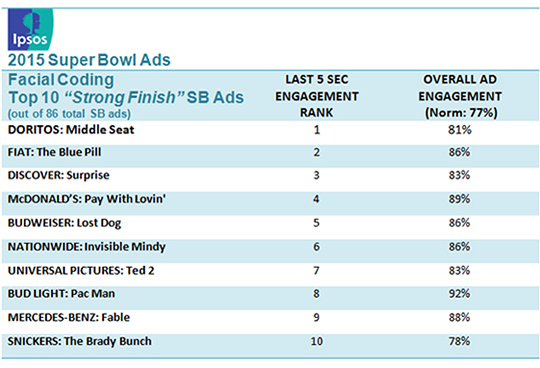
The study reveals that the ads registering the most positive emotional response during the brand payoff are also extremely high (above norm) on overall emotional engagement.
Below are examples of how two of the top 2015 Super Bowl performers elicited Emotional Engagement throughout the ads and especially during the final branding moments.
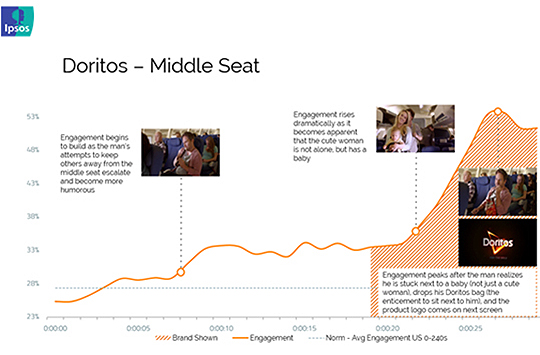
Example 1: DORITOS "Middle Seat"
The Doritos "Middle Seat" ad has only a slow steady upward engagement trend, but then pays off with a jolt in the final seconds during the story climax. Engagement in the most important last third of the ad starts to swiftly accelerate as the joke is paid off and the Doritos brand is relevantly positioned to leave a lasting positive impression.
Example 2: NATIONWIDE "Invisible Mindy Kaling"
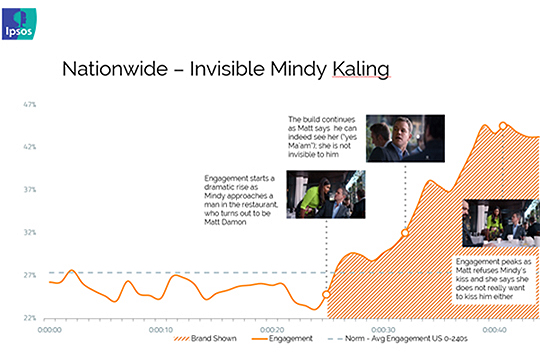
Engagement for Nationwide's "Invisible Mindy Kaling" essentially meanders in the first half of the ad (could be better) but picks up serious emotional momentum in the second half of the ad, as viewers watch Mindy approach star actor Matt Damon. Engagement skyrockets as the two characters interact. The playfulness of the two celebrities results in Engagement peaking sharply in the last 5 seconds of the spot reaching a strong apex for the finale.
For the 2015 Super Bowl, not only did the best ads provide great entertainment and for some, a few good laughs, but they were also able to engage the audience early, sustain that engagement and end on an emotional high note supporting the ultimate brand impression. There are many criteria by which the industry judges each year's Super Bowl ads ranging from personal opinion to various data schemes. But according to Ipsos ASI, to be able to grab the audience's attention and especially to heighten that attention for the most defining final brand shot in those crucial last five seconds is a sure way for a client to know they got their Super Bowl money's worth.
Final thoughts
Neuroscience can add immense value in understanding what makes an ad successful. As seen in this case study, facial coding technology was leveraged to answer many questions about the levels of emotional engagement. However, it cannot answer why they feel they were engaged in the same way than an open-ended question can. This is why we have to make sure that we take a considered approach when using new research methodologies to yield better insights.
![[WEBINAR] When Consumers Ask AI, Does Your Brand Show Up?](/sites/default/files/styles/list_item_image/public/ct/event/2026-10/thumbnail-ai-does-your-brand-show.png?itok=PTvURsC2)
![[WEBINAR] Creativity Over Clicks: Insights from our Retail Media Report](/sites/default/files/styles/list_item_image/public/ct/event/2026-09/thumbnail-retail-media2.png?itok=xd9egZ8b)
