
Why Emotions Matter in Advertising
Defining Emotional Advertising
There was a lot of debate about the importance of emotional advertising in the zeitgeist-fuelled world of adland last year. Creative agencies searched for it, some clients yearned for it, and researchers naturally felt that they had the best way to evaluate it.
But we should remember that the concept of `emotional advertising' has multiple meanings and definitions in our marketing communication world. Before you start asking whether you truly have an `emotional' campaign, you will possibly save yourself some time by agreeing what you are talking about. Do you mean `system 1' or `system 2', engagement, valance, resonance, physiological reactions, emotional priming or emotional brand building, or all of the above?
We consider all of these concepts when we evaluate a campaign. But we should remember that an emotional ad isn't one we classify as such, it is one people have an emotional response to. That should be the final arbiter of success or failure when judging creative work's ability to deliver those elusive and much sought after emotional reactions.
Opposing camps? Emotional vs Rational
So how did the debate play out this year? Well, we are talking about advertising here, which of course gives us license to use metaphor, exaggeration and hype, in order to emphasize a point. So let us imagine two camps entering the emotional battleground, both fuelled by the self-righteous confidence that they are following a path to success.
Camp one is all about the emotions. They will tend to be more concerned with the creative and how it makes people feel. They've read the books (or someone has told them about the books at least), and can quote evolutionary psychology and the work of Daniel Kahnemann. They are all well versed in the received wisdom around how advertising works these days.
For this group it really is just a case of be emotional and let the ROI come rolling in...
Camp two, by contrast, is more rational, has some sales targets and need to hit them, and need to hit them now. This means that they need to sell stuff. That stuff is their product, therefore they would like to see their product in their advertising. They want to show how it works, what it does and why it might be useful to people who want to buy it. Their product is the most interesting thing in the world, so why wouldn't people willingly drop everything they are doing and spare some valuable time learning about what their product or service does?
The Long and Short of It
So how to reconcile these seemingly diametrically opposing factions? The answer is to avoid the conjecture, opinion and hype and seek fact based truth. Les Binet and Peter Field's comprehensive interrogation of the IPA Effectiveness Awards, `The Long and the Short of it', provides that truth.
Through meta-analysis of the short and long-term effects of all the hundreds of campaigns contained within the database, they are able to prove that rational messaging is great at delivering short-term effects. Fine, but this impact comes and goes without delivering more sustained effects that benefit the brand in the longer term. Conversely, emotional campaigns often take a while to have as big an impact, but work to the brand's benefit in the long run via `emotional priming'.
The authors also demonstrate that while most campaigns use both rational and emotional approaches, those campaigns with a primary focus on emotional are more effective across all metrics.
So it seems that the `emotional' camp wins? Not quite. There is a watch out. If you are going with an `emotional priming' campaign, you need to have a good activation strategy running alongside to deliver your sales targets. This keeps the wolves from your door until the long-term effect comes through (and keeps the `rational' camp happy).
Emotional Winners
So if emotional campaigns are the key to long-term profitability, how do we measure them so that we know people have genuinely experienced a strong emotional response? Remember, the response should be the ultimate definition of whether a campaign is emotional or not!
Throughout 2014 we evaluated campaigns that truly hit the emotional high spots, using measures that are designed to evaluate this aspect more sensitively than traditional measures of recall and persuasion. These range from classic diagnostics that reflect personal resonance, distinctiveness and entertainment, to looking at subtle shifts in brand closeness by observing and deriving campaign impacts using test and control designs.
We also employ facial coding techniques to understand an individual's instinctive `emotional journey' as they go through an ad or a piece of branded video content. A participant views a piece of video, and as they do so we record their micro expressions through a webcam. We put this through an algorithm and it gives us six emotions: happiness, surprise, confused, scared, disgusted and sad. When we bring these together we get a measure of emotional engagement with the ad.
Case study: Emotional Involvement - Apple
Last year's iPhone 5s campaign was a great example of `emotional involvement'. This genre of advertising works by touching emotions or feelings in people and/ or by being well liked. It is looking to generate emotional engagement with the campaign so that positive image and associations are transferred across to the brand. Of course, there is a long purchase cycle on mobile phones for most of us, normally a year, sometimes longer. The primary role for this advertising is to warm people up to the brand and therefore it is crucial that this campaign achieves a positive emotional response.
Looking at the ongoing level of emotional engagement throughout the ad from our facial coding data, we see that if we refine the results down to the people for whom this story is most personally relevant (Parents!), a much bigger spike of engagement is evident at the beginning. It just keeps developing as the ad continues amongst those fortunate enough to have experienced at first hand the joys of parenthood.
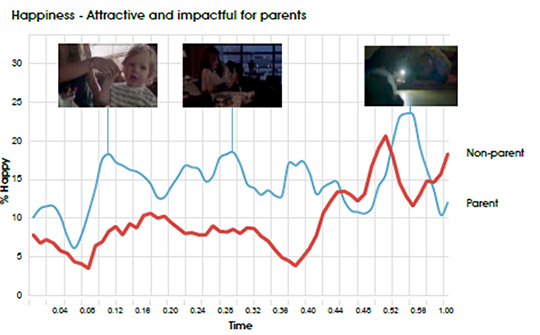
This demonstrates that when we are trying to pull on heartstrings, it is important that we connect the brand to the things the target audience really care about in their life. Given this sustained emotional engagement journey, it is no surprise that for parents the campaign achieved a 16% uplift in consideration for the brand over and above a control cell that was not exposed to the advertising.
This case study highlights why emotions matter. People don't care that much about most brands, so powerful high quality creative, that elicits a genuine emotional response will help overcome that indifference. Making the brand distinctive, delivering impressive outcomes for your business.
To view a detailed version of this article with several additional case studies, visit this link.
![[WEBINAR] Creativity Over Clicks: Insights from our Retail Media Report](/sites/default/files/styles/list_item_image/public/ct/event/2026-09/thumbnail-retail-media2.png?itok=xd9egZ8b)
![[WEBINAR] Beyond the Screen: Authenticity Among Social Media Influencers](/sites/default/files/styles/list_item_image/public/ct/event/2026-07/thumbnail-beyond-screen.png?itok=5y8XXamB)
![[WEBINAR] How Visible is Your Brand on ChatGPT, Gemini, and Claude?](/sites/default/files/styles/list_item_image/public/ct/event/2026-07/thumbnail-AI-Visibility-Webinar.png?itok=B_4Kumgd)