
Let's Talk About Mental Health
A new Ipsos Public Affairs poll conducted in April 2015 in support of Mental Health Week (n=2,010, nationally representative adults, online) suggests that Canadians are wearing rose-coloured glasses when they are assessing their mental health.
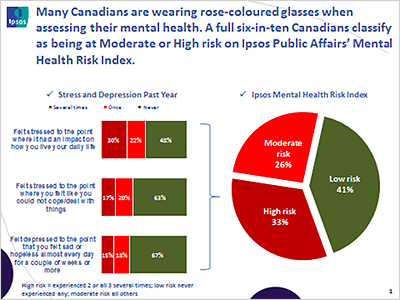
While nine in ten (90%) Canadians describe their personal mental health as being excellent (35%), very good (35%) or good (20%), a Mental Health Risk Index created by Ipsos shows that a full one in three (33%) Canadians classify as being "high risk" for mental health issues, and another 26% are at "moderate risk."
The Ipsos Mental Health Risk Index was created by understanding Canadians' experiences concerning stress and depression over the last year. Perhaps most seriously, 32% of Canadians reported feeling depressed (at least once) to the point that they felt sad or hopeless almost every day for a couple weeks or more. When it comes to feeling stressed to the point where it has an impact on how they live their daily life, 52% of Canadians said this happened to them at least once. Over a third (37%) of Canadians reached a point at least once in the past year where they felt they could not cope or deal with things.
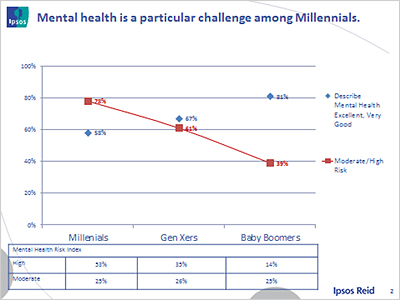
The most startling finding is generational: a majority (53%) of Millennials (aged 18 to 34) classify as being "high risk," compared to 35% of Gen Xers (aged 35 to 54), and 14% of Baby Boomers (aged 55+).
Other demographic differences include: women, who are 35% more likely than men (30%) to classify as "high risk," as are those in households earning less than $40,000 a year (44%) compared to those who earn $40K to $60K (28%), $60K to $100K (30%) or more than $100K (23%). Atlantic Canadians (44%) are also considerably more likely than those in Saskatchewan and Manitoba (36%), Alberta (33%), Ontario (32%), Quebec (32%), and British Columbia (26%) to rate as high risk.
Canadians have outlined some of the ways that mental health issues have disrupted their lives in the past year. Two in ten (18%) have taken medication for stress or depression. One in ten (12%) has missed social gatherings or family events due to their mental health, and a similar proportion (11%) has taken time off work or school to deal with a personal mental health issue. One in twenty (5%) has even taken time off work or school to help a family member or close friend with a mental health issue.
The data reveal a silver lining, however, in that many (31%) Canadians are talking about mental health issues to others. One quarter (24%) have talked to their friends and family about mental health issues and concerns, while 16% have talked with their primary healthcare provider, like their family doctor, about their own mental health. One in ten (11%) have spoken with a counselor, psychologist or psychiatrist about their mental health. Those who are at high risk are most likely (61%) to have spoken with someone about their mental health, but that means that four in ten (39%) Canadians at high risk haven't talked to anybody else about their mental state. One in three (33%) at moderate risk have had a discussion with someone, while only 5% of low-risk Canadians are having these types of discussions.
So what's the bottom-line? Simply, that recent initiatives by the private and public sector to get Canadians talking about mental health are clearly targeted at meeting an important, unmet need. Canadians are in need of a sustained wake-up call if the gap is to be closed between perceptions of personal mental health and the reality.
For more information, see the press release or view the infographic.
![[WEBINAR] Ipsos Reputation Council 2026: Life After Predictability](/sites/default/files/styles/list_item_image/public/ct/event/2026-09/thumbnail-templates%20demo_1.png?itok=wgA7L90n)
![[WEBINAR] Ipsos Global Trends 2026: The Canadian Edition](/sites/default/files/styles/list_item_image/public/ct/event/2026-08/thumbnail-gt-26.png?itok=kAF_s5h8)
![[WEBINAR] KEYS: Ipsos Global Trends](/sites/default/files/styles/list_item_image/public/ct/event/2026-09/thumbnail-keys-0924_2.png?itok=oLb0FTuT)