
Unhealthy Foods: More Nudging or Mandating
In Canada, it is estimated that one-in-four adults and one-in-three children1 are "obese," and many more are "overweight." This has been linked to a variety of consequences from putting increased pressure on an already stretched healthcare system, to more recent linkages made between a healthy diet and mental health.
While Canadians are generally cognizant of the importance of diet to their overall health, it is clear from the statistics that many are not heeding the warning to change their behaviours. Given this, there has been and continues to be a debate about if and how government should or might intervene to address this issue. And key in this debate is whether government should try to "nudge" people to behave in a certain way, or to more aggressively "mandate" their behaviour.
A recent Ipsos international study (an online survey of 16,259 adults across 22 countries conducted in summer of 2015) sheds some light on this issue.
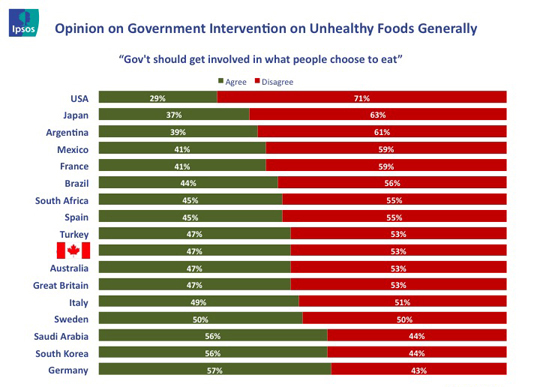
The study shows that at a general level, Canadians are divided on whether government should get involved in what people choose to eat. Canadians are more interventionist than citizens in some countries such as the United States, Japan, and France, but less so than citizens in others such as Sweden and Germany.
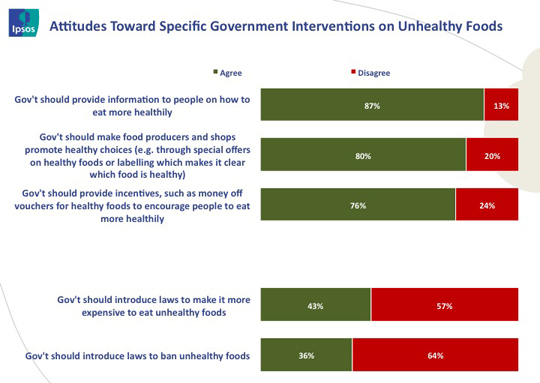
However, further probing shows that Canadians acceptance of government intervention on unhealthy foods depends largely on what the action is as they are much more supportive of being nudged than being mandated. For example, they are overwhelmingly of the view that government action to provide information to the public, regulate the food industry, and even provide a good behaviour incentive would be a good thing. However, attitudes towards more punitive measures such as increasing the cost of unhealthy foods, or even an outright ban received substantially less support.
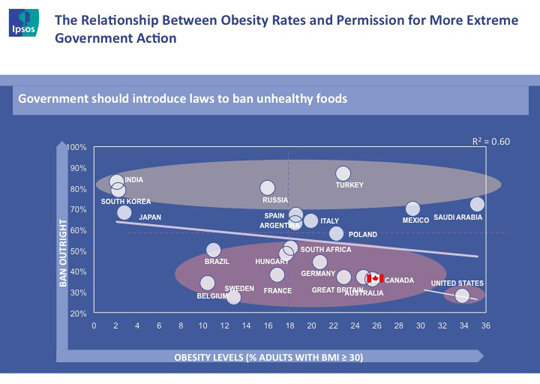
Particularly interesting in the Ipsos study is that obesity rates do not seem to be linked to public sentiment for strong government intervention on unhealthy foods. Using opinions on government banning unhealthy foods as the measure, countries with higher obesity rates (including Canada), are among the least likely to believe that governments should ban unhealthy foods.
Unsurprisingly, there is similar global support for the nudge options such as more government information about how to eat healthy (with a spread of 20 percentage points or less between country support levels). Support for government to provide coupons for healthy foods also received approval from a strong majority in almost all countries.
Global support for the mandate options ranged more (with a spread of 48 percentage points between approval levels). Citizens in the United States, France, Germany, and Canada had the lowest level of approval for government to increase the cost of unhealthy food. At the other end of the scale, India, Turkey, and Russia show strong majority support for this option. Even more divisive (with a spread of 60 percentage points between approval levels), were citizen opinions on banning unhealthy foods outright. More than half of the countries participating in the survey had a majority supporting this option. Again, Canadians along with citizens in Sweden, the United States, and Belgium showed the least support for this option.
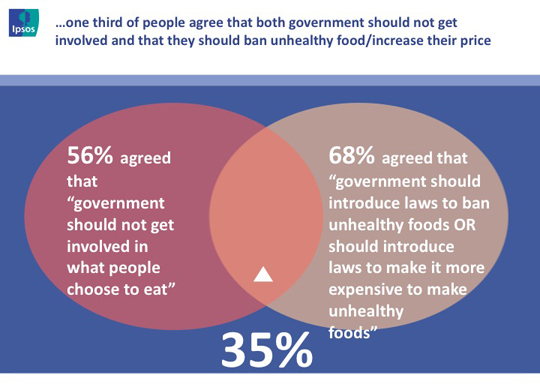
Globally, the study also reveals that citizens can hold somewhat contradictory views, as evidenced by the one-third of global citizens who agree both that government should not get involved in what people choose to eat, but at the same time believing that government should ban or increase the cost of unhealthy food.
So what is the bottom-line?
While the unhealthy eating behaviours of Canadians continue to increase (along with obesity rates), the public does not see the urgency for government to do anything more than continue to nudge them along. Of course, this nudging could be in the form of increasing Canadians' motivation, capability, or opportunity to understand or address their unhealthy eating habits. And despite calls from some groups who are pushing for stronger government intervention, the public is simply not there (yet), and there is limited support for more aggressive forms of action such as unhealthy food price increases, or outright bans.
![[WEBINAR] Ipsos Reputation Council 2026: Life After Predictability](/sites/default/files/styles/list_item_image/public/ct/event/2026-09/thumbnail-templates%20demo_1.png?itok=wgA7L90n)
![[WEBINAR] Ipsos Global Trends 2026: The Canadian Edition](/sites/default/files/styles/list_item_image/public/ct/event/2026-08/thumbnail-gt-26.png?itok=kAF_s5h8)
![[WEBINAR] KEYS: Ipsos Global Trends](/sites/default/files/styles/list_item_image/public/ct/event/2026-09/thumbnail-keys-0924_2.png?itok=oLb0FTuT)