

Seven in 10 Consumers Require Creator Authenticity Before Hitting 'Follow'
Toronto, Canada, July 22, 2026 — In an increasingly saturated content creator landscape, authenticity alone is no longer a differentiator. New research from Ipsos and Viral Nation shows that while authenticity is critical—72% of consumers say it matters before deciding to follow a creator—measured authenticity scores among creators vary only marginally. Across 18 creators spanning beauty, tech, gaming, fitness, food, and lifestyle, and ranging from niche to global followings, mean scores fall within a narrow band of 6.2 to 7.5 on a 10-point scale, suggesting that nearly all viable creators meet a baseline expectation of authenticity. At the same time, only specific dimensions of authenticity meaningfully influence brand outcomes, highlighting a gap between what consumers say matters and what actually drives engagement and equity.
Authenticity Is a Gatekeeper, Not a Differentiator
Authenticity plays a decisive role early in the creator selection process, making it a prerequisite rather than a competitive advantage. This threshold rises further among text and audio audiences, where 82% use authenticity as a deciding factor, compared to 73% among image and video audiences.
Six Dimensions of Authenticity
Social listening data—captured through digital mentions, discussions, and threads across social media platforms, forums, search engines, and review sites—was tracked over 12 months using Ipsos Synthesio. Combined with a literature review and survey results, this analysis identified six distinct dimensions of authenticity:
- Resonant Openness
Vulnerability and the willingness to share something that does not reflect well on you. The dimension consumers most often use the word "real" to describe. - Distinctive Identity
What makes a creator recognizable in two seconds of scroll. Voice, point of view, format, the consistent thing nobody else does in quite that way. - Engagement
Replies, follow-ups, community moderation. The texture of how a creator behaves when nobody is looking at the camera - Transparency
Disclosure, sponsorship labelling, behind-the-scenes context, and the absence of the things that make audiences feel manipulated - Consistency
Showing up, in cadence and in voice. The creator who posts on the same days about the same things in the same way over years. - Credibility
Expertise, accuracy, and the reasonable expectation that what a creator says about their domain is true.
Resonant Openness Dominates Perception of Authenticity
When asked what defines authenticity, consumers most frequently cited transparent communication (42%) and relatable personality (42%). These attributes together form Resonant Openness, which also generated the highest volume of social conversation. This dimension reflects the extent to which creators appear genuine and unfiltered, and is most closely associated with how audiences describe creators as “real.” However, while highly visible and frequently discussed, it is not the strongest driver of downstream brand impact.
Engagement and Identity Drive Brand Equity
Engagement and Distinctive Identity deliver the greatest impact on Attitudinal Equity—a composite measure predicting purchase intent, advocacy, and willingness to adopt new brands. In contrast, Transparency, although ranked highest in stated importance by consumers, shows comparatively low derived impact. This positions transparency as a “hygiene factor”: necessary for credibility, but insufficient to drive differentiation or growth on its own.
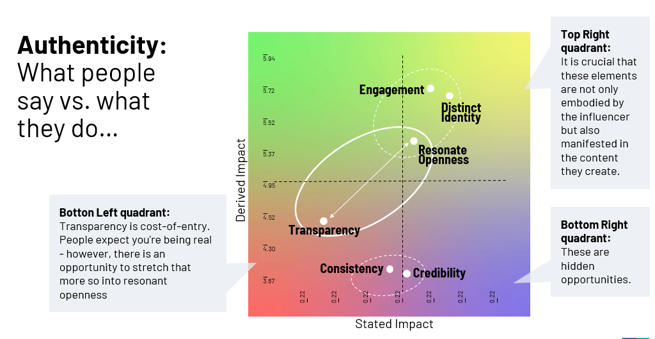
Three distinct pathways to Attitudinal Equity emerge based on the dimensions each creator over-indexes on—what works for an Engagement-led creator differs from what works for one led by Distinctive Identity or a Respondent Openness Identity. In each case, success comes from building on the dimension the creator already owns.
Most Creators Win by Owning One or Two Dimensions
While overall authenticity scores look similar, the details tell a different story. Most creators studied stand out in just one or two areas, while performing about average in the rest. These standout strengths form each creator’s “signature,” and are what really drive their effectiveness. For example, creator closeness scores ranged from 5.8 to 6.6—an even tighter range than authenticity—showing that top-line scores can hide the real differences between creators.
The Shift From Authenticity to Differentiation
The findings suggest a fundamental shift in how brands should evaluate creators. With authenticity scores tightly clustered, the more important question is no longer whether a creator is authentic, but how they are authentic. By identifying and activating the specific dimensions each creator owns, brands can move beyond baseline credibility and unlock measurable gains in engagement, equity, and influence.
About the Study
These findings are based on a multi-method research program conducted by Ipsos on behalf of Viral Nation, including a literature review, 12 months of social listening using Ipsos Synthesio, and a quantitative survey. The survey was conducted between January 14th to January 21st, 2026 among a sample of 757 Americans aged 18 and over via the Ipsos online panel. Quotas (50% Males/50% Females; Northeast 17%/Midwest 21%/South 38%/West 24%; 50% 18-34 y.o./50% 35-54 y.o.; 100% social media engagement of some kind) and weighting were applied to ensure that the sample reflects the composition of the American adult population according to census data. The results have a credibility interval of ±4.4 percentage points, 19 times out of 20, of what the results would have been had all American adults been surveyed.
Ipsos’ Synthesio platform was used to pull social listening data (social media platform content only, US/Canada, August 27th, 2024-August 27th, 2025).
To understand the dimensions of social listening, a literature review was conducted by systematically searching academic databases for relevant peer-reviewed articles and synthesizing key themes, frameworks, and definitions from the existing body of research.
For more information on this news release, please contact:
Mark Modeski, Vice-President
Service Line Leader, Ipsos Synthesio Canada
+1 416 324-2900
[email protected]
About Ipsos
Ipsos is one of the largest market research and polling companies globally, operating in 90 markets and employing nearly 20,000 people.
Our passionately curious research professionals, analysts and scientists have built unique multi-specialist capabilities that provide true understanding and powerful insights into the actions, opinions and motivations of citizens, consumers, patients, customers or employees. Our 75 business solutions are based on primary data from our surveys, social media monitoring, and qualitative or observational techniques.
“Game Changers” – our tagline – summarizes our ambition to help our 5,000 clients navigate with confidence our rapidly changing world.
Founded in France in 1975, Ipsos has been listed on the Euronext Paris since July 1, 1999. The company is part of the SBF 120, Mid-60 indices, and is eligible for the Deferred Settlement Service (SRD).
ISIN code FR0000073298, Reuters ISOS.PA, Bloomberg IPS:FP
www.ipsos.com


