

The Uneven Road to Economic Confidence
All Canadians are not enduring the same economy, and they are not on the same road to confidence.
Canadians are living through what Ipsos has called the Endurance Economy: a prolonged period of adjustment in which households, businesses, and institutions are adapting to the idea that affordability challenges are not temporary, but likely to remain part of Canadian life for years to come.
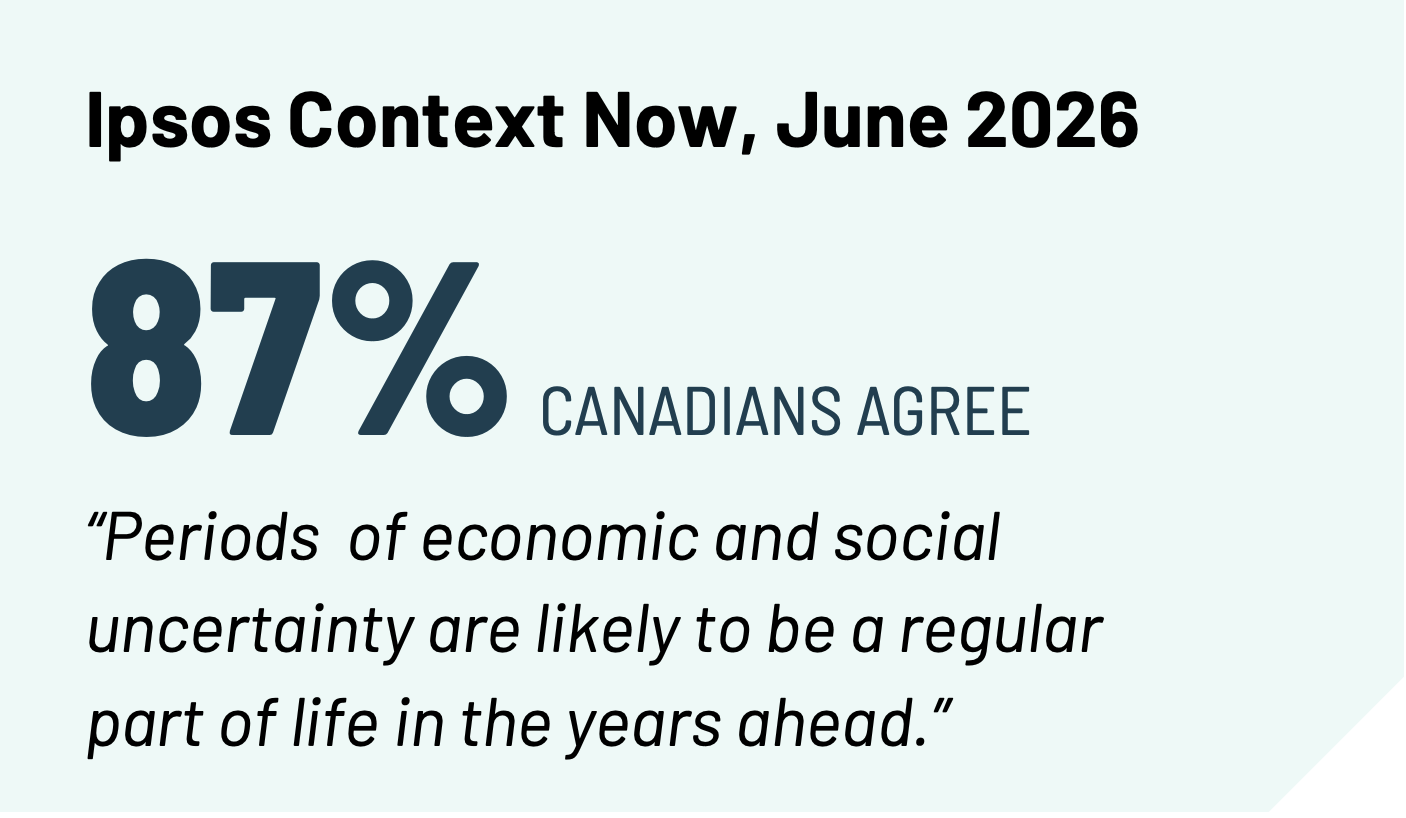
But while the majority of Canadians share this reality, they are not experiencing it equally.
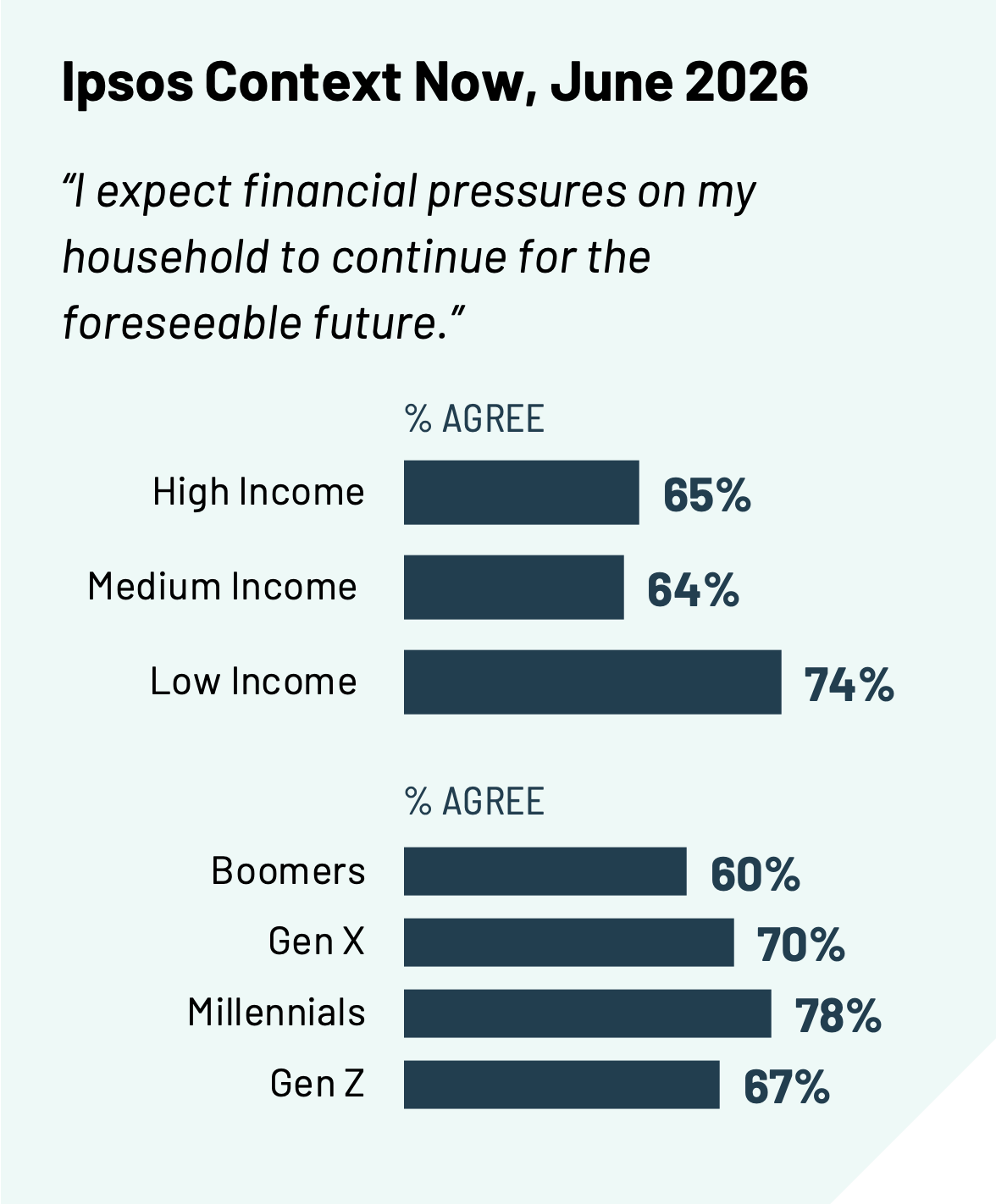
The Endurance Economy has always been about adaptation. Increasingly, Canadians are adapting from very different starting points and with very different prospects for recovery. The traditional language of the "haves" and "have-nots" no longer fully captures Canada's economic reality. More importantly, many of the economic indicators we use to describe the economy are becoming less effective at describing how Canadians actually experience it.
What has emerged instead is a gradient. At one end are the Confident: Canadians whose incomes, assets, and financial position continue to improve. At the other are the Enduring: Canadians adapting to persistent financial pressure by lowering expectations, delaying goals, and adjusting their lifestyles to make budgets work. Most Canadians now sit somewhere along this endurance spectrum.
Even before the 2020 Pandemic, Ipsos Context data was pointing to a growing disconnect between headline economic indicators and household experience. Post the Pandemic as inflation moderated and interest rates began to fall large majorities of Canadians continued to expect enduring financial pressure and adjusted their expectations downward. The disconnect was evident before the inflation shock and has persisted through the recovery, suggesting that many Canadians are responding not simply to changing economic conditions, but to deeper concerns about housing affordability, debt burdens, economic mobility, and long-term financial security. Recent Boston Consulting Group analysis helps explain why the performance of the overall economy has been increasingly out of sync with the economic sentiment and financial health of most Canadians.
The BCG Report released in July gives us the clearest picture yet of how narrow the Confident segment actually is. Tracking Canadian households between 2021 and 2025, BCG found that only the top 20% of earners experienced income growth sufficient to fully cover increases in spending. For this group, income growth covered 106% of rising expenditures. Everyone else fell behind.
Among the middle 60% of earners, income growth covered just 57 cents of every additional dollar spent. For the bottom 20%, spending rose dramatically faster than income, forcing many households to rely on savings, borrowing, or existing assets to maintain their standard of living.
This is not the traditional Canadian promise that hard work and steady employment create a reliable pathway to greater prosperity. Increasingly, economic progress is concentrated among a relatively small share of households, while a much larger group is simply trying to keep up.
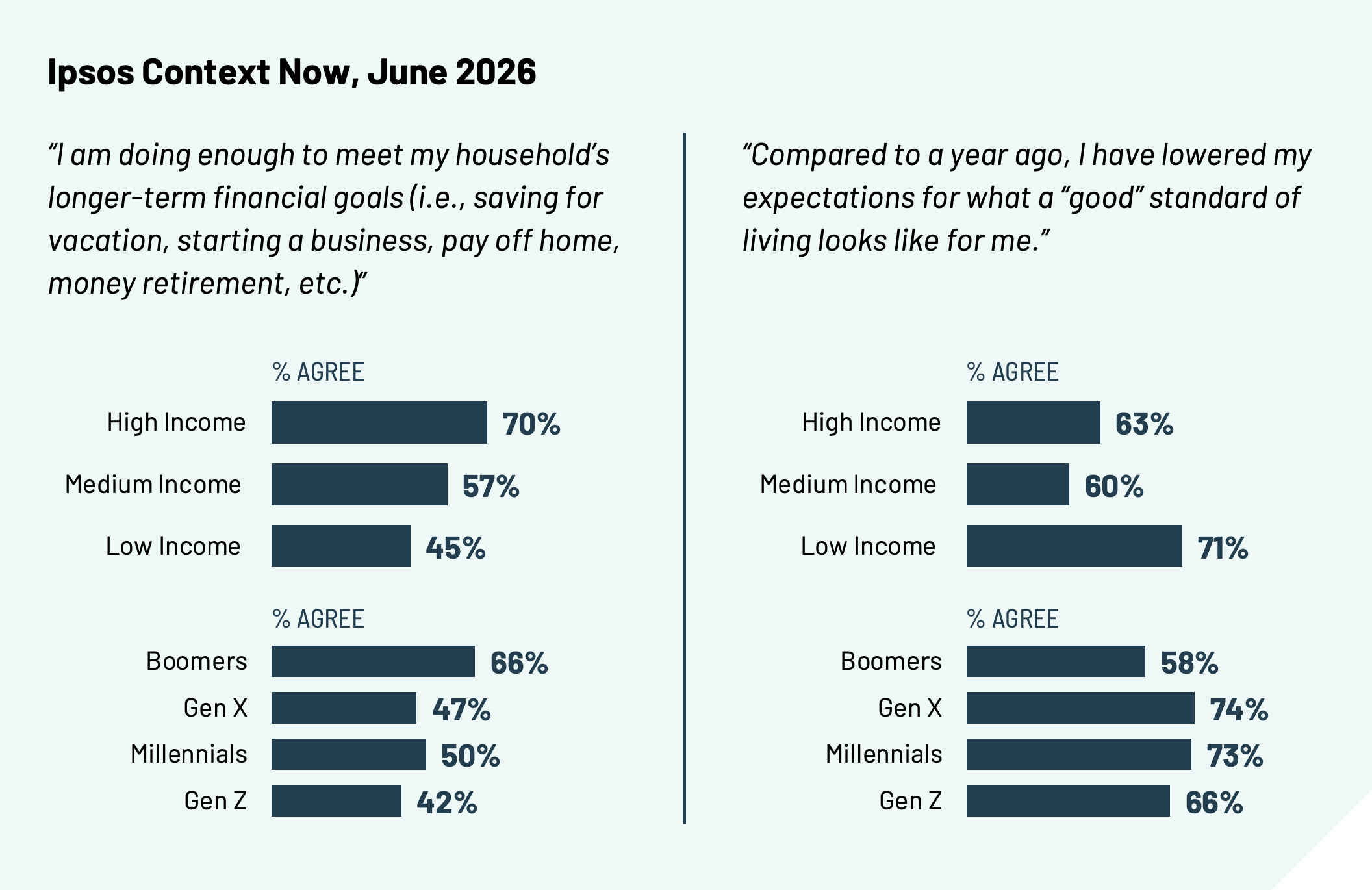
Our Ipsos data show that Canadians feel this divide. High-income households and Baby Boomers are significantly more likely than younger and lower-income Canadians to say they are doing enough to meet their long-term financial goals. Meanwhile, majorities across all generations report lowering their expectations for what constitutes a good standard of living.
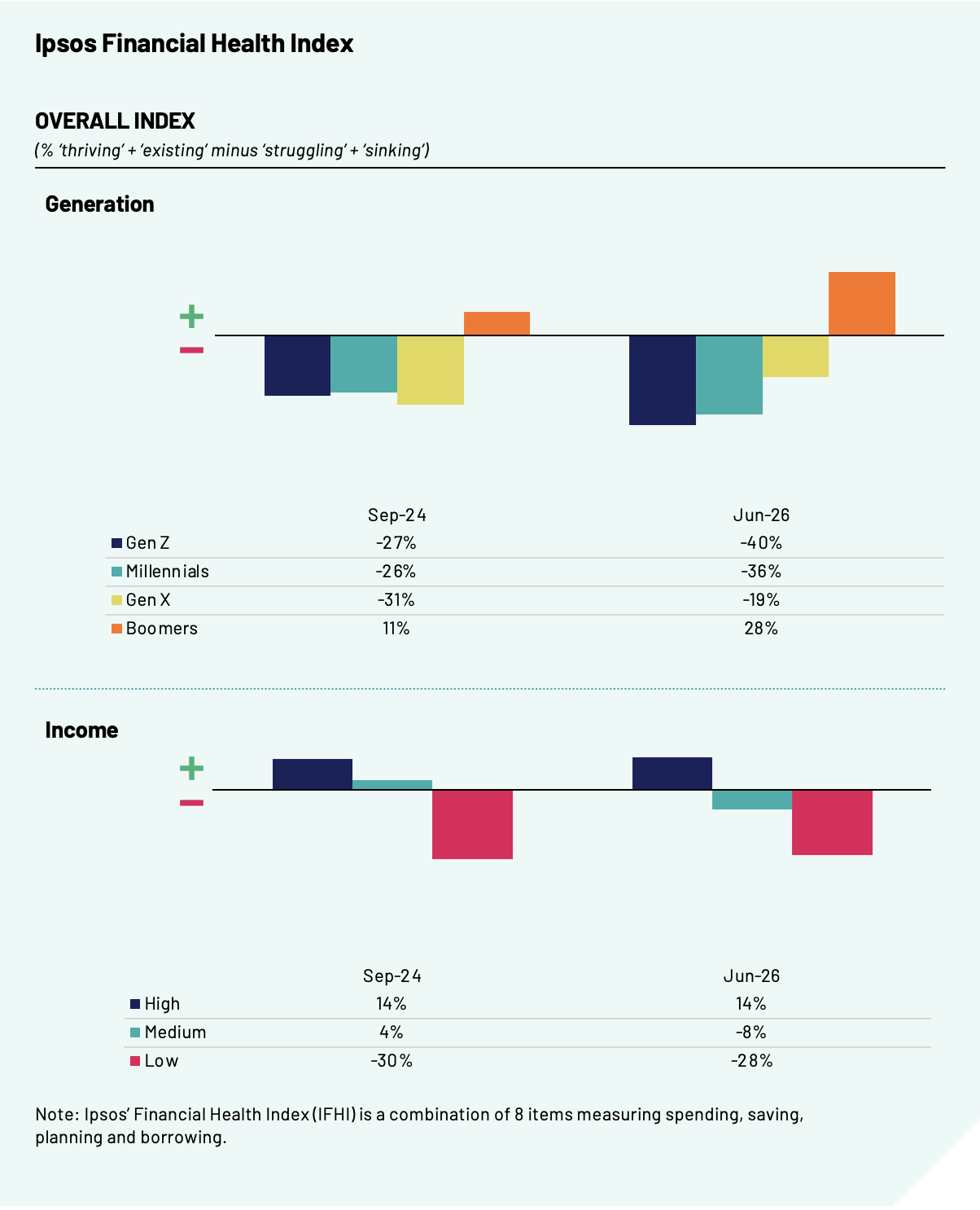
Beyond economic sentiment, the Ipsos Financial Health Index, mirrors the BCG report showing Baby Boomers and high-income Canadians doing well and younger generations, mid and low-income Canadians struggling to make ends meet.
One Economy, Multiple Realities
Canadians may be experiencing the same headlines, but increasingly they are not experiencing the same economy. A positive GDP report, lower inflation reading, or interest-rate cut may signal improvement for some households while meaning very little to others. What makes this moment different from a normal economic downturn is that Canadians are not simply experiencing different degrees of hardship. They are increasingly on different economic tracks and experiencing the same economy through very different financial realities.
For the Confident, the traditional economic cycle still matters. Lower interest rates, rising asset values, and stronger growth generally translate into improvements in household finances.
For many of the Enduring, however, the challenges are structural rather than cyclical. Renters priced out of ownership, younger Canadians whose wages struggle to keep pace with living costs, and households increasingly dependent on debt are unlikely to see meaningful relief from modest rate cuts or stronger GDP figures alone.
The result is that economic indicators increasingly describe different groups of Canadians with very different levels of accuracy. Signals that point to recovery for some households are often interpreted as largely irrelevant by others.
This distinction became particularly apparent in late 2024. By December, the Bank of Canada had lowered interest rates five consecutive times to 3.25%, while inflation had fallen from 2.7% in June to 1.6% in September. By conventional economic measures, the pressures that typically drive household financial stress were easing. Yet broad improvements in financial optimism failed to materialize. In other words, the relationship between improving headline economic indicators and improving consumer confidence appears weaker than it once was.
That disconnect lies at the heart of the Endurance Economy thesis. It suggests that many Canadians are responding not simply to temporary economic conditions, but to longer-term concerns around housing affordability, stagnant productivity growth, high debt burdens, demographic pressures, and limited opportunities for upward mobility. More recent uncertainties, including trade tensions with the United States, may have intensified these concerns, but they did not create them.
Why This Matters
The challenge is not that GDP, inflation, and interest rates are wrong. The challenge is that they increasingly describe some Canadians far better than others.
For governments, it means that economic recovery cannot be measured solely through GDP growth, inflation, or interest rates. Those indicators matter, but they primarily improve conditions for Canadians already positioned to benefit from them. For a much larger share of households, confidence will require structural improvements in housing affordability, wage growth, and economic opportunity.
For brands, it means the idea of a single "average consumer" is becoming less useful. Consumers increasingly occupy very different financial realities, even when they appear similar on traditional demographic measures. Understanding where consumers sit on the endurance spectrum may now be more important than understanding where they sit on an income chart.
For many brands, the fastest-growing consumer mindset is not characterized by abundance, but by caution, deliberate decision-making, and a constant search for value.
A Long Road Ahead
The Endurance Economy was never intended as a theory of permanent decline. It is a framework for understanding consumer behaviour today and why recovery is proving so uneven.
Some Canadians are already moving toward greater confidence. Many others remain focused on endurance. The challenge facing Canada is not simply that there are winners and losers. It is that a growing number of Canadians feel they are running hard simply to stay where they are.
While the evidence points to a widening divide between Canadians moving toward confidence and those still focused on endurance, the reality is likely more nuanced. Future Ipsos analysis will explore the different forms of economic security, financial resilience, and adaptation emerging across the broader population.
The next phase of the Endurance Economy may not be defined by endurance itself, but by a growing recognition that a single economic narrative no longer adequately describes the Canadian experience. Canadians may be living in the same economy, but they are increasingly experiencing it in very different ways.
Recognizing where people sit along this evolving spectrum, and responding accordingly through policy, business strategy, and communication, may be one of the defining challenges of the years ahead.
All of the data in this article can be found in the Ipsos Context Report Q2 2026.
About Context Now
Context Now helps organizations understand the intersection of citizen and consumer sentiment by tracking shifts in economic confidence, financial health, social cohesion, issue priorities, activism, and broader societal trends.
Because today's citizens and consumers are increasingly the same person, understanding the broader context in which people live has become critical for strategy, communications, reputation, policy, and growth.
Contact me to learn more about Context Now:
Sanyam Sethi
Vice President, Ipsos Public Affairs Canada
[email protected]

![[WEBINAR] KEYS: Ipsos Global Trends](/sites/default/files/styles/list_item_image/public/ct/event/2026-09/thumbnail-keys-0924_2.png?itok=oLb0FTuT)
![[WEBINAR] Ipsos Reputation Council 2026: Life After Predictability](/sites/default/files/styles/list_item_image/public/ct/event/2026-09/thumbnail-templates%20demo_1.png?itok=wgA7L90n)