
Understanding Society & What We Worry About
What keeps us up at night and what should
The world is scary, and getting scarier. At least that's what we believe. Eight in ten (83%) of the nearly 18,000 people from 24 countries that we surveyed said the world has become more dangerous over the last year. The biggest doomsayers live in Turkey where a startling 91% think there is more to fear.
What keeps us up at night? We are preoccupied by external personal threats - things that could be done to us by someone or something else. At the top of the list is the potential for our personal electronic information to be compromised. Sixty four percent of us are worried about having our personal data hacked via the Internet or Email (although this concern is down 6% from 2013). You feel especially vulnerable if you live in Spain, Turkey or Germany.
According to a multi-country study we did for the Center for International Governance Innovation (CIGI), we are most concerned about criminals hacking into our personal banking information (78%), followed by the theft of personal information such as photos and private messages (77%), and private companies monitoring our online activity and selling this information for commercial purposes (74%).1
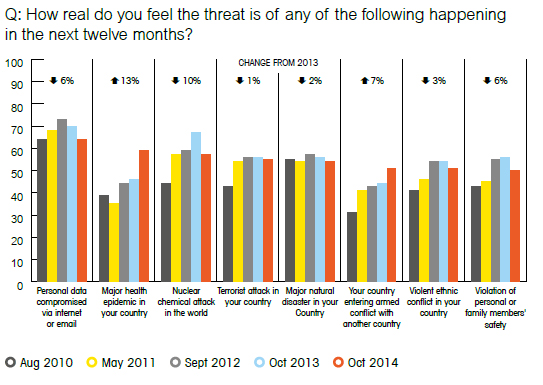
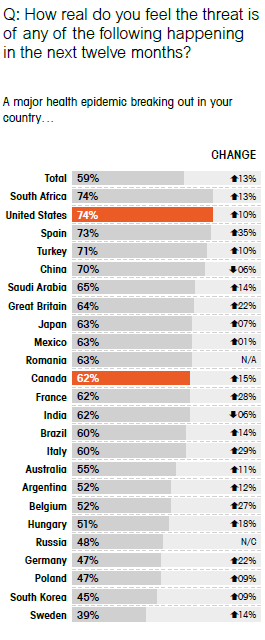
Let's face it though, while having your personal data compromised creates a sense of violation and potentially a major inconvenience in your life, it won't kill you. For that we have to turn to our next big worry - the outbreak of a major health epidemic in our home country (59%). This is up 13% in 2014, and is especially strong in South Africa, the US, and Spain. This is clearly being driven by news about the outbreak of the Ebola virus in Africa.
Should you be worried about dying from being infected by the Ebola virus? If you live in West African countries such as Liberia, Sierra Leone, or Guinea you should absolutely be taking precautions. But, the truth about Ebola is that it caused just over 11,000 deaths up to May 2015 - almost exclusively in West Africa. 2 In the United States, one of the countries that saw the biggest jump in concern about health epidemics, the number of fatalities attributed to Ebola was just two.
What about war and terrorism? These risks cause over half of us to toss and turn at night (51% and 55% respectively) 3. But here's the truth - war caused 176,000 casualties in 2014 (according to the International Center for Strategic Studies), and deaths due to terrorism numbered about 18,000 (U.S. State Department) 4. That's certainly a lot of fatalities, especially when compared to Ebola. And again, how worried you should be obviously depends where in the world you live. But, if you keep in mind that roughly 150,000 people die every day in the world - around 55 million a year - these risks are quickly put into some kind of perspective.
Completing our list of the biggest external fears are natural disasters (56%) - which caused 22,000 deaths in 20135 - and violent personal crime (50%), which accounted for a much larger number of deaths - around a half million worldwide in 2012.6
It's important to go through these grim statistics to make a point. While external threats dominate the news cycle and understandably get considerable attention and resources from our political leaders, they are not the biggest causes of death in the world today.
So why are we so afraid of what is so statistically unlikely to harm us? Contemporary models of risk perception are that people do not estimate risk using only reason or by looking at statistics. The psychometric paradigm (originally set out by Paul Slovic) suggests people are more likely to be afraid of things they cannot control (such as natural disasters) or that are unknown or new (such as the murky world of terrorism).7 The Social Amplification of Risk Framework contends that external factors, such as media coverage or cultural influences, can also ramp up or cool down people's perception of risks.8 On this model, it's no surprise we saw such a leap in fear of external diseases in the wake of such extensive coverage on the Ebola virus.
This at least helps explain our misperceptions of risk. As other articles in this edition make clear, being irrational is hardwired in us, and can have clear benefits when it comes to weighing risks and choices. But what if we were to look at potential threats in a cool, reasoned way? What should we really be afraid of?
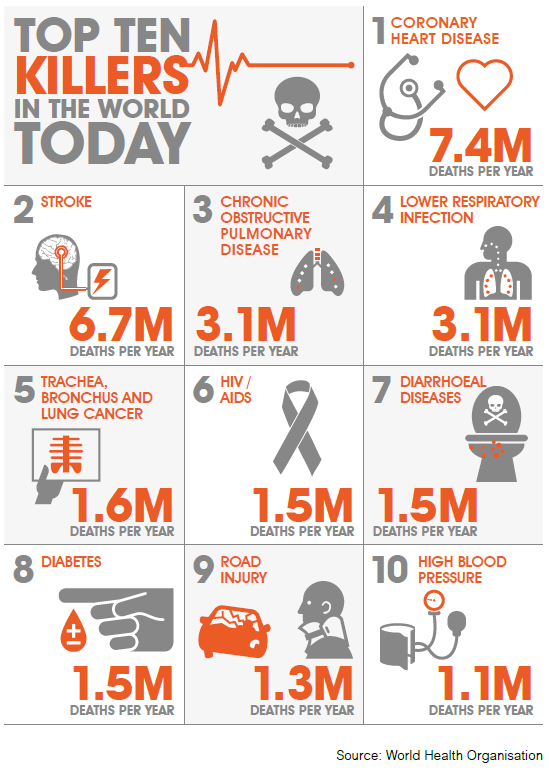
What does this tell us? For the most part, the biggest risks we face are diseases that can't be passed from person to person. Indeed, many of these diseases are brought on by our own poor lifestyle choices related to smoking, diet and exercise. In fact, the top 5 killers are all heart or lung related diseases.
So want to sleep better at night? Focus on what you do to yourself as opposed to what may be done to you by someone or something else. Quit smoking (causes six million deaths a year), eat better, get some exercise (being overweight caused 2.8 million deaths in 2014), and relax (stress is a leading contributor to cardiovascular diseases, the number one killer). Although the world is a scary place and seems to be getting scarier, we are more in control than we think.
Source:
1. https://www.cigionline.org/internet-survey
2. http://www.bbc.co.uk/news/world-africa-28755033
3. http://apps.who.int/ebola/current-situation/ebola-situation-report-27-may-2015
4. http://www.state.gov/j/ct/rls/crt/2014/239416.htm
5. http://uk.businessinsider.com/red-cross-says-disasters-killed-22000-2014-10
6. http://www.unodc.org/unodc/data-and-analysis/WDR-2012.html
7. Paul Slovic, Perception of Risk (1987): http://www.uns.ethz.ch/edu/teach/0.pdf
8. Social Amplification of Risk Framework
![[WEBINAR] Ipsos Reputation Council 2026: Life After Predictability](/sites/default/files/styles/list_item_image/public/ct/event/2026-09/thumbnail-templates%20demo_1.png?itok=wgA7L90n)
![[WEBINAR] Ipsos Global Trends 2026: The Canadian Edition](/sites/default/files/styles/list_item_image/public/ct/event/2026-08/thumbnail-gt-26.png?itok=kAF_s5h8)
![[WEBINAR] KEYS: Ipsos Global Trends](/sites/default/files/styles/list_item_image/public/ct/event/2026-09/thumbnail-keys-0924_2.png?itok=oLb0FTuT)