Canadians Doubt that the Government is Capable of Solving Today’s Challenges
Canadians are angry. Worried. Stressed. You can pretty much insert your choice of negative emotion to describe how Canadians are feeling today. Why? While it may feel like the current mood is new, it is really the continuation of a trend that started before the arrival of COVID-19.
The negative sentiments being expressed by Canadians didn’t start in September 2022, over worries of a possible recession. It didn’t start with the rise of inflation last January, or the countering rise in interest rates this past spring. It didn’t start with the pandemic in the spring of 2020. We have to go back to March 2019 to find the last quarter that ended with Canadians in a net positive mood.
At Ipsos we track citizen and consumer sentiment through an index called the Ipsos Disruption Barometer. The barometer is a combination of questions measuring citizen and consumer satisfaction with the current and future state of the country, the economy, and their own lives. It’s a lot of data rolled into one number, and we have been running it monthly across 28 countries for over a decade. It gives Ipsos and our clients unique insight into the mood of the society that governments and businesses operate in.
The picture in Canada today is not pretty. Current sentiment is as negative now as it was at the peak of the pandemic in March 2020. Remember March 2020? How uncertain and afraid many of us were? We shut down almost everything to stop the spread of COVID. Businesses and schools closed. All but essential public services and grocery stores were closed. People were told to stay indoors, not to visit friends or family, and we were even limited to the number of people that could stand outside in our own backyard. And here we are now – mostly vaccinated, with massively diminished worries about COVID, low unemployment and a hot economy, yet we are as worried, concerned, and angry today as we were then.
What has happened? Quite simply, pandemic-generated worry and concern has been replaced with a host of other issues. Many of these issues like healthcare, climate change and ageing society were pre-pandemic worries. They have resurfaced as concern for the pandemic receded. Since the Fall of 2021 the fastest rising issues have included a bundle of economic concerns ranging from the everyday cost of living to the inability of younger generations to get a foothold in the housing market, to the fears of older Canadians that they will outlive their nest eggs.
During the pandemic the Government of Canada moved fast and spent billions of dollars to cushion the largest, most rapid shut-down of Canada’s economy in its history. Throughout, the prime minister updated Canadians every day on the steps being taken to combat COVID and provide financial relief to Canadians.
For a brief shining moment citizens, governments, and businesses worked together to get through the pandemic. Canadians responded with record-high approval ratings for governments and their leaders. There was discussion in progressive circles that governments had re-found their purpose, that the pandemic had shown us a path for addressing climate change and that the public would support an invigorated public sector that would address the challenges ahead of us. This was only two years ago.
Today, government approvals sit at near record lows, and we now see declining faith in the ability of the Government of Canada. Canadians are looking at the long list of urgent issues and their declining quality of life and asking themselves “Is the Government of Canada up to the task?” Most of us have our doubts.
We asked Canadians if they think the Government of Canada is capable of making progress on some of the top issues facing Canada today. We found that on virtually all issues, Canadians are far more pessimistic than they were only 19 months ago.
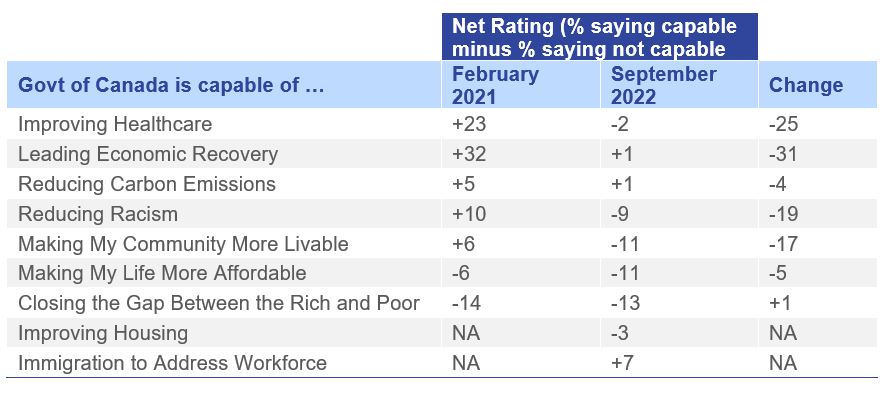
The bottom line is that Canadians doubt that the Government of Canada can do the heavy lifting that will be required to make progress on the issues they feel are most important.
Answering the question of who is to blame is not as easy as it seems. It’s too easy to blame this on politicians focused on divisive identity campaigns targeted only to their base constituents. While this has certainly not helped things, it is hardly a new tactic. It’s also unfair to blame this on bureaucratic-led departments that deliver services and do the forward thinking that goes into the legislation designed to protect us and drive economic growth. During COVID-19, many federal departments demonstrated a capacity for agility and action never before seen. Perhaps that raised our expectations as we saw what government was capable of when it mattered most. Most likely both of these factors contributed to the current feelings of pessimism we are seeing, but the blame hardly matters as much as whether, and how, governments can restore the faith that was so high only nineteen months ago.
Canadians have lost confidence in the ability of the Government of Canada. Until Canadians see that the quality of their lives is improving, feel that their children will have a healthy and comfortable future, and experience proof that the Government is responding, improving, and modernizing, they will be increasingly disenfranchised.
It is in this climate of diminished confidence that our governments and businesses must navigate what increasingly looks like a pending economic recession, weakening social cohesion, and even weaker financial household health.
Canadian businesses are becoming increasingly implicated as well, as Canadians demand they communicate transparently and live up to their ESG promises. More and more Canadians expect the companies they buy from to have as much impact on furthering their social and economic priorities as the governments they vote for.
In the world of politics, if the federal NDP-Liberal coalition holds, we will see a federal election in 2025. While it’s impossible and irresponsible make a prediction now on what that the outcome of the election will be, it’s safe to say that the winner will not have much to work with if we see two more years of the current context. Whoever ends up winning the next election will likely inherit the main thing ailing Canadians right now: loss of faith in the institutions they once thought would be there for them when it mattered most. That is a problem for parties of all political stripes and will be a challenge long after we tame inflation and the economy rebounds.
![[WEBINAR] Ipsos Global Trends 2026: The Canadian Edition](/sites/default/files/styles/list_item_image/public/ct/event/2026-08/thumbnail-gt-26.png?itok=kAF_s5h8)