
Consumer Sentiment of Urban Indians rebounds in July, up 3.2 percentage points: LSEG-Ipsos PCSI July India wave
Consumer sentiment of urban Indians has rebounded strongly in July 2026, rising 3.2 percentage points according to the latest LSEG-Ipsos Primary Consumer Sentiment Index (PCSI), which tracks consumer confidence across 30 global markets.
The recovery positions India among the strongest-performing countries globally this month and reinforces its standing as the world's most confident consumer market. With a National Index score of 67.1, India remains the only country in the survey to score above the 60-point mark.
The improvement comes at a time when consumers appear to be finding relief from a period of heightened uncertainty. While households continue to face cost pressures, the absence of fresh economic shocks, relative stability in fuel prices, easing concerns around global energy markets, and signs of diplomatic de-escalation in the Middle East appear to have reduced anxiety and improved consumer outlook. The result is a more optimistic assessment of both personal finances and the broader economy.
Ipsos’ Global Consumer Confidence Index is up 1.1 points this month and sits at 49.0. The index has increased for the third consecutive month and sits nearly one point higher than its reading from this time last year.
Sentiment continues to inch closer to where it was prior to the start of the Iran war, as the index now stands one point lower than this mark. Sentiment remains significantly lower than it was pre-war in 14 countries.
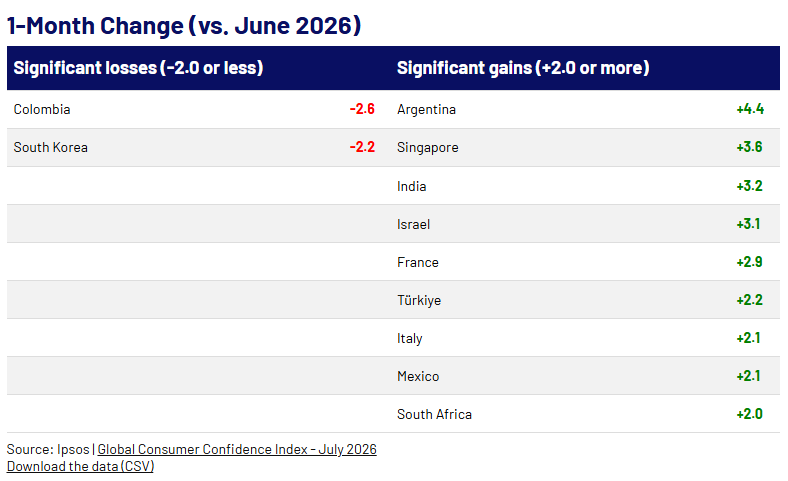
Among 30 economies measured, nine countries show significant gains in consumer sentiment, while only two countries show a notable decline. All four sub-indices show increases this month.
Based only on the “legacy 20 countries” tracked since March 2010, the Index would read at 47.4, a 1.2-point increase from June.
Sentiment is up in the Asia-Pacific this month. Singapore (+3.6 points) and India (+3.2 points) are both up significantly this month, while South Korea (-2.2 points) is the only country in the region to fall significantly.
Similarly, consumer confidence has increased in Latin America. Argentina (+4.4 points) shows the largest increase among all countries, and Mexico (+2.1 points) is also up significantly.
The Global Consumer Confidence Index is the average of all surveyed countries’ Overall or “National” indices. This month’s installment is based on a monthly survey of more than 21,000 adults under the age of 75 from 30 countries conducted on Ipsos’ Global Advisor online platform. This survey was fielded between June 19 and July 3, 2026.
Consumer sentiment in 30 countries
Among the 30 countries, India (67.1) holds the highest National Index score. India is the only country this month to hold a National Index score of 60 or higher.
Fourteen other countries now show a National Index at or above the 50-point mark:
Sweden (58.6), Malaysia (57.0), Singapore (54.1), Mexico (53.7), Thailand (52.7), Hungary (52.1), Brazil (52.1), Colombia (51.4), Indonesia (51.2), the U.S. (51.0), Israel (50.8), the Netherlands (50.7), Spain (50.6), and Peru (50.0).
In contrast, just two countries now show a National Index below the 40-point mark: Japan (39.7) and Türkiye (38.0).
Suresh Ramalingam, CEO, Ipsos India, summarizing on the findings said, “Consumers are breathing a little easier. July's rebound reflects a simple but powerful reality: there have been no new shocks. Stable fuel prices, easing energy market concerns and a calmer geopolitical backdrop have helped restore confidence. When uncertainty recedes, optimism returns, and that's exactly what we're seeing among urban Indians this month.”
"Confidence is influenced not only by current conditions but also by perceptions of future preparedness. While fuel prices remain vulnerable to global geopolitical developments and energy market disruptions, consumers are increasingly aware of India's efforts to diversify its energy mix through ethanol blending, flex-fuel technologies, biofuels and other sustainable alternatives. Although these solutions are still evolving, they signal a longer-term pathway towards greater energy resilience and reduced dependence on conventional fuels. This growing sense of preparedness may be helping to support consumer confidence despite ongoing uncertainties in global energy markets," added Ramalingam.
Consumer sentiment has improved across all 4 sub indices
Consumer sentiment has strengthened across all four sub-indices, pointing to a broad-based improvement in consumer confidence among urban Indians. Economic Expectations rose by 2.7 percentage points, reflecting growing optimism about the country's economic trajectory. The Employment sub-index increased by 2.8 percentage points, indicating a modest but notable improvement in confidence around job security and employment prospects. Current Personal Financial Conditions advanced by 2.9 percentage points, suggesting that consumers feel more positive about their present financial situation. Leading the gains, the Investment Climate sub-index climbed 3.7 percentage points, signalling greater confidence in making major purchases and investments. Together, these movements underscore a more upbeat consumer outlook across both personal and macroeconomic dimensions.
About the Study
These findings are based on data from a monthly 30-country survey conducted by Ipsos on its Global Advisor online survey platform. They are first reported each month by LSEG as the Primary Consumer Sentiment Index (PCSI).
The results are based on interviews with over 21,000 adults aged 18+ in India, 18-74 in Canada, Ireland, Israel, Malaysia, South Africa, Turkey, and the United States, 20-74 in Thailand, 21-74 in Indonesia and Singapore, and 16-74 in all other countries.
The sample consists of approximately 1,000 individuals each in Australia, Belgium, Brazil, Canada, France, Germany, Great Britain, India, Italy, Japan, the Netherlands, Spain, and the U.S., and 500 individuals each in Argentina, Chile, Colombia, Hungary, Indonesia, Ireland, Israel, Malaysia, Mexico, Peru, Poland, Singapore, South Africa, South Korea, Sweden, Thailand, and Türkiye.
Samples in Argentina, Australia, Belgium, Canada, France, Germany, Great Britain, Hungary, Italy, Japan, the Netherlands, Poland, South Korea, Spain, Sweden, and the U.S. can be considered representative of their general adult populations under the age of 75. Samples in Brazil, Chile, Colombia, India, Indonesia, Israel, Ireland, Malaysia, Mexico, Peru, Singapore, South Africa, Thailand, and Türkiye are more urban, more educated, and/or more affluent than the general population. The survey results for these countries should be viewed as reflecting the views of the more “connected” segment of their populations.
The data is weighted so that the composition of the sample in each country best reflects the demographic profile of the adult population according to the most recent census data.
The global indices and averages reported here reflect the average result for all the countries and markets in which the survey was conducted. They have not been adjusted to the population size of each country or market and are not intended to suggest “total” results.
Sample surveys and polls may be subject to other sources of error, including, but not limited to coverage error and measurement error. The precision of Ipsos online surveys is calculated using a Bayesian credibility interval with a survey of N=1,000 being accurate to +/- 3.5 percentage points and a survey of N=500 being accurate to +/- 5.0 percentage points. For more information on credibility intervals, visit this page.
For the Global Index, significant changes are +/- 0.5 point. For individual countries, significant changes are +/- 2.0 points.
This month’s fieldwork started after the June 17 announcement that the U.S. and Iran signed an initial peace deal to end the war. Fieldwork was completed prior to the U.S.-Iran ceasefire ending on July 8.