
India’s Consumer Sentiment Dips in June Amid Fuel Crisis
India’s consumer sentiment declined by 2.7 percentage points in June 2026, weighed down by the Strait of Hormuz standoff, disruptions to oil trade, and a consequent surge in fuel prices. These pressures have heightened the cost of living, placing an increased burden on households. Despite these headwinds, India continues to rank highest on the Global Consumer Confidence Index (GCCI), leading all 30 markets surveyed.
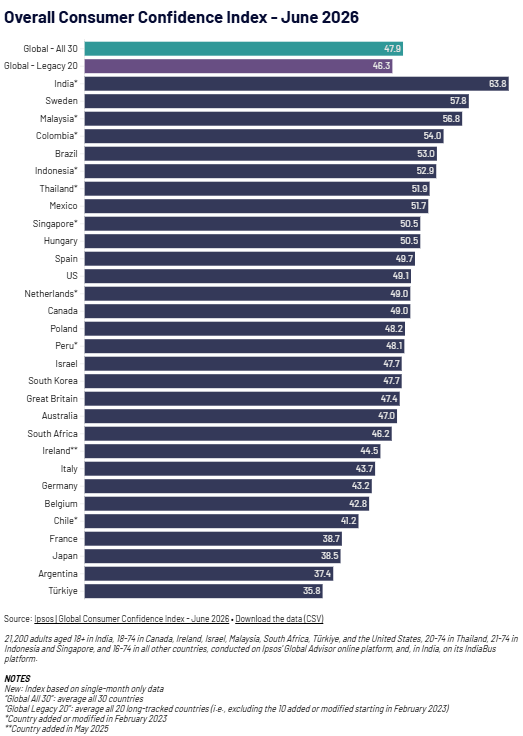
Ipsos’ Global Consumer Confidence Index is up 0.5 point this month and sits at 47.9. The index has increased in back-to-back months and sits in line with its reading from this time last year.
Despite increases the past two months, the index is still two points lower than it was prior to the start of the War in Iran. Sentiment is significantly lower than it was pre-war in 16 countries.
Among 30 economies measured, eight countries show significant gains in consumer sentiment, while five countries show a notable decline. The Current, Investment, and Jobs sub-indices all show increases this month, while the Expectations sub-index is stable.
Based only on the “legacy 20 countries” tracked since March 2010, the Index would read at 46.3, a 0.6-point increase from May.
Sentiment shows an uptick in Europe this month. Spain (+3.1 points), Germany (+2.6 points), Great Britain (+2.4 points), Hungary (+2.4 points), Sweden (+2.4 points), and the Netherlands (+2.2 points) are all up significantly this month.
In contrast, consumer confidence is mixed in Latin America. Colombia (+5.4 points) shows the largest increase among all countries. However, Argentina (-3.4 points) has fallen to its lowest point since November 2023.
The Global Consumer Confidence Index is the average of all surveyed countries’ Overall or “National” indices. This month’s instalment is based on a monthly survey of more than 21,000 adults under the age of 75 from 30 countries conducted on Ipsos’ Global Advisor online platform. This survey was fielded between May 22 and June 5, 2026.
Consumer sentiment in 30 countries
Among the 30 countries, India (63.8) holds the highest National Index score. India is the only country this month to hold a National Index score of 60 or higher.
Nine other countries now show a National Index at or above the 50-point mark: Sweden (57.8), Malaysia (56.8), Colombia (54.0), Brazil (53.0), Indonesia (52.9), Thailand (51.9), Mexico (51.7), Singapore (50.5), and Hungary (50.5).
In contrast, four countries now show a National Index below the 40-point mark: France (38.7), Japan (38.5), Argentina (37.4), and Türkiye (35.8).
Of note, Hungary has risen to its highest point since tracking began in March 2010.
Elucidating on the findings of the survey, Suresh Ramalingam, CEO, Ipsos India said, “The extended US–Iran conflict and the resulting volatility around the Strait of Hormuz have unsettled global oil markets, triggering supply concerns and sustained price pressures. India has already seen multiple rounds of fuel price increases over the past month—across petrol, diesel, and LPG—placing tangible strain on household budgets and heightening consumer anxiety.
Yet, India’s continued leadership of the Global Consumer Confidence Index underscores the inherent resilience of its consumers, even in the face of a significant energy shock. This confidence is also being reinforced by proactive government measures aimed at insulating the impact, whether through efforts to moderate consumer burden or by accelerating the shift towards alternative energy pathways. The growing emphasis on electric vehicles and flex-fuel adoption marks a strategic pivot to reduce dependence on oil imports while advancing sustainable solutions.
Looking ahead, a de-escalation through diplomatic channels could help stabilise the situation and restore greater certainty to global energy markets.”
Consumer sentiment lowers across sub-indices
Consumer sentiment has softened across all four pillars of the PCSI, signalling a broad-based erosion rather than a sector-specific dip. Economic expectations have moderated, with the sub-index declining by 1.8 points, reflecting growing caution about near-term macroeconomic prospects. Employment sentiment has also edged down by 1.2 points, indicating early signs of unease in the jobs outlook.
More notably, the sharper corrections are visible at the household level. The Current Personal Financial Conditions sub-index has fallen by 3.0 points, underscoring the immediate strain of rising living costs, while the Investment Climate sub-index has dropped 3.5 points, suggesting a pullback in risk appetite and discretionary financial planning.