

Only four markets say their country is on the right track in October
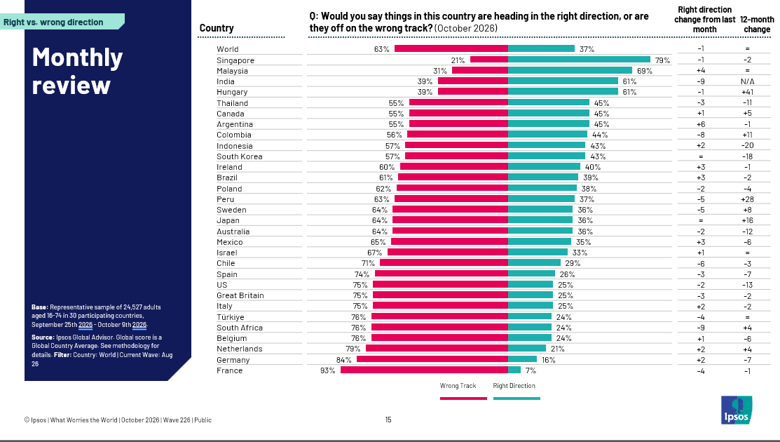
Just four of 30 markets surveyed say their country is heading in the right direction, according to the October 2026 Ipsos What Worries the World study.
Singapore (79%), Malaysia (69%), India (61%) and Hungary (61%) stand out as the only markets where a majority express optimism about their country's direction. Across the remaining 26 markets, sentiment remains overwhelmingly negative, with only 37% globally believing their country is on the right track.
At the other end of the spectrum, France ranks last, with only 7% saying the country is moving in the right direction. Recent student-led unrest appears to have weighed on public sentiment, reinforcing concerns about the country's trajectory.
While a majority of Indians continue to believe the country is heading in the right direction, confidence has eased since last month, with the score declining by 9 percentage points.
"Around the world, citizens are facing a succession of crises with little respite. The lingering effects of Covid-19 have been followed by wars, energy shocks and economic uncertainty, leaving many questioning the future of their countries. That only four markets report a positive sense of national direction highlights the extent of this global unease. Yet amid these headwinds, India remains one of the few countries where a majority continue to believe the nation is on the right track. While confidence has moderated, the resilience and optimism of Indians continue to stand out in an increasingly uncertain world," stated Suresh Ramalingam, CEO, Ipsos India.
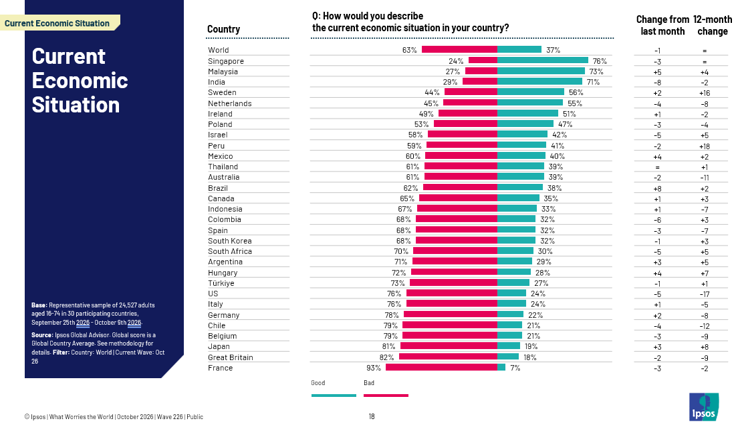
Further, markets with weaker perceptions of their country's direction were also more likely to report poor assessments of their economy, suggesting that economic conditions remain a key driver of public outlook.
India stood out as one of the most positive markets on perceptions of the economy, with 71% describing the state of the economy positively. In contrast, sentiment across most other markets remained subdued, with citizens expressing a far less optimistic view of their economic conditions. The chart below provides the metrics.
What worries citizens?
Ipsos What Worries the World also highlights the issues weighing most heavily on the minds of Indians. Unemployment emerges as the leading concern, cited by 47% of respondents, followed by financial and political corruption (35%), crime and violence (32%), poverty and social inequality (29%), and education (23%). Notably, inflation, which has dominated concerns globally in recent years, ranks lower among Indians at 19%.
Globally, inflation remains the top concern at 31%, closely followed by crime and violence (31%), poverty and social inequality (29%), unemployment (29%), and financial and political corruption (27%).
The survey also identifies the single biggest concern in each market, illustrating how public priorities differ across countries depending on their economic, social and political contexts. The chart below highlights the issue citizens in each market are most concerned about today.
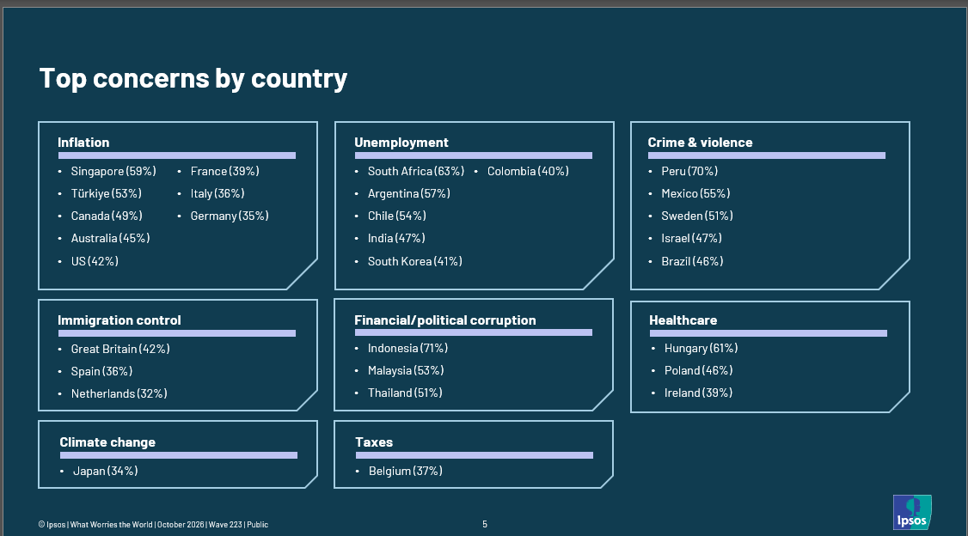
"India presents an interesting paradox. Despite being among the world's most optimistic markets on both the economy and the country's direction, unemployment remains the foremost concern for nearly one in two Indians. This suggests that while citizens are confident about the country's trajectory, they remain focused on the need for broad-based employment opportunities and economic inclusion.
The prominence of unemployment and corruption among India's top concerns highlights that citizens increasingly measure progress not just by economic growth, but by access to jobs, fairness and opportunity. As India continues to strengthen its labour market, maintaining momentum on job creation will remain essential to converting economic optimism into lasting public confidence," added Ramalingam.


