India Defies the Global Cost-of-Living Squeeze: Ipsos Cost of Living Monitor 2026
At a time when the cost of living continues to dominate household concerns around the world, India stands apart as one of the most resilient consumer markets globally. Nearly six in ten Indians (59%) (top2box) describe themselves as financially comfortable or doing alright, well above the global average of 38%. At a time when many consumers globally report growing financial strain, India ranks among the strongest-performing countries on financial wellbeing.
These are the findings of the Ipsos Cost of Living Monitor 2026, spanning 33 countries, that reveals a sharp divergence in how consumers are experiencing and responding to the pressures of a higher-cost environment. Across many advanced economies, rising prices are increasingly translating into concerns about financial security, purchasing power and future living standards. In India, however, consumers continue to demonstrate a stronger ability to weather these pressures while maintaining confidence in their household finances and quality of life.
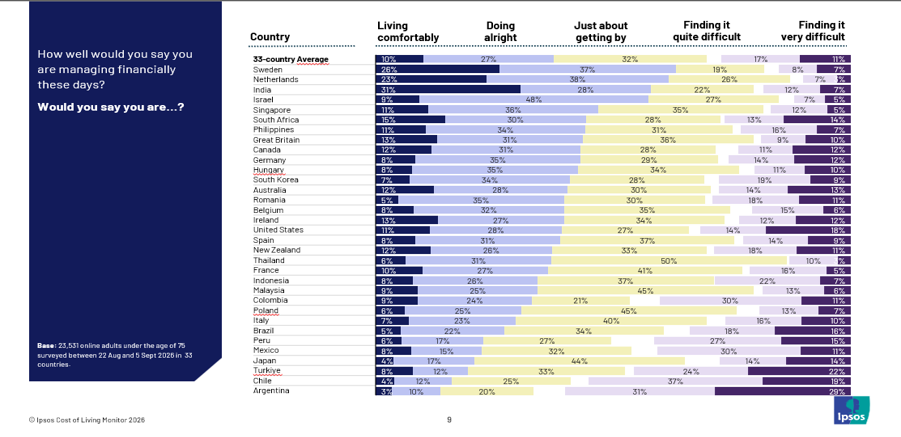
The findings also reveal that Indians remain considerably more positive than their global peers about the trajectory of their household finances. More than half (54%) expect their disposable income to increase over the next year, the highest level recorded across all countries surveyed. Similarly, a majority (57%) anticipate improvements in their standard of living, placing India among the most positive markets globally.
Together, these findings point to a consumer landscape where rising costs are acknowledged but have not fundamentally altered expectations about future financial progress.
Cost Pressures Remain Front and Centre
India's resilience does not reflect an absence of concern about inflation.
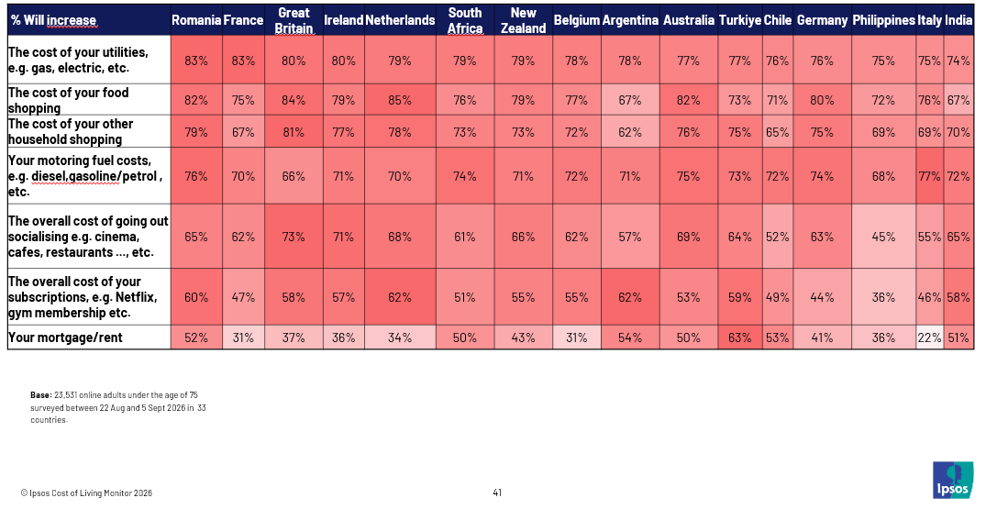
The study finds that Indians remain highly conscious of rising living costs and the challenges they pose to household budgets. Two-thirds (66%) expect inflation to increase over the coming year, while substantial majorities anticipate further rises in the cost of utilities, groceries, fuel and other essential household expenses.
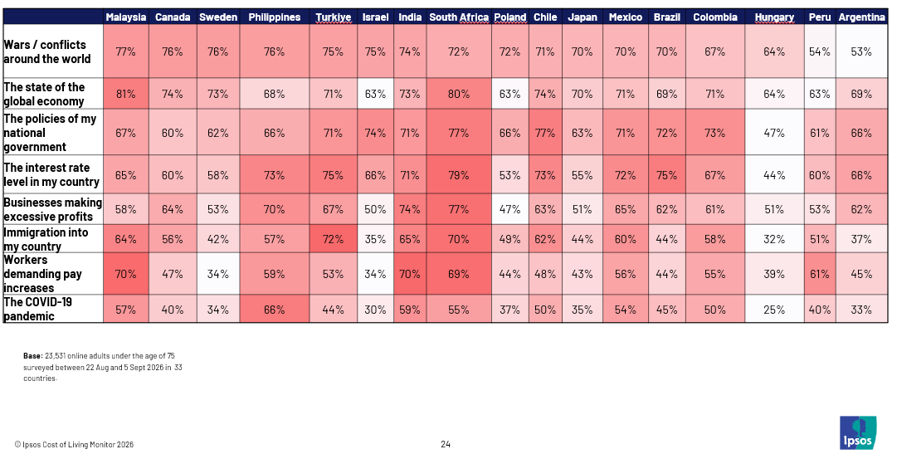
Consumers identify several factors contributing to cost pressures. Nearly three-quarters (74%) cite global conflicts and their consequences as key drivers of rising living costs, while around 74% to government policies and excessive corporate profits,73% hold the state of the global economy, 71% interest rates as some of the key contributing factors.
These findings underline a reality shared by consumers around the world: the cost of living remains a significant concern. What distinguishes India is not the absence of pressure, but the way consumers appear to be responding to it.
Suresh Ramalingam, CEO, Ipsos India stated, "The defining story in this year's Cost of Living Monitor is not whether consumers are facing inflationary pressures, because that is a near-universal reality. The real difference lies in how consumers believe those pressures will affect their future. In many markets, rising costs are increasingly associated with declining living standards and reduced financial security. India stands apart. Consumers recognise the strain on household budgets yet continue to demonstrate a remarkable belief in their ability to maintain purchasing power, improve their living standards and progress financially. That resilience makes India one of the most distinctive consumer stories in the global cost-of-living landscape. Government welfare schemes have increased the disposable income available to low-income households, enabling greater discretionary consumption.”
Methodology
These are the results of a 33-country survey conducted by Ipsos on its Global Advisor online platform, between Friday, August 21, and Friday, September 4, 2026. For this survey, Ipsos interviewed a total of 23,531 adults aged 18 years and older in India, 18-74 in Canada, Republic of Ireland, Malaysia, New Zealand, South Africa, Türkiye, the United States, and Vietnam, 20-74 in Thailand, 21-74 in Indonesia and Singapore, and 16-74 in all other countries.
The sample consists of approximately 1,000 individuals each in Australia, Belgium, Brazil, Canada, France, Germany, Great Britain, India, Italy, Japan, New Zealand, Philippines, Spain, and the U.S., and 500 individuals each in Argentina, Chile, Colombia, Hungary, Indonesia, Ireland, Malaysia, Mexico, the Netherlands, Peru, Poland, Romania, Saudi Arabia, Singapore, South Africa, South Korea, Sweden, Thailand, and Türkiye.
Samples in Argentina, Australia, Belgium, Canada, France, Germany, Great Britain, Hungary, Italy, Japan, the Netherlands, New Zealand, Poland, Romania, South Korea, Spain, Sweden, and the U.S. can be considered representative of their general adult populations under the age of 75. Samples in Brazil, Chile, Colombia, India, Indonesia, Ireland, Malaysia, Mexico, Peru, Philippines, Singapore, Saudi Arabia, South Africa, Thailand, and Türkiye are more urban, more educated, and/or more affluent than the general population. The survey results for these countries should be viewed as reflecting the views of the more “connected” segment of their population.
The data is weighted so that the composition of each country’s sample best reflects the demographic profile of the adult population according to the most recent census data. In Great Britain, the data was weighted by age, gender, and education. “The Global Country Average” reflects the average result for all the countries and markets in which the survey was conducted. It has not been adjusted to the population size of each country or market and is not intended to suggest a total result.
When percentages do not sum up to 100 or the ‘difference’ appears to be +/-1 percentage point more/less than the actual result, this may be due to rounding, multiple responses, or the exclusion of “don't know” or not stated responses.
The precision of Ipsos online polls is calculated using a credibility interval with a poll where N=1,000 being accurate to +/- 3.5 percentage points and of where N=500 being accurate to +/- 5.0 percentage points. For more information on Ipsos' use of credibility intervals, please visit the Ipsos website.
The publication of these findings abides by local rules and regulations.