
360 View of CX in Thailand 2026
Customer expectations in Thailand are evolving rapidly. Consumers increasingly expect experiences that are easy, convenient, personalised and responsive across every interaction and every channel.
But delivering a good product or service is no longer enough.
The latest Ipsos CX Global Insights 2026 findings reveal that while many Thai consumers continue to have positive experiences with brands, significant gaps remain — particularly when something goes wrong.
Our 360 View of CX in Thailand explores the changing customer experience landscape and provides insights into the drivers of memorable experiences, emotional attachment, service recovery, AI adoption and industry-specific CX performance.
The key finding: only 35% of customer issues are fully resolved
While 64% of Thai consumers say they have had a positive and memorable experience with a brand, this figure has declined from 73% last year.
At the same time:
16% report having had a poor experience with a brand.
70% say resolving an issue required roughly equal effort from themselves and the brand.
1 in 5 say they had to put more effort into resolving an issue than the brand.
Only 35% of customer issues are fully resolved.
This highlights a critical challenge for businesses in Thailand. Customer experience is not defined only by how well brands perform when everything goes smoothly. It is also shaped by how effectively a brand responds when customers need help.
Customers may not remember every routine transaction, but they remember the moments when a brand plays an important role in their lives, particularly when something goes wrong and they need support.
Pimtai Suwannasuk, Senior Client Officer, Ipsos in Thailand
From customer satisfaction to emotional attachment
Great customer experience goes beyond functional satisfaction.
Ipsos finds that customers who develop an emotional attachment to a brand demonstrate significantly stronger business outcomes than those whose needs remain unfulfilled. The findings demonstrate that functional performance is the foundation of customer experience — but emotional connection can be a powerful differentiator.
What drives emotional connection?
Four key factors contribute to stronger customer experiences and emotional attachment:
- Empathy
Helpful employees, caring representatives and service staff who understand customers' situations. - Rapid Support
Fast claims, quick problem resolution and timely assistance when customers need help. - Reliability
High-quality products, dependable services and consistent performance. - Recognition
Benefits, rewards, personalised gestures and experiences that make customers feel valued.
Ipsos Building Blocks of Great CX
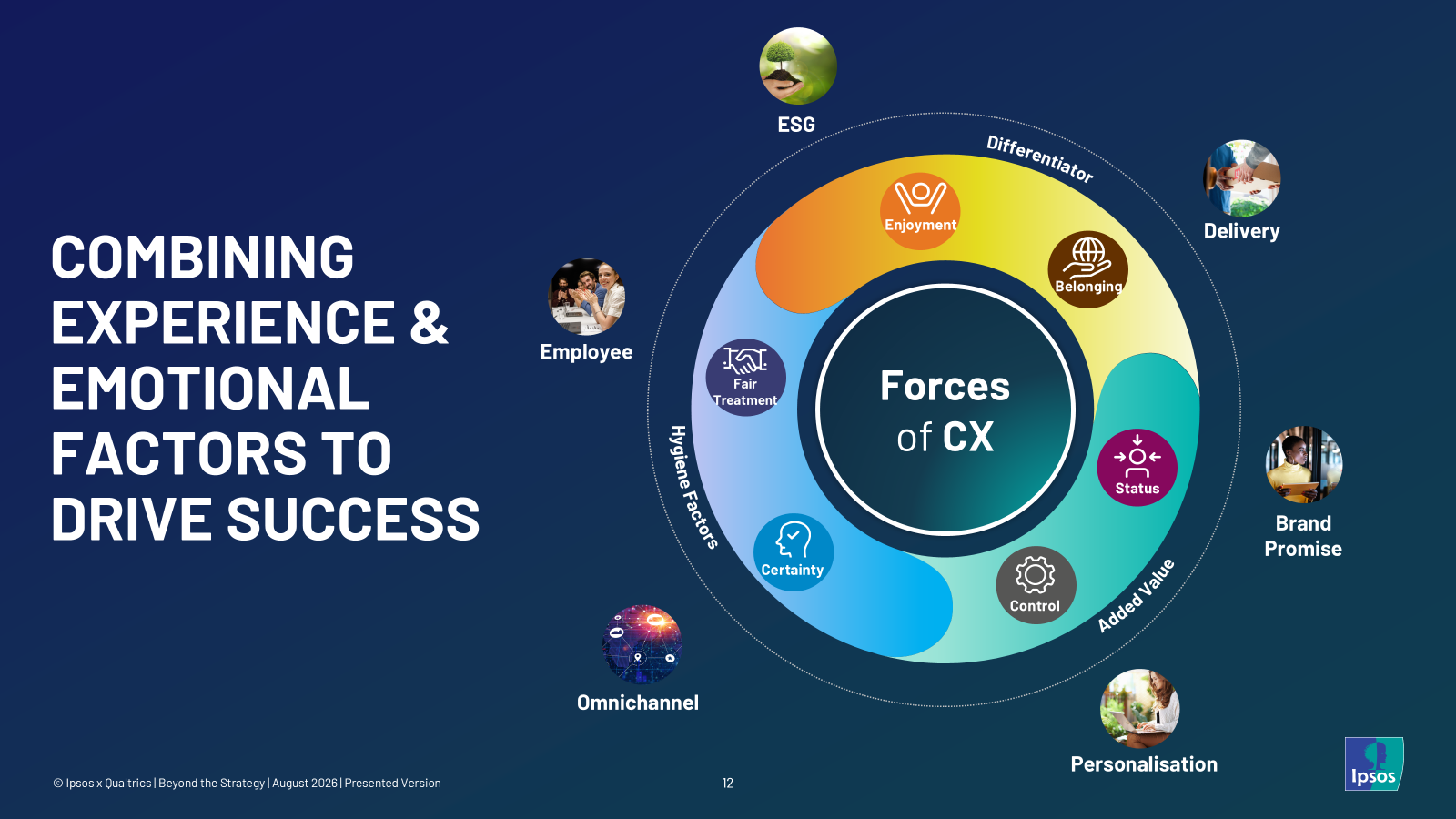
To help organisations understand what drives meaningful customer experiences, Ipsos has developed the Building Blocks of Great CX framework.
The framework connects three critical layers of customer experience:
- Human Needs: At the centre of great CX are fundamental human needs, including belonging, status, control, certainty, participation and how people are treated.
Experience Value: Customer experiences need to deliver the right balance between:
Hygiene Factors — the fundamentals customers expect.
Enablers — elements that make experiences better and easier.
Differentiators — experiences that create meaningful distinction and emotional impact.- Brand Delivery: The experience customers receive is shaped by how brands deliver across:
Together, these elements help organisations take a more holistic view of customer experience — from understanding human needs to delivering consistently across every touchpoint.
What drives great customer experience in Thailand?
Positive and negative experiences differ considerably across industries.
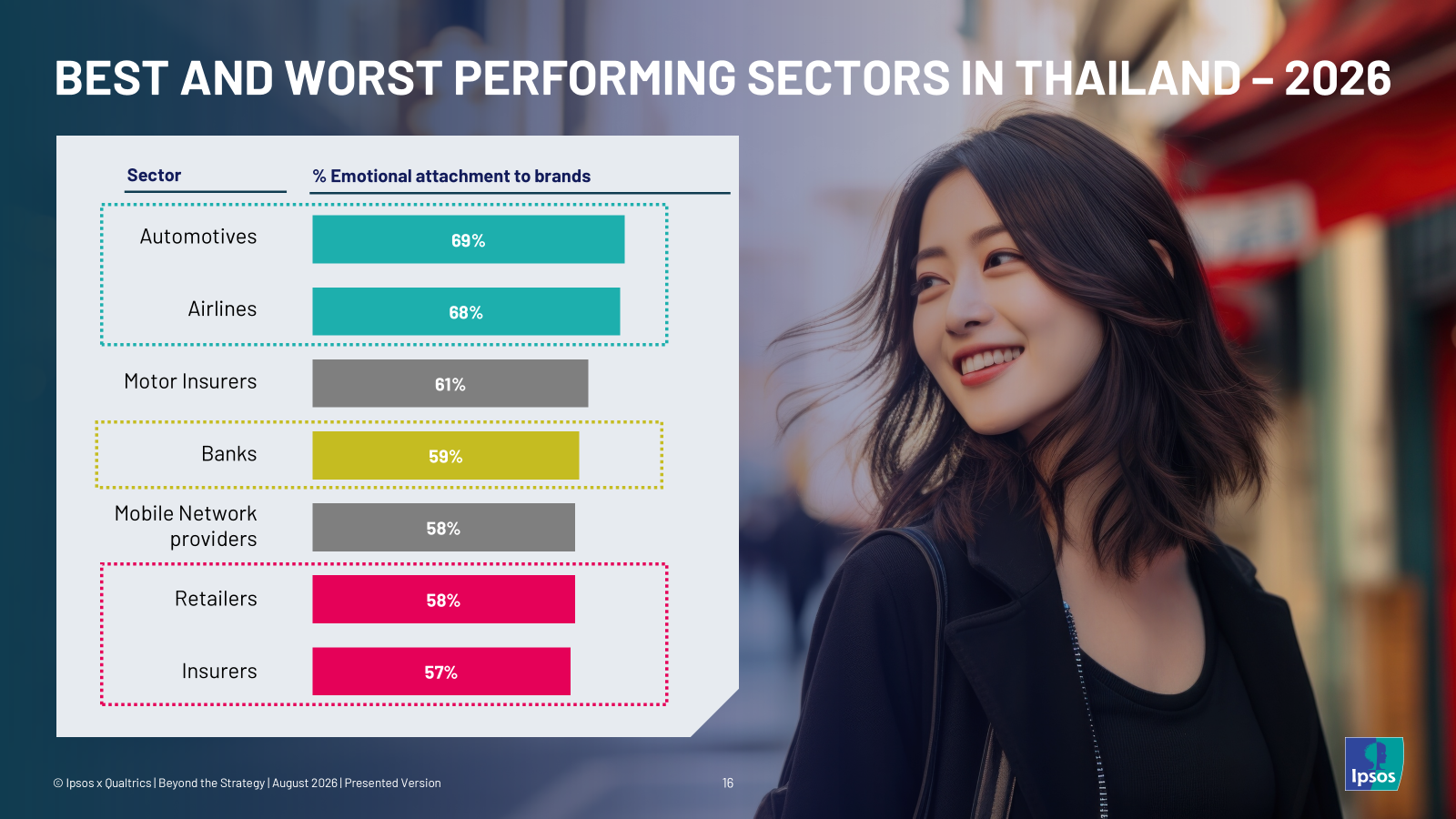
Automotive leads customer experience performance
Across seven key sectors in Thailand, the proportion of consumers reporting positive experiences is
The drivers of positive experiences are different in every industry
In banking, customers value helpful employees and effective problem-solving. Mobile customers respond positively to rewards and network quality. In motor insurance, fast claims services are important, while caring agents play a key role in insurance.
For airlines, attentive employees make a difference. Automotive customers value product reliability, while staff assistance is an important driver of positive retail experiences.
However, the sources of negative experiences also vary significantly — from banking app and system failures to network quality, billing, service delays, flight disruptions, maintenance costs and product availability.
The implication is clear: there is no single formula for great customer experience. Brands need to understand the specific moments, needs and pain points that matter most within their category.
AI in customer experience: technology must create genuine value
AI and automation are becoming increasingly important in the customer experience landscape. However, the Ipsos findings show that consumers do not simply want technology for technology's sake.
In Thailand:
- 10% of consumers say they would allow AI to act by default.
- 24% say they would not use AI at all.
Consumers' willingness to delegate to AI is influenced not only by technology but also by trust, emotional connection and the context of the interaction.
Customers are less willing to allow AI to take over high-stakes or sensitive situations, including financial decisions, insurance disputes and major service failures.
For brands, the question should not simply be:
“Where can we use AI?”
Instead, organisations should ask:
“Where can AI genuinely make the customer experience better?”
Technology should reduce effort, not simply shift effort from the organisation to the customer.
The future of CX in Thailand: the 3As
The Ipsos findings point to three key principles for businesses seeking to build stronger customer experiences in an increasingly technology-enabled world.
Accessibility: Make CX easy and available
Customers expect brands to be accessible when and where they need them.
Effective omnichannel experiences should make it easier for customers to get things done, whether through people, digital platforms or AI. The goal should always be to reduce friction rather than create additional effort.
Algorithmic: Make technology work for people
AI and automation can improve efficiency and optimise customer experiences, but technology must be applied thoughtfully.
Brands should use AI where it creates genuine value for customers, while recognising that human involvement remains important in complex, emotional and high-stakes situations.
Authenticity: Build genuine empathy and trust
Technology cannot fully replace the human qualities that make experiences meaningful.
Empathy, trust, recognition and sincere interactions can transform functional satisfaction into emotional attachment. Brands need to ensure that their actions consistently reflect their promises and that customers genuinely feel understood and valued.
Customer experience must start with people
The future of customer experience in Thailand is not about choosing between human connection and technology. It is about bringing the two together.
Brands that succeed will be those that understand fundamental human needs, use technology intelligently and create experiences that are consistently easy, relevant and emotionally meaningful.
Customer experience must start with people. Putting human needs at the heart of CX design is critical, while AI and automation are simply tools. They matter only when they help brands consistently deliver better emotional outcomes across a wider range of customer experiences.
Pimtai Suwannasuk, Senior Client Officer, Ipsos in Thailand