What is the real cost of the cost of living crisis?
 |
 |
| Dr Ricky Lawton Economic Evaluation Director
|
Cameron Garrett Research Manager
|


A national crisis
The “Cost of Living Crisis” has become such a ubiquitous phrase that it can seem inescapable. Nearly all of us, over nine in ten (93%), have been paying attention to news about it1. This has translated into almost everyone expressing concern about how it might impact the country (91%)2.
For most of 2022, the public have consistently named either inflation or the economy as the most important problems facing Britain in Ipsos’ longstanding Issues Index. In August, the proportion citing inflation reached 54%, levels last seen in the early 1980s, while October saw mentions of the economy peak at 51%, the highest since 20133.
Understandably, the public are pessimistic, as nine in ten (89%) describe the current state of the British economy as poor4. With the Bank of England warning that the UK could “fall into the longest ever recession”5, they are not expecting a snap recovery either. Seven in ten (72%) think the economy will only get worse next year – matching levels of fiscal pessimism last experienced in 20086.
A political crisis
The national economic crisis has gone hand in hand with a political one, and each has fed upon the other. During the Conservative leadership contests this year, the public overwhelmingly said the topic they most wanted to hear about were candidates’ plans for the cost of living, and it was similarly the most important issue in spring’s local elections7.
It has also changed how people judge the economy. A decade ago, during the onset of austerity, unemployment was the most important influence on peoples’ view on the strength of economy, followed by inflation and debt, but now the top factors are inflation, the strength of the pound and interest rates8.
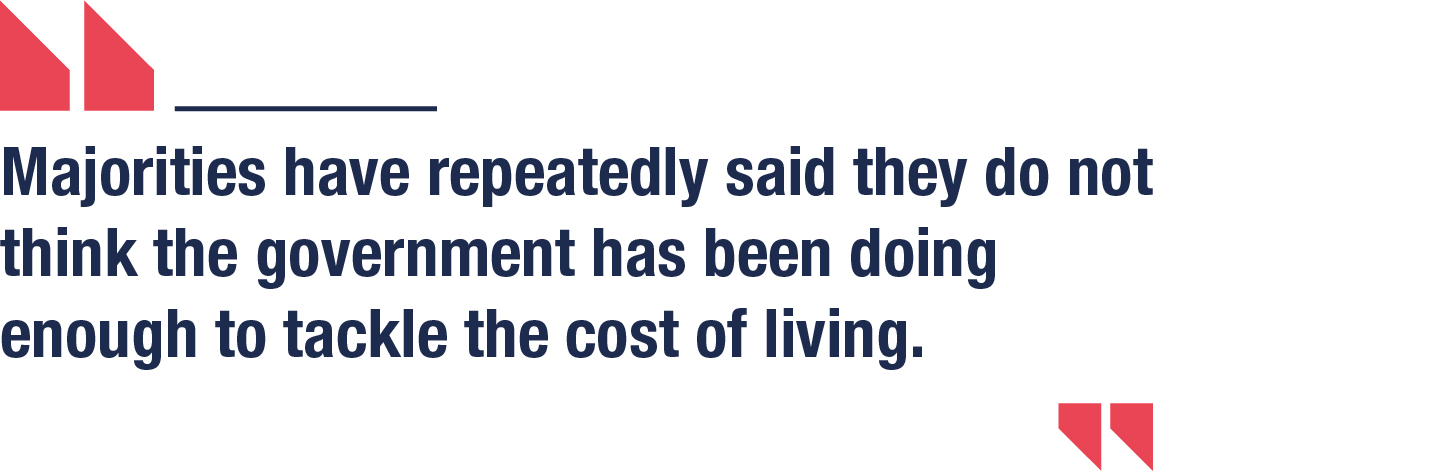
Majorities have repeatedly said they do not think the government has been doing enough to tackle the cost of living, peaking at 76% in mid-May9. This criticism has followed all of this year’s Downing Street inhabitants: three in four (75%) thought Boris Johnson’s government did a bad job on dealing with the cost of living10, Kwasi Kwarteng received the lowest ratings for a Chancellor that Ipsos has recorded since 1976 (following the majority feeling worse off after Liz Truss’ mini-budget)11, and although Rishi Sunak personally is relatively trusted on the economy, the aftermath of the Autumn Statement has left people feeling more concerned than reassured about their own finances and public services12.
This partly reflects the very difficult decisions that face the government, as Jeremy Hunt has recognised. Where the government has acted, some policies have been well-supported. For example, earlier this year, two in three (65%) backed the government freezing the energy price cap13.
When it comes to potential policies to reduce the national debt, there has been support for targeted actions such extending windfall taxes on oil and gas companies, tax rises on higher earners, and freezing overseas aid. But there’s little public appetite for broader, more painful measures such as raising council tax or VAT, limiting spending on public services or public sector pay, or removing the pensions triple lock14.
Ultimately, there are no easy answers to the current state of the economy, and no public consensus on the levels of tax and spending either, as our research for Deloitte’s 2022 State of the State report has shown15.
And while personal economic concerns are likely increasing opposition to tax rises, this is matched by worries about public services – whether that is NHS waiting lists or ongoing concerns about regional inequalities and levelling-up.
A social crisis
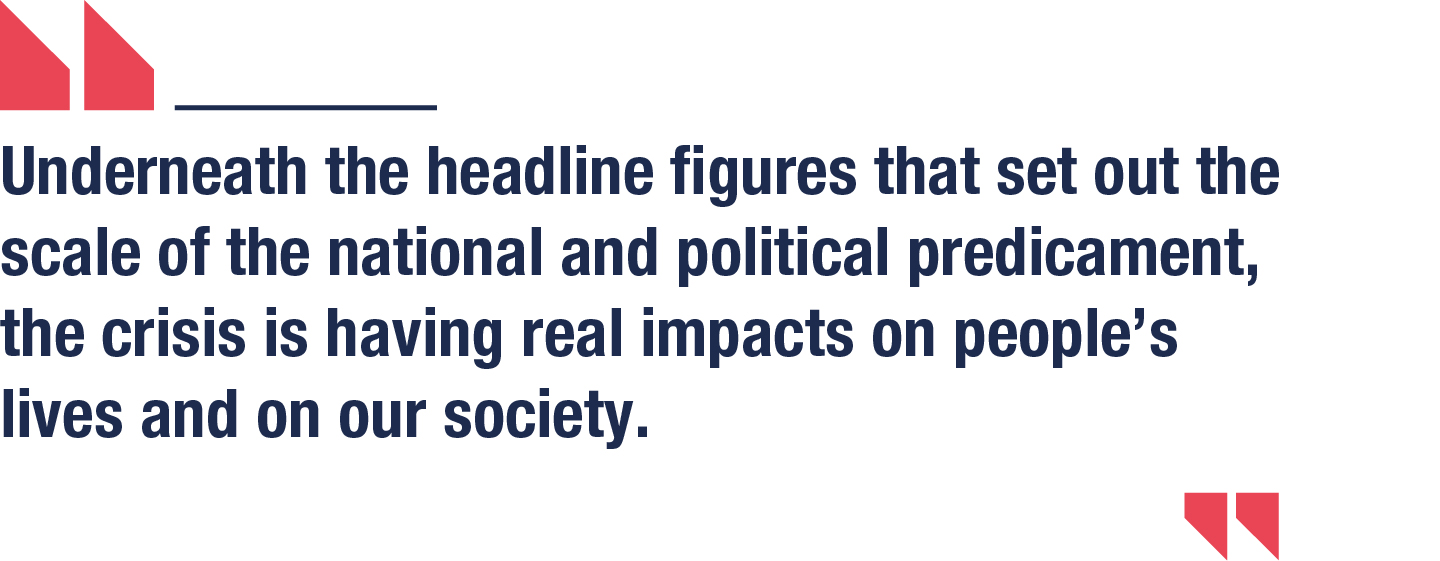
But underneath the headline figures that set out the scale of the national and political predicament, the crisis is having real impacts on people’s lives and on our society.
This is a different debate to the well-rehearsed reasons behind the current price rises: supply chain constraints following a once-in-a-lifetime (maybe) shutdown of swathes of the economy followed by a sudden reopening and resurgence in demand; wars in places that provide fossil fuels and grain to the world; and worsening projections about government debt and climate uncertainty. Many of these are understood by the public, who recognise the range of global factors that are contributing towards rising prices – the pandemic, Ukraine, and general state of the world economy, even if they are also (increasingly) blaming government policies too16.
However, the question for policymakers and public services remains: why does an increase in the cost of living constitute a social crisis, and how can we respond to it?
The answer may seem obvious: suddenly the goods and services we purchase to keep us warm, fed and happy cost more, meaning we cannot afford as many of them as before. This is the ‘macro-economic’ perspective.
But the job of social research is to explore the detailed evidence that sits beneath headline figures; to understand how these macro-economic changes impact individuals’ happiness and welfare: how do reduced household budgets affect people’s ability to satisfy their basic needs, and what trade-offs are made in consuming some goods and services over others?
A wellbeing crisis
The articles in this edition of Understanding Society show the cost of living is impacting all parts of society – from the environment and housing, to health and financial security. These are the ‘domains of wellbeing’ where people’s overall satisfaction with life is achieved. Some are more crucial to life and the pursuit of happiness than others: Amartya Sen and colleagues set out in the 1970s the core capabilities that individuals must be able to enjoy for a good life as part of a Human Capabilities Index:
A decrease in real-terms income decreases people’s economic opportunities, and this limits their ability to maximise their wellbeing. But the cost of living crisis is also impacting on the conditions people require for good health, education, housing, and other crucial domains of wellbeing. And as we show throughout this report, the effects are felt differently by old and young, urban and rural, rich and poor. For example, our Financial Wellbeing tracker reveals five segments across society who are dealing with the crisis in different ways, and identifies the most vulnerable to be renters, those with children, single adult households and people claiming benefits18.
This is to be expected given what we already know about the intersectionality between lower socioeconomic status and other drivers of wellbeing. The impacts are likely to be more severe for lower income households, since a pound lost is worth more compared to those on higher incomes. A pound lost by a household who were previously just scraping by may mean the difference between heating and feeding your family – one in four have told us they have skipped meals to cut costs. Meanwhile, those on higher incomes are more likely to make lifestyle changes such as driving their car less or switching to cheaper brands19.
This is known as the ‘diminishing marginal utility of income’: as you earn more, each additional pound is worth relatively less in terms of the ‘happiness’ it will buy you, but when you are on the breadline, that pound lost may be the difference between food and heat.
An enduring crisis
This is not simply a pounds and pence argument. Economists talk about ‘negative externalities’: by-products of economic activity. During economic downturns, externalities can include lifelong health conditions associated with children living and sleeping in cold conditions or receiving inadequate childcare20; the anxiety and distress of living in financial insecurity21; or the lost years of life in areas which have higher pre-existing levels of health deprivation22.
The cost of living constitutes a crisis for the very fabric of society if the societal narrative of growth and progress feels reversed. Six in ten are already worried about their household’s financial situation, more than double the number saying they are struggling on their income23.
Evidence suggests that it is not just the direct impacts, such as unemployment in a recession or a reduction in real-terms income because of inflation, which influence wellbeing; people’s wellbeing is also affected by indirect impacts such as uncertainty and negative expectations by limiting their life choices24. And when decisions are made under stress and constraints – within a fog of financial uncertainty and immediate stresses about choosing between heating costs or food bills – they tend to be poorly judged, sub-optimal, and with negative consequences for long-term outcomes, producing further risks for individuals and society more broadly.
There is no doubt that the cost of living is a priority for both the public and policymakers – in the same way that COVID-19 was, not so long ago – and it is likely to dominate the agenda throughout 2023 too.
This means it is vital to explore what this multifaceted crisis really means for different individuals and groups, as circumstances vary and people are affected in different ways. We cannot forget that there are real lives being affected and research can help us make sense of the complexity of people’s reactions and needs so that solutions can be better balanced. This has implications across a whole range of public services – from how we organise and deliver our health service, to the food we eat, and the way we manage support benefits. So having a better understanding of how this situation affects people can help us to better predict, prepare for, and manage the pressures on public services and society, and help us to navigate this complex time with greater confidence now and for the future.
Some other articles you might like...
|
|
|
|
| An economist's take: Interview with Dr Linda Yue | Poverty, poor health, and the NHS: Stopping the spiral | Food insecurity: too much to stomach |