Mission critical – Levelling Up, a balancing act
 |
Holly Day Senior Research Executive
|


The cost of living crisis is all consuming, with the potential to push inequality down the issues agenda while inflation and the economy take centre stage. However, this doesn’t mean that it’s been forgotten, and the consequences of the decisions being made now are likely to be felt differently across the country.
Despite overarching economic concerns, the nations and regions across the UK still expect action to level up the country and invest as much in their area as others. As shown in Figure 1 below, the North East, North West and Yorkshire & the Humber in England, and the devolved nations, feel particularly strongly that Westminster doesn’t spend or invest as much in their local area as it does in other regions - a perception that could be reinforced by tough economic decisions in the years to come.
Figure 1: Perceived government spending across UK regions
Throughout the summer leadership campaign and subsequent October sequel, there were calls for Conservative candidates for Prime Minister not to lose sight of the flagship 2019 manifesto commitment to level up the country. However, alongside the economic difficulties for the government, the public aren’t convinced that they will deliver on levelling up either.
Our data94 shows that a majority think it unlikely that government policy will reduce inequalities in their local area in the long-term (59%), and the ominous national economic challenges will not make this any easier. However, the government should also consider that addressing the existing inequalities in the first instance could improve some of the economic issues we face with productivity and growth.
So how does the government measure up? The economic threat to local progress
The Ipsos Levelling Up Index95 was established to track public perceptions of the government's performance on the levelling up agenda. We have taken the twelve missions set out in the Levelling Up White Paper – which range from increasing R&D investment, to improving wellbeing and devolution – and collected data to generate a score for each mission commitment. The Levelling Up Index scores each mission between +200 and -200 based on a range of different survey questions.
 Following the latest Index as shown in Figure 2, across the 12 missions, our findings suggest the public are generally more positive than negative on the current state of most of the missions in relation to their local area – particularly in ensuring internet accessibility and people's wellbeing (although we saw little signs of progress in the first part of the year, and many ratings are at best lukewarm). However, public opinion is more pessimistic when considering the levelling up goals around devolution, R&D investment, crime and housing.
Figure 2: Ipsos’ Levelling Up Index Mission scores May 2022
It could be argued, however, that three aspects of levelling up are particularly under threat by the current cost of living crisis: wages, wellbeing and local pride. Record levels of economic inactivity and inflation threaten wages. Wellbeing is threatened by increasing worry about the cost of living and the real-life impacts of people having to tighten their belts. And pride in place is dented by underinvestment in high streets and the impact of the recession on local businesses.
Given the economic uncertainty and with productivity stagnation over the past decade and a half, the public were looking for action on jobs and wage increases even prior to the inflationary impacts on people’s everyday spending.
Our research into personal finances has also revealed that concerns about income impacts personal wellbeing. Although absolute levels of wellbeing remain more positive than negative, the current economic uncertainty and subsequent impact on households and individuals threatens this balance. Life satisfaction, happiness, and feelings about their local area are all being impacted, with inter and intra-regional disparities becoming increasingly apparent96. Mental health and wellbeing are a public priority and a commitment to narrowing the gap is explicitly stated as a government mission so measurable success here is crucial.
Similarly, the public are evaluating their local high streets, town centres and facilities against the backdrop of underinvestment. Following the hardships of the pandemic for local economies, the government faces a challenge to rejuvenate areas in need. Funds have been set up as part of this commitment (High Streets Fund, Towns Fund) and the public see this as a core local identity issue - with tangible improvements vital to personal and local satisfaction measures.
Let’s take a look at each of these three missions in turn, taking account of the current economic and political backdrop and how public perception differs across the country.
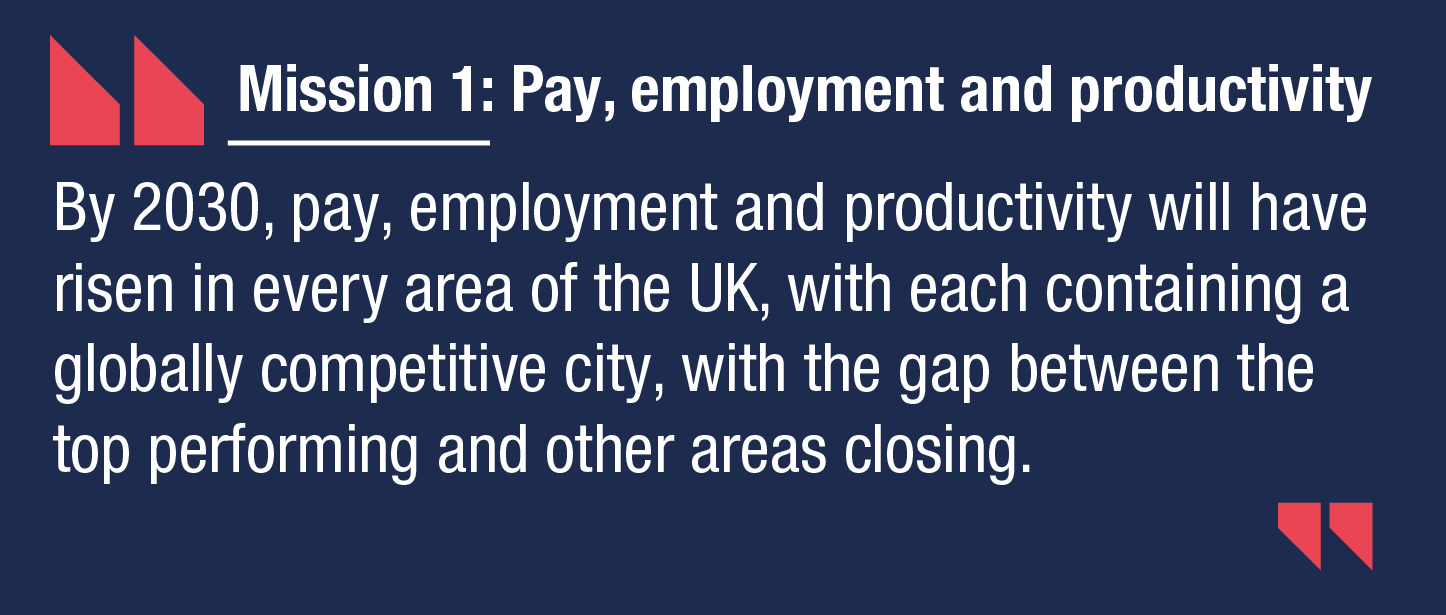 Record levels of economic inactivity, real terms pay cuts and stagnating productivity threaten the government’s mission to boost employment, pay and productivity. Action to tackle the multi-faceted economic crisis risks further widening the gap between more and less deprived areas across the country. The Social Mobility Commission97 reported that areas of the highest deprivation already experience lower pay, lower social mobility, lower house prices, a smaller professional labour market and fewer educational opportunities. Further cuts to public services, pay cuts and inactive or unproductive workforces could exacerbate these issues and widen gaps between these and more affluent areas.
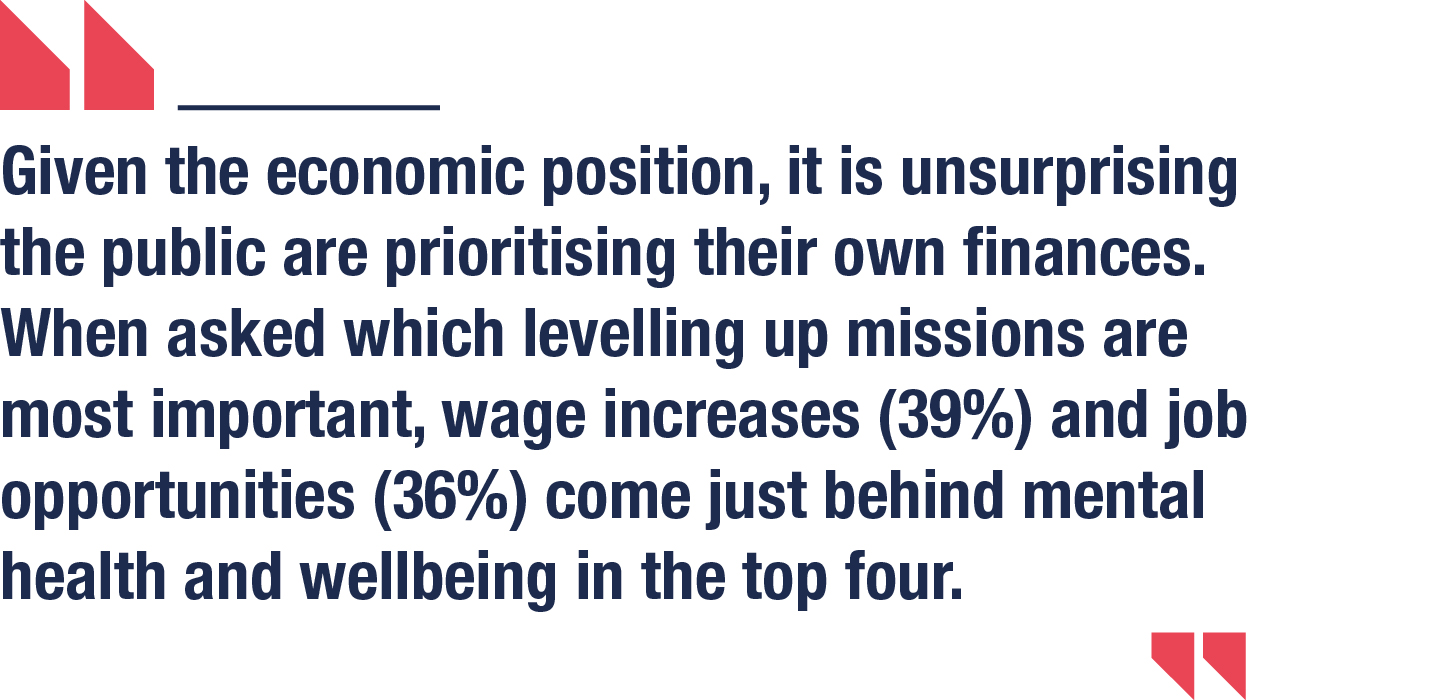
Given the economic position, it is unsurprising the public are prioritising their own finances. When asked which levelling up missions are most important, wage increases (39%) and job opportunities (36%) come just behind mental health and wellbeing in the top four.
There are significant regional differences when looking at satisfaction with pay, employment and productivity. More deprived areas are more critical on this mission: the most deprived areas produce a score of -11 compared to +34 in the least. Figure 3 below illustrates on our index scale how the regions across the UK perceive their area to be performing on measures relating to pay, productivity and employment.
This translates into more positive views across southern regions, and more negative views further north, particularly in the North East, which are the very regions the government are trying to target with the levelling up agenda. With median weekly earnings at £640 across the UK, again there are regional disparities, with the South East (£664) and London (£805) earning above the average, while those in the North East (£575) and Yorkshire (£579) are earning below.
Figure 3: Ipsos’ Levelling Up Index Mission 1- Pay, productivity and employment by UK region
ONS figures98 show unemployment now sits at 2.5%, continuing a downward trend. However, the economic inactivity rate (those neither employed nor unemployed and actively searching for work) has risen to 21.7% and is increasing. Large proportions of the older working age population have taken early retirement, exacerbating labour shortages in critical sectors, an issue that the Bank of England warned would further drive up prices and wages, fuelling inflation and hampering growth.
The year building up to April 2022 saw a real term cut of 2.6% in average total pay99, with inflation since then outpacing pay increases. This has paved the way for strike action across the public sector including nurses, ambulance drivers and rail workers.
According to Ipsos’ Financial Wellbeing tracker100, three in five are now worried about their financial situation (59%). Those in the South West and South East of England are less concerned about their financial situation, with the strongest concern in the North East- over a third of whom are finding it very difficult or difficult and feeling worried (37%). The majority say they have curtailed their saving while three in ten have been dipping into their savings to fund their day-to-day spending. This is as one in five are reporting increases in their rent - disproportionately hitting those on lower incomes and/or those that are less financially secure.
Both the public purse and household finances are facing a turbulent period, which will inevitably have long-term consequences. The government will be assessed by the public on this mission by their ability to protect jobs, boost wages and keep local economies moving.
 There is a strong link between financial concerns and wellbeing, with those living comfortably and not worried about their finances reporting higher levels of life satisfaction than those finding it very difficult and worried about their finances, as shown below in Ipsos’ Financial Wellbeing tracker (Figure 4 below).
Figure 4: Ipsos’ Financial Wellbeing Tracker- Life satisfaction by financial comfort
Financial pressures can impact on an individual’s health – and our tracker shows that improving people’s mental health and wellbeing is the joint top priority for people’s local areas.
The mission strives to improve wellbeing across the country and crucially reduce the gap between areas, and although the public are positive on these measures, there are signs that financial worries could have a particularly negative impact on the wellbeing of those more likely to be struggling already.
Figure 5: Ipsos’ Levelling Up Index Mission 8- Wellbeing by Indices of Multiple Deprivation
The happiest among us are those in the South – specifically South West (+79), South East (+73) and East of England (+73) - all above average.
However, there are underlying differences relating again to deprivation levels on this mission as shown in Figure 5, as those living in the most deprived areas tell us that they are unhappier than those living in more affluent areas. This shows that despite the regional consistency across the country as a whole, within regions themselves, significant disparities in wellbeing measures exist. Similarly, socioeconomic disparities exist, with the long-term unemployed (+9) and full-time students (+39) rating less positively.
With the mission explicitly aiming to close the gap, mental and/or financial difficulties for those living in the most deprived areas could significantly inhibit the government’s ability to succeed.
 The public are pessimistic when it comes to government action to improve their local area. Following the pandemic, high street rejuvenation is desperately needed in order to create vibrant local communities that provide people with a sense of belonging. Investment is key, and economic circumstance will also play a role in dictating what rejuvenation is possible.
Funds such as the Future High Streets Fund and widened support from the High Street Task Force were committed to as part of the Levelling Up White Paper, in an attempt to rejuvenate localities. According to the Centre for Progressive Policy, one in four (26%) said that investment to improve high streets was a priority for improvement in their local area. The Centre for Cities have commented that 'the lack of economic dynamism is the root of the problem, and derelict high streets are the outcome, not the other way around'101.
 Of the 12 missions, local pride showed some of the biggest variation by level of deprivation. It is those who live in the most deprived areas who are the least proud, compared to more affluent areas. But there are also clear differences by type of area, as shown in Figure 6, with pride in place lower for those living in areas categorised by the ONS102 as Service and Industrial Legacy areas such as traditional mining towns (+16), as well as for many mid-level towns and cities in Urban Settlements (+23) and Ethnically Diverse Metropolitan areas in outer London and other large centres of population such as Birmingham, Leicester, Luton and Slough (+25) , compared with Affluent England in counties around London (+58) and inner-London Cosmopolitan boroughs themselves (+63).
Figure 6: Ipsos’ Levelling Up Index Mission 9- Pride in Place by ONS Area Classification
According to the Ipsos Levelling Up Index, worrying statistics for the government attempting to improve the living standards of people and communities across the country are that a significant majority don’t think that the government cares about them (78%) or their local area (80%). Less than one in ten (9%) think that the government is going to make a positive difference to their local area, which highlights the challenge of public perception when it comes to levelling up.
All of this sits within an uncertain economic context where 75% of people expect the local situation to worsen in the coming year. One of Rishi Sunak’s first acts as Prime Minister in forming his cabinet was to re-appoint Michael Gove to the Department for Levelling Up, Housing and Communities - an appointment welcomed by levelling up champions who had called for an ‘experienced operator and effective manager who understands the task ahead’. The next stage will be to square the circle of a public desire for greater investment where they live, at a time of profound economic challenge and with commitments to fiscal responsibility.
The government’s levelling up agenda is going to go head-to-head with the reality of a cost of living crisis, at which point, public attitudes towards these three missions in particular will be significantly challenged - as well as towards progress on the agenda as a whole. But given the importance Britons place on improving regional inequalities, and the potential for it to improve our underlying economic performance in the first place, the promises of levelling up are unlikely to be forgotten.
Some other articles you might like...
|
|
|
|
| Paying a price for rural living | Poverty, poor health, and the NHS: Stopping the spiral | Harsh home truths |