India retains top spot with highest national index score of 64.5 across 29 global markets: LSEG-Ipsos PCSI July 2024
The July 2024 wave of the LSEG-Ipsos Primary Consumer Sentiment Index (PCSI) shows India retaining the top spot across all 29 countries covered in the survey, with the highest national index score of 64.5, displaying the highest consumer sentiment, despite the sentiment lowering by -0.7 percentage points in July 2024.
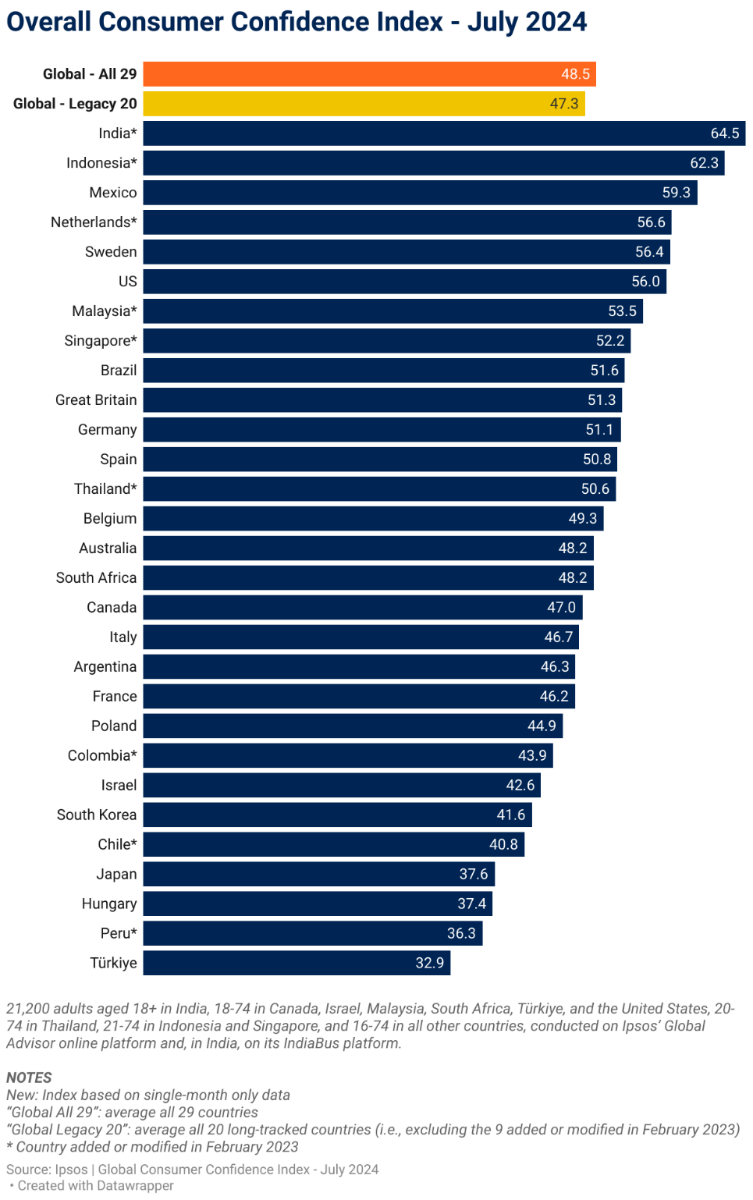
India and Indonesia (62.3) are the only countries with a National Index score of 60 or higher.
Eleven other countries now show a National Index above the 50-point mark: Mexico (59.3), the Netherlands (56.6), Sweden (56.4), the U.S. (56.0), Malaysia (53.5), Singapore (52.2), Brazil (51.6), Great Britain (51.3), Germany (51.1), Spain (50.8) and Thailand (50.6).
Notably, Spain’s National Index score is the highest for the country since tracking began back in March 2010.
In contrast, just four countries show a National Index below the 40-point mark: Japan (37.6), Hungary (37.4), Peru (36.3), and Türkiye (32.9).
The LSEG-Ipsos PCSI maps consumer sentiment on 4 sub-indices and while sentiment around the PCSI Current personal financial conditions sub index (Current Conditions) was up +0.1 percentage points, sentiment around the PCSI Employment Confidence (“Jobs”) sub-index, has seen a minor dip of -0.2 percentage points; the PCSI Investment Climate (“Investment”) sub-index too too has seen a minor dip of -0.2 percentage points; it’s the PCSI Economic Expectations (“Expectations”) Sub-Index that has dropped by -3.2 percentage points.
Amit Adarkar, CEO, Ipsos India said, "India being the highest on the national index score despite all the global ongoing disruptions, speaks volumes about our resilience and our demographic dividend steering our economy through domestic consumption. The good news is that personal finances have seen an uptick which means consumers have funds for day to day spends and running their households. Confidence is slightly shaken around the economy, as there is a global economic slowdown and in India too there was an initial setback on the govt being a coalition one with external support. But, after the budget, the dust has settled and both partners of TDP and JD(U) have vowed unstinting support to the govt to last its full term of 5 years. Things are back on grid and bode well for the economy and the confidence of the people in the system."
Compared to 12 months ago, eight countries have shown a significant drop in consumer sentiment. In contrast, thirteen countries have shown a significant increase, most of all in Argentina (+9.0), India (+7.7), and South Africa (+7.6).