Indians hold positive views for road to net zero; show misperceptions about aspects of climate change: Ipsos Earth Day 2025 Global Report
The Ipsos Earth Day 2025 Global Report shows Indians hold positive views to net zero and believe transitioning India’s economy away from fossil fuels and towards renewable energy is likely to have a positive impact on a gamut of key areas – 43% citizens believe the transition to renewable energy will have a positive impact on air quality; 44% are of the view that public health will see a lot of improvement; 45% citizens expect the employment levels to improve; further, urban Indians expect positive impact towards food security (43%), disease outbreaks around the world could see improvement (41%), positive impact on global security (44%), natural disasters (43%) and animals around the world (43%).
“Cutting down on carbon emissions through sustainable vehicles choices using electrification, waste management, making lifestyle changes through use of public transportation is our aim of achieving net zero. And our progress needs to be consistent to make India realize its goal of reaching net zero by 2070, as announced by PM Modi at COP26 in 2021. Indians see the positive impact of moving away from fossil fuels on the ecosystem,” said Parijat Chakraborty, Group Service Line Leader, Public Affairs, Corporate Reputation, CSR & ESG, Ipsos India.
Misperception among Indians across a plethora of issues
The survey mapped views of citizens on a number of macro issues to understand their sense of awareness around them. The survey showed glaring misperceptions:
When we probed about what proportion of SDG Goals were on track to be achieved by 2030 – the correct answer was a fifth (17%) – only 25% got it right by answering a fifth – the others said 70% (14%), about half (25%), and less than 5% (17%). The Sustainable Development Goals (17 of them) were adopted by all UN member states in 2015 and set goals for peace and prosperity to be achieved by 2030.
On the proportion of global waste currently collected and managed sustainably, the correct answer was a fifth (22%). Only 24% Indians rightly answered a fifth. The others said 70% (15%), about half (26%) and less than 5% (16%).
Citizens were probed on their awareness of water crisis – that what proportion of the world experienced severe water scarcity for at least part of the last year. The correct answer was about half – only 27% Indians answered correctly (about 50%) – the rest said 70% (14%), about a fifth (26%) or less than 5% (15%).
Last, but not least, citizens were asked to share the proportion of species threatened with extinction globally – the correct answer was about a quarter (28%) – the closest answer was a fifth, answered by 23% Indians – the rest were off the mark with 70% (16%), about half (27%) and less than 5% (16%).
In terms of their sustainability journey, globally the citizens were divided into 5 groups. The Activists (21%) holding the belief that it is upon me to accelerate change and wake up the world; willing contributors (14%), with the belief that I know it is urgent and I am happy to contribute; discerning realists (20%), with the view, I’m focused on proven ESG solutions that fit into my busy lifestyle ; passive compilers (21%), saying, I will do enough not to be called out; and last, disengaged distancers (24%), with the belief, I am not the one to save the world. Indians were seen to be displaying a lot of disengaged distancers’ trait, with only 54% Indians believing that they needed to act urgently to combat the impact of climate change, else they would be failing their future generations. 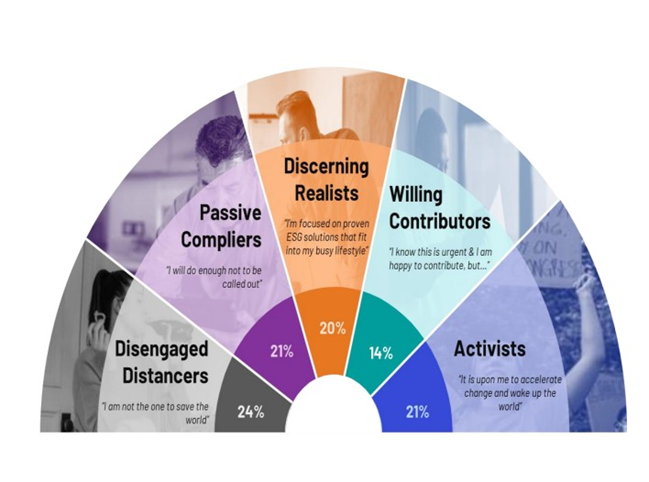
The survey highlighted the importance of brands to assess where they were on their sustainability journey and see how they could engage with the 5 different segments of consumers. Consumers on their part were seen to trust the environmental claims of companies about their products and processes. With 4 in 10 Indians (40%) endorsing this view and in comparison, only 22% global citizens held this view.
These are the findings of the Ipsos Earth Day survey titled Ipsos People and Climate Change Report that showed majority of Indians were concerned about the impact of climate change, but fewer felt they need to act. The survey was conducted in 32 countries and among 23,745 respondents.
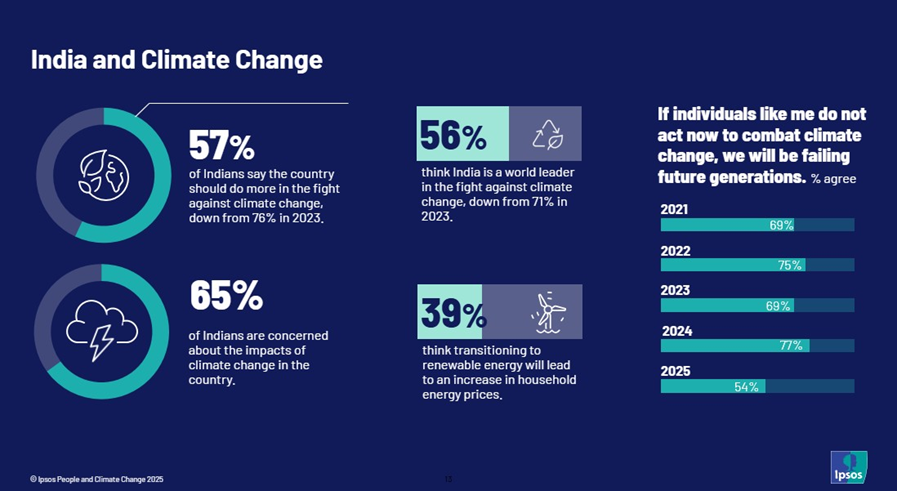
The India snapshot looked like this:
The survey also highlighted one key trend of APEC markets.
25% of Australians believe their country is a world leader in the fight against climate change. Climate concern is real—but confidence is low.
58% of Kiwis say the country should do more in the fight against climate change, down from 64% in 2024. Yet only 28% think New Zealand is a world leader for climate change.
87% of Indonesians are concerned about the impacts of climate change in their country. One of the highest globally.
79% of Thais say their country should do more to combat climate change. A strong public mandate for action.
Climate momentum is growing. 72% of Malaysians want more action, up from 68% in 2023.
90% of Filipinos are concerned about impact of climate change in the Philippines - the highest across all 32 countries surveyed.
In 2023, 71% of Indians believed their country was a climate leader. In 2025, that number has dropped to 56%.
Despite rising concern (from 69% in 2022 to 81% in 2025), only 49% of Japanese think the country should do more to fight climate change.
Climate concern is climbing. 85% now worry about the impact of climate change in the country.
81% of Singaporeans are concerned about climate change, yet only 63% think the country should do more to fight climate change.
Most markets across the region are harping on the need for action. Japan, India are somewhat losing interest.
Technical note: Ipsos interviewed 23,745 people online between January 24, 2025 and February 7, 2025 in 32 countries. Quotas were set to ensure representativeness and data have been weighted to the known population profile of each country. The sample consists of approximately 1,000 individuals each in Australia, Brazil, Canada, France, Germany, Great Britain, Italy, Japan, New Zealand, the Philippines, Spain, and the U.S., and 500 individuals each in Argentina, Belgium, Chile, Colombia, Hungary, Indonesia, Ireland, Malaysia, Mexico, the Netherlands, Peru, Poland, Singapore, South Africa, South Korea, Sweden, Switzerland, Thailand, and Türkiye. The sample in India consists of approximately 2,200 individuals, of whom approximately 1,800 were interviewed face-to-face and 400 were interviewed online.
We’ve highlighted one key insight per country in this carousel — offering a snapshot of evolving attitudes in the region.
From rising climate concern in South Korea to shifting perceptions in India, this data reflects how citizens are engaging with the issue today.