
Consumer confidence experiences sharpest decline since COVID and brand trust hits a new low in Asia Pacific
Consumer confidence across the Asia Pacific has hit one of its sharpest declines since the pandemic in April 2026, as the ongoing Iran conflict intensifies economic pressure, new Ipsos data has revealed. India displays highest confidence. However, due to the change in the methodology in India from face to face and online survey (2200 sample) to only online (1000), in sync with other markets, comparison to previous wave is not being done, and unlike the other waves, this provides an urban view.
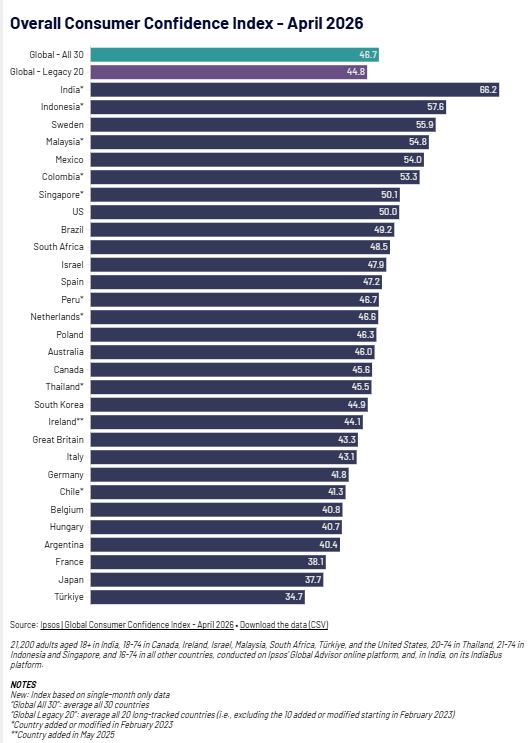
Though some Asian markets continue to figure among markets with highest confidence, like Indonesia and Malaysia.
In India, Ipsos Country Manager, Suresh Ramalingam, said “The Iran conflict is testing India’s resilience. Higher import costs are pushing consumers toward essentials, and the government has introduced measures like ‘low flame menus,’ fuel saving cooking alternatives, and incentives for renewables and electric mobility. These initiatives reflect India’s dual push for affordability and sustainability, with brands that emphasize resilience and innovation best placed to connect with cautious consumers.”
The new Understanding Asia: Brand Shifts in Asia Pacific Amid the Iran Conflict report shows how the US-Iran conflict is sending shockwaves across the Asia Pacific, reshaping economic stability, energy security, consumer confidence and brand trust perceptions.
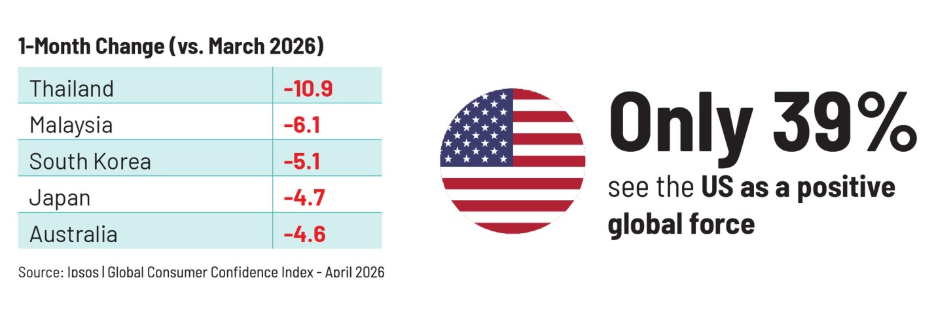
According to the report, consumer confidence has experienced one of its sharpest declines since COVID-19, with Asia Pacific nations accounting for five of the six largest global declines. Thailand (-10.9 points), Malaysia (-6.1 points), South Korea (-5.1 points), Japan (-4.7 points)
and Australia (-4.5 points) all recorded significant declines, in line with Ipsos’ Global Consumer Confidence Index, which has also dropped by two points to 46.7.
The report shows the downturn is being driven by rising fuel costs, inflation concerns and growing economic certainty, which is also affecting how consumers view global influence and brand trust.
The latest Ipsos What Worries the World Monitor backs the data, with a fall noted in the proportion of people who think economic conditions are ‘good’. The fall was highest in South Korea (at 25%, down 17 percentage points), followed by Australia (37%, down 11pp) and Thailand (29%, down 11pp), with Singapore, Malaysia, Indonesia and Japan also - recording declines.
Trust in ‘brand America’ slumps, while China influence rising
Trust in “brand America” is weakening, the report says, with just 39% of 30 countries internationally seeing the US as a positive force, while China’s influence is rising, particularly across ASEAN nations, where positive views of China now exceed 70%.
Ipsos CEO APEC, Hamish Munro, said the sharp fall in consumer confidence across the
Asia Pacific region reflected how deeply the conflict was being felt in households and businesses.
“With trust in ‘brand America’ weakening and Asian brands now gaining momentum,
businesses need a total understanding of local expectations to stay relevant,” he said.
Local market perspectives: how the conflict is shaping Asia Pacific
Across the Asia Pacific, Ipsos country leaders have described a region trying to adjust to the economic and behavioural effects of the US-Iran conflict, with energy volatility, inflation pressures and supply chain uncertainty influencing both policy makers and everyday consumer decisions.
According to the report, the economic impact of the conflict has been most visibly felt through changes to energy markets. Countries that rely heavily on imported oil, including Japan, South Korea, and India, have been particularly exposed to fluctuations in global supply and pricing,
while governments in Southeast Asia have responded with targeted interventions. Region-wide, consumers are adjusting their behaviour in real time, becoming more value-conscious and selective.
In Japan, Ipsos Country Manager, Shunichi Uchida, said: “Japan is highly exposed via energy imports. The conflict shows the difficult trade-off between energy security and climate commitments which is driving fuel price spikes, inflation, and supply risk, pressuring firms and consumers, with discretionary spending falling.”
In South Korea, Ipsos Country Manager, Hwanglye Park, said pressure was being felt through household costs and business confidence: “Seoul has introduced temporary fuel price caps and drawn on PLG reserves, and prepared support for affected exporters and middle-to-lower income households. These measures show how closely energy volatility is tied to consumer behaviour.
For brands, the priority is to offer stability, practical value and reassurance.”
In the Philippines, Ipsos Country Manager, Vicky Abad, said: “Rising fuel costs are already reshaping consumer and government behaviour. Diesel prices have surged ahead of other Southeast Asian markets, prompting the government to declare a National Energy Emergency. We’re seeing reduced mobility, deferred spending, and early signs of softer Overseas Filipino Workers remittances.”
Shifting global influence
As cost pressures intensify, consumers across the Asia Pacific are becoming more cautious and selective, placing greater emphasis on value, reliability, and trust. At the same time, perceptions of global influence are shifting. Just under two in five countries (39%) now see the US as a positive force in world affairs, continuing a downward trend observed across most markets.
In contrast, China’s perceived influence is strengthening, particularly in ASEAN countries, where positive sentiment has exceeded 70% in several markets, including Malaysia (83%), Indonesia (81%), Thailand (74%) and Singapore (71%). Views remain more cautious in Japan and South Korea, where figures stand at 18% and 23% respectively. This divergence highlights a broader realignment in how global power and reliability are perceived across the region.
Nationality as a core brand signal
According to the report, these shifts are reshaping the role of nationality in brand perception. Country of origin is no longer a passive label but an active signal that shapes trust and purchase intent. In many markets, American brands are facing greater scrutiny, while brands from across Asia are gaining legitimacy and relevance.
Ipsos data shows APAC customers are more likely to consider that global brands make better products than strictly local ones (60% in Thailand, 59% in Vietnam and Malaysia, 55% in Singapore, compared to 42% globally), but the rise of global brands of Asian origin in many different sectors is profoundly changing the meaning and implication of this claim.
Although the impact varies by market, the regional story is clear: Asia Pacific is absorbing the conflict through energy costs, inflation anxiety and weakening consumer confidence. As pressure moves through households and businesses, consumers are becoming more cautious, more value-conscious and more selective about who they trust.
ACCESS THE FULL REPORT HERE
https://www.ipsos.com/en-th/understanding-asia-brand-shifts-asia-pacific-amid-iran-conflict