
Know the New America & Beyond: June 2026
While the world’s eyes are often metaphorically on the U.S., those eyes will literally be on the country (as well as Mexico and Canada) for the next month and a half — thanks, of course, to the World Cup. But the event is causing some degree of controversy in the U.S., thanks to sky-high ticket prices. Ipsos polling shows that three in five Americans (59%) believe it’s too expensive for the average American to attend a game; only 2% believe it is affordable. The debate about affordability may introduce a new layer of reputational complexity for brands sponsoring the World Cup.
Still, the event is spurring excitement in the U.S. — and not just for the home team. Two in five Americans (41%) say there are other countries they enjoy rooting for besides the U.S., according to Ipsos polling.
As the World Cup unites global citizens as fans, will the world mend its fences on geopolitics as well? Many Americans are pessimistic, when it comes to the peace deal between the U.S. and Iran: 63% of Americans think it’s unlikely that the deal will lead to lasting peace between the two countries, according to a new Reuters/Ipsos poll. Most Americans believe the U.S. military’s actions in Iran have not been worth it, while only 24% say they were.
Thank you for reading — please contact us to help you navigate this uncertain environment.
Read on to discover the latest insights on America from Ipsos.

Most Americans say it is too expensive for the average American to attend a World Cup game
59% of Americans and 76% of World Cup viewers say the overall cost of attending a World Cup game is too expensive for the average American; few say it is affordable, according to Ipsos polling.

Amidst economic concern, U.S. consumers reshape food shopping habits
Half of Americans (48%) are now paying more attention to the per-unit cost versus the total cost of food items, according to the Ipsos Consumer Tracker.

Two in three Americans say U.S. democracy is in danger of failing
While a large majority of Americans say democracy is the best form of government, two in three also feel that U.S. democracy is in danger of failing, according to a new Reuters/Ipsos poll.
Trump’s approval remains low amid Iran war
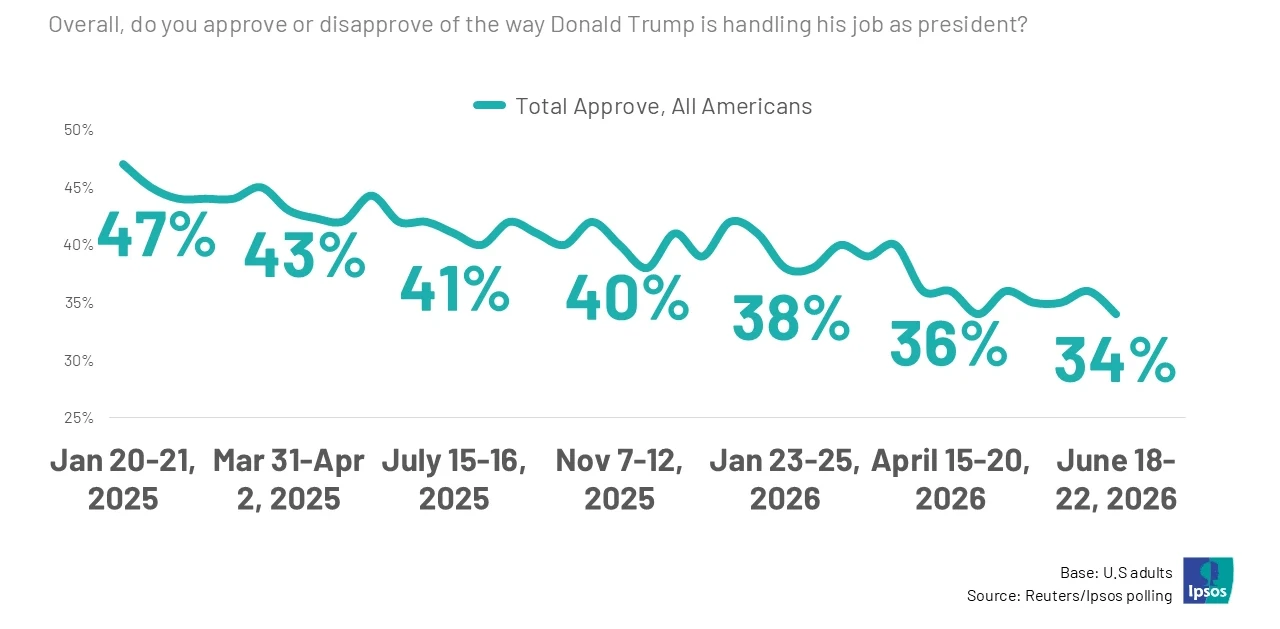
The recent peace deal with Iran hasn’t yet registered in Americans’ approval ratings for President Trump. For now, his approval rating remains statistically unchanged from the low point it hit after the war began. Whether it will recover remains to be seen, as the economic shocks triggered by the war are likely to linger for quite some time.
Consumer confidence is at its lowest since COVID
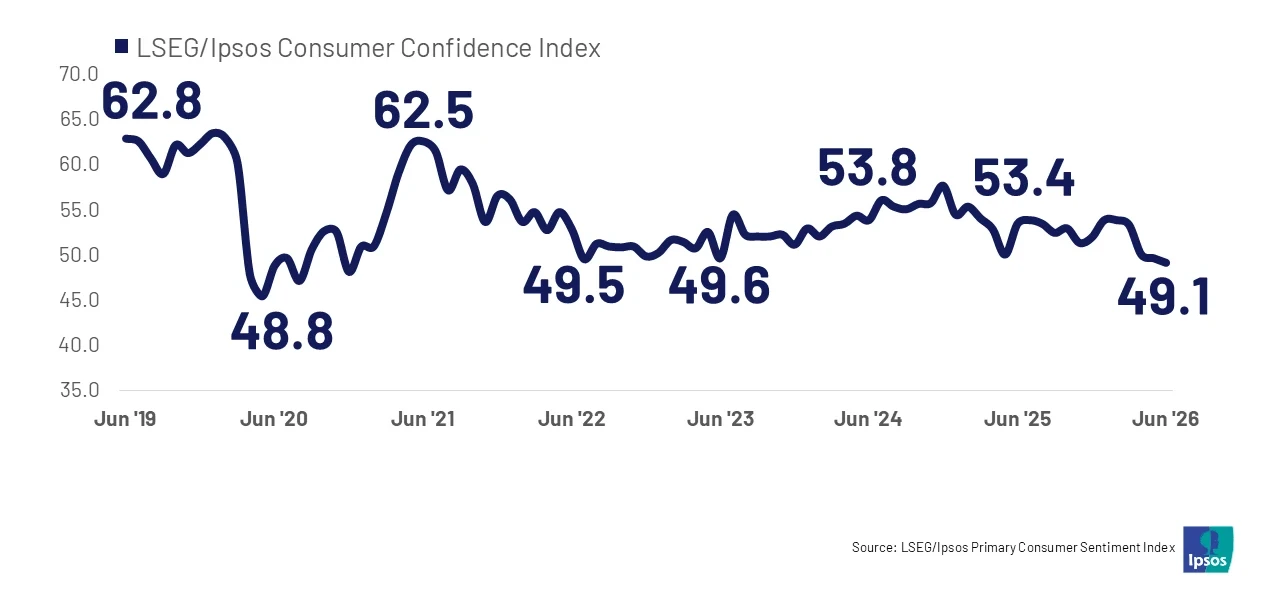
America’s confidence in the economy just hit another painful benchmark we haven’t seen since the COVID recession in 2020: The LSEG/Ipsos Primary Consumer Sentiment Index just registered its second consecutive month with a score below 50. Its mark of 49.1 this month is the lowest since December 2020.
How does that compare to other economic crises? When the “Liberation Day” tariffs were announced last year, the index hit 50 but didn’t drop below. During peak inflation in 2022 and 2023, the index dipped below 50 three times, but never this low, and never for back-to-back months. And before COVID, the index hadn’t dropped below 50 since 2013.
All this points to a challenging economic environment for companies to navigate - as consumer confidence may not bounce back quickly.
What the rest of the world thinks
The view from Australia
Australians are a generally unideological bunch, more focused on opportunity and quality of life. However, over recent years the U.S. has introduced instability that threatens that Aussie sense of wellbeing — be it in the form of sharp tariff hikes in 2025, or the disruption to the international order with the current Middle Eastern conflict bringing rising fuel prices — and it’s not well received.
This is reflected in Australians’ lowest-ever rating of the U.S. as a “positive influence in the world,” 33% — and why in looking for global leadership and greater stability, more now identify China as offering the positive influence they want for their region, 40%.
Only time will tell how much this shift reflects a temporary response to Trump’s policies, or whether it marks a longer-term Australian reorientation.

Jessica Elgood
Head of Public Affairs, Ipsos Australia
United Kingdom
World Cup in the Middle East and North Africa
India
Canada
Germany
Keep in touch with the latest Ipsos research and polling on the Iran conflict from around the world on our new web page.
And finally, other Ipsos global reports this month