
Britons still support Ukraine but uncertain how war will end, as new Ipsos poll reveals what they want to see from a potential peace deal
A new Ipsos poll reveals that concern among the British public about the impact of the Russian invasion of Ukraine remains high, more than three years after the conflict began. Four in five Britons say they are concerned about the impact on Ukrainian civilians (82%) and the UK's own economy (80%). The poll, conducted between 22-25 August 2025, shows these anxieties have been a consistent feature of public opinion, with concern for the UK economy and Ukrainian civilians remaining at similar levels since the start of the war in 2022. Concern for UK national safety and security is also high at 76%, while half of the public (52%) are concerned about the impact on themselves personally.
Key findings
- Stable support for UK's role: Six in ten (59%) Britons continue to support the UK's current role in providing economic, humanitarian, and defensive military assistance to Ukraine. This figure has remained steady throughout much of the last 3 years.
- Right level of support: Half of the public (49%) believe the UK has provided "about the right amount" of support to Ukraine. Equal proportions (18% each) think the UK has provided too much or too little.
- Sanctions endorsed despite costs: Half (51%) of Britons continue to believe that economic sanctions on Russia are necessary to support Ukraine, even if it means energy and food prices remain higher for a while. Only 21% think the sanctions are not worth the economic impact on the UK.
- Uncertainty on war's outcome: Britons are divided on how the war will end. The most common expectation, held by a quarter of the public (25%), is that Russia and Ukraine will each keep the territories they hold at the end of the war. Two in ten (20%) believe that there will be a return to the borders before the 2022 Russian invasion, while 13% think there will be a return to borders before the 2014 Russian invasion. 5% believe there will be the complete annexation of Ukraine by Russia. However, another 18% think the way may never end, and 19% just don’t know.
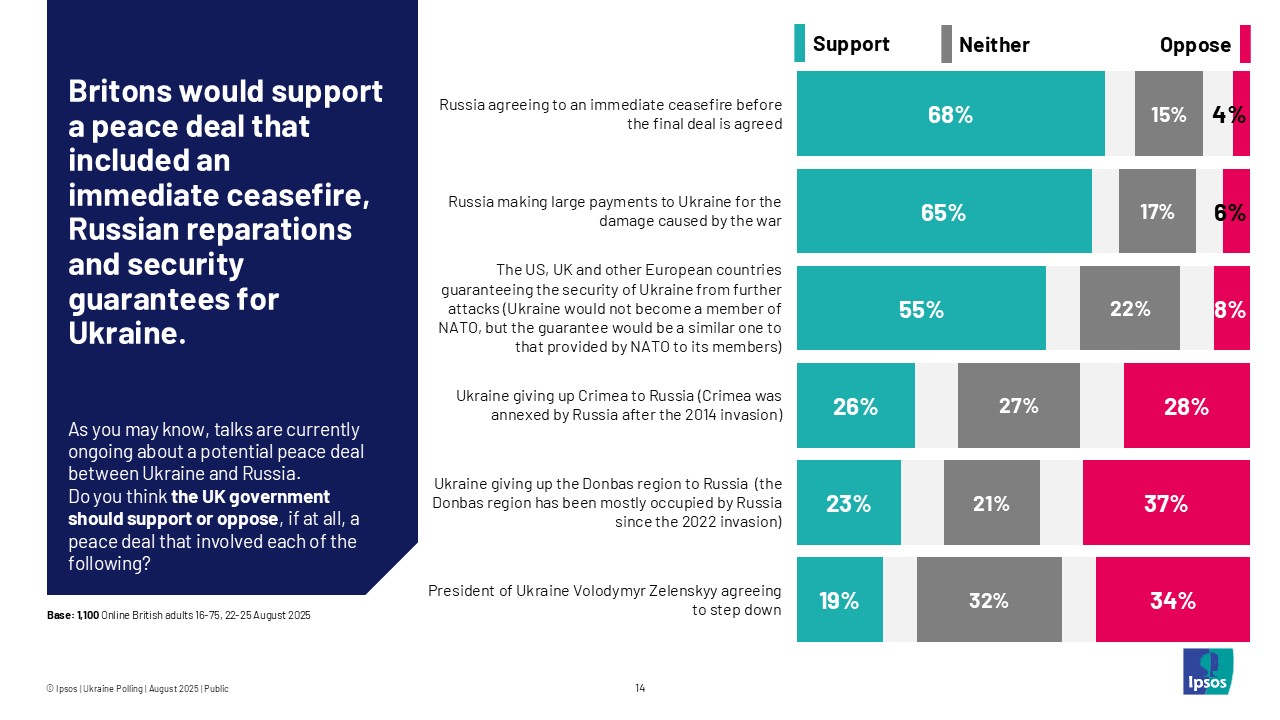
- Clear terms for peace: There is public backing for the UK Government supporting a potential peace deal that includes an immediate ceasefire (68% support), Russia making large payments to Ukraine for war damages (65%) and the US, UK and Europe providing NATO-style security guarantees for Ukraine. However, there is little appetite for Ukraine making territorial concessions, with only 23% in favour of Ukraine giving up the Donbas region (37% oppose) and 26% for Ukraine giving up Crimea (28% oppose).
- Support for peacekeeping troops: Two in five Britons (41%) would support sending British troops to Ukraine for peacekeeping purposes if a peace deal is reached. This is supported by half of 2024 Labour (50%) and Conservative (51%) voters but opposed by as many Reform UK voters (51%).
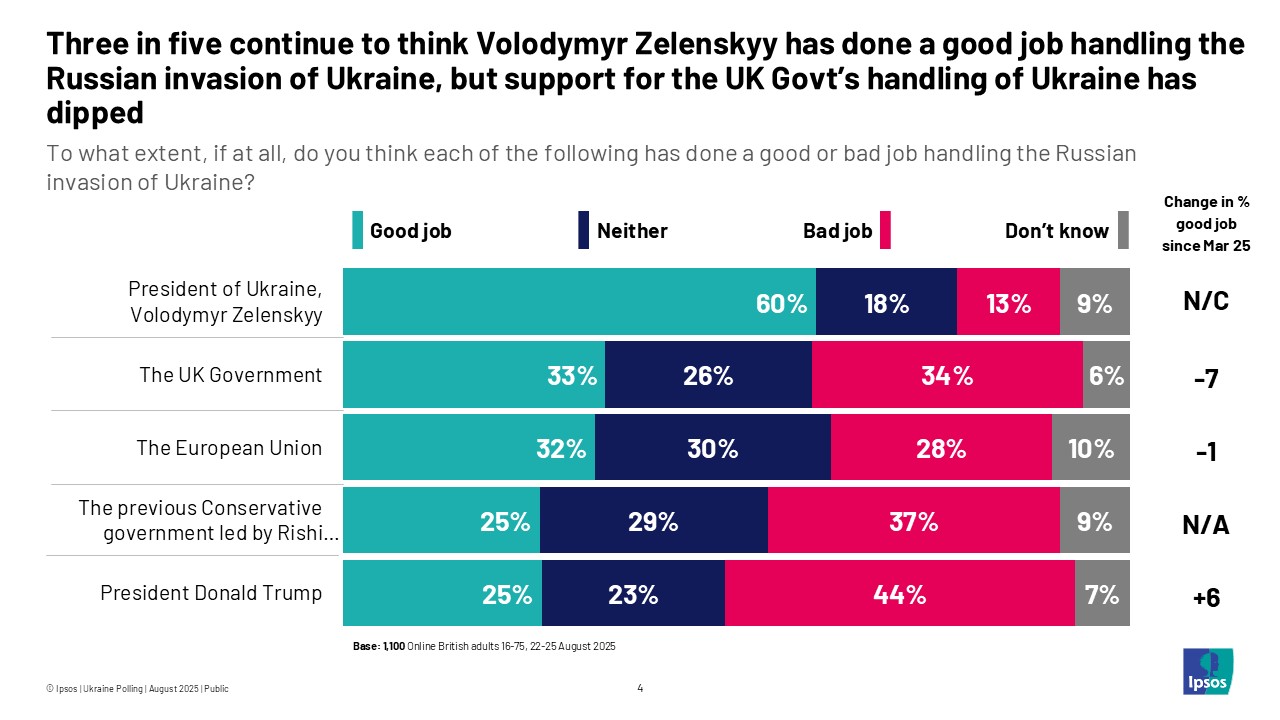
- Zelenskyy's leadership praised: Three in five (60%) say that Ukrainian President Volodymyr Zelenskyy has done a good job handling the Russian invasion, a figure that has been quite stable over the last two years. He is also the most trusted figure to help deliver peace, with two-thirds (66%) trusting him to do so.
- Mixed views on UK and US leadership: The UK Government receives a mixed rating for its handling of the invasion (33% good job vs. 34% bad job), but views have become more negative since March (“good job” down 7ppts from 40%). Meanwhile, President Donald Trump's approval has risen since March but remains net negative (25% good job vs. 44% bad job, +6 ppts good job since March). A significant majority (64%) do not trust President Trump to help deliver peace.
Commenting on the findings, Gideon Skinner, Senior Director of UK Politics at Ipsos, said:
Three and a half years on from the invasion, the British public’s concern for the people of Ukraine and the war's economic fallout at home has not diminished. Support for the UK's role remains solid, and a majority are still prepared to endure higher prices as a consequence of sanctions against Russia. This shows a remarkable resilience in public attitudes. However, beneath this stable support lies an uncertainty about how the conflict will actually come to an end. While President Zelenskyy retains the firm trust of the British people, there is much less confidence in other international leaders, and at home the boost received by Keir Starmer and his government in March has now fallen away. The public has clear asks for what a peace deal should include – a quick ceasefire, Russian accountability and security guarantees for Ukraine – but there is much less enthusiasm (but also some ambiguity) towards territorial concessions, which highlights the difficult path ahead for diplomats.
Technical note:
- Ipsos interviewed a representative sample of 1,100 adults aged 16-75 across Great Britain. Polling was conducted online between the 22nd and 25th August 2025.
- Data are weighted to match the profile of the population. All polls are subject to a wide range of potential sources of error.


