
Half of Britons now say they feel worse off since Labour was elected – but lack confidence in any of the main parties to have a sound long-term economic plan
New polling from Ipsos in the UK (carried out 31 October-3 November) reveals that ahead of the Budget, Britons are increasingly saying that they feel worse off since Labour came to power. There is also significant scepticism about their ability to get the balance right on taxation and spending, although confidence in any of the major parties having a sound long-term economic plan is low.
Britons increasingly feel worse off since Labour was elected as two-thirds lack faith that they will get the balance right on taxation and spending
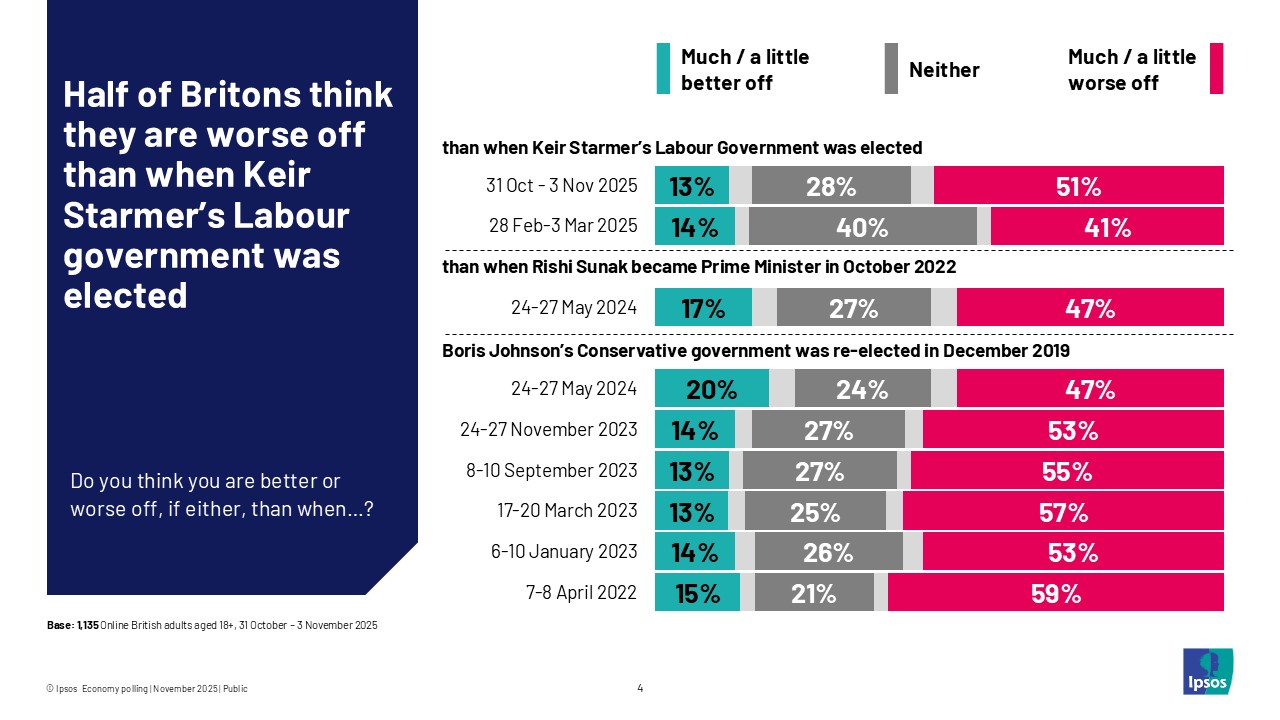
- Half (51%) of Britons think that they are worse off than when Keir Starmer’s Labour government was elected – up from 41% in March.
- Two thirds of Britons (66%) are not confident that Labour will get the balance right between taxation, borrowing and public spending. 61% are not confident in the Conservatives, and 57% are not confident in Reform UK.
But confidence in all political parties is in short supply
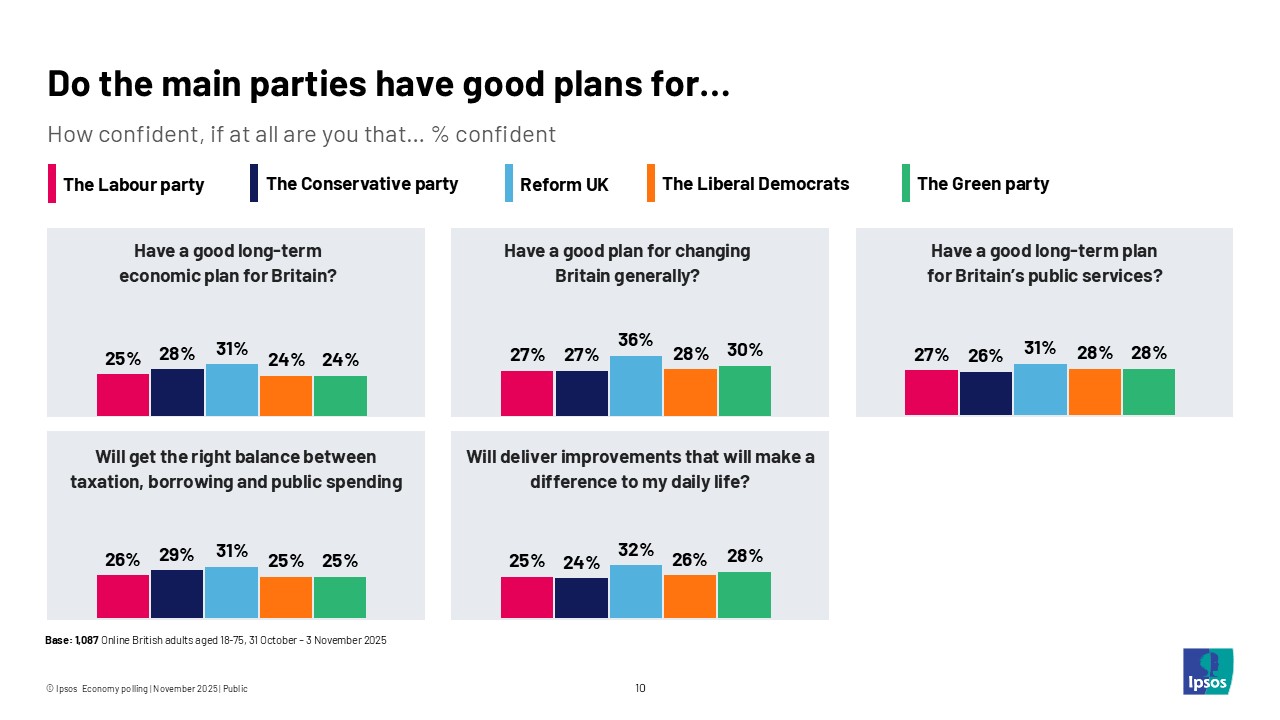
- Overall, Britons lack confidence in any major political party having a sound long-term economic plan. Reform UK leads marginally with 31% expressing confidence, but 57% remain sceptical.
- When it comes to improving public services, 31% believe Reform UK has a solid strategy. However, once again over half are not confident that any of the main parties have a good long-term plan for public services.
- Over half of Britons not confident that any of political parties have a good plan for changing Britain generally. Britons are most likely to be confident in Reform UK (36%), but levels of confidence in them are slightly down -3 ppts compared to last month.
- Two thirds of Britons are not confident that Labour (66%) or the Conservatives (65%) will deliver improvements that will make a difference to their daily life. Over half lack confidence in Reform UK (57%), the Green party (56%), and the Liberal Democrats (56%).
- There is also little trust in any of the parties that they would keep to their promises over increasing or decreasing taxes or increasing or decreasing public spending (between 27%-31% trust each party on each issue).
Rachel Reeves’ approval ratings continue to be low – but no clear choice for a successor emerges
- Half of Britons (49%) believe Rachel Reeves has been doing a bad job as Chancellor, with her ratings consistently low during this year. Just 17% believe that she is doing a good job (21% neither, 13% don’t know).
- Half of Britons (53%) report that the decisions made by Rachel Reeves have made them less confident the economy will grow. 18% believe they have had no impact, while 16% believe that her decisions have increased their confidence.
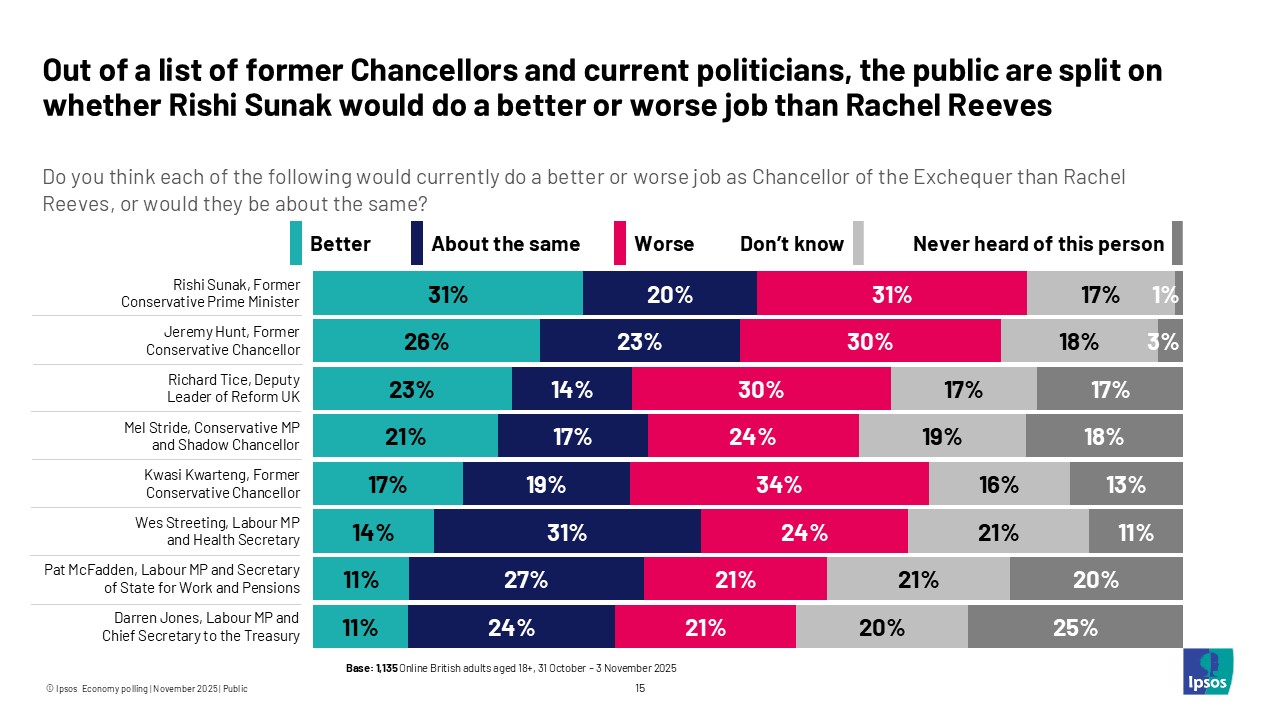
- Out of a list of former Chancellors and current politicians, the public are split on whether Rishi Sunak would do a better (31%) or worse (31%) job than Rachel Reeves, but overall few think any of them would do a better (or a worse) job.
Policy preferences ahead of the Budget
- Two in five Britons would prefer for the Chancellor to reduce borrowing to cut the national debt, even if means less spending on public services (40%) rather than increase borrowing to spend more on public services (27%).
- Britons are now more slightly more likely to say they would prefer to see taxes cut that they personally pay even if it means less spending on public services (36%) rather than increase spending on public services (30%), though there is still no overall consensus.
- Britons are also now more likely to prefer to see taxes that they pay personally or borrowing reduced (38%), rather than increasing long-term investment spending (30%).
Commenting on the findings, Gideon Skinner, Senior Director of UK Politics at Ipsos, said:
In the midst of deep-rooted economic pessimism, our latest findings highlight the formidable challenges facing Chancellor Rachel Reeves as budget day approaches. There is still no clear consensus among the public when it comes to debt reduction and tax cuts versus increased public service spending, but the mood is turning in favour of more balanced budgets and lower taxes just as the Chancellor indicates that further tax hikes may be necessary. Even though there is not much confidence that other parties have the answer either, there is a stark contrast between the desire for change that people voted for at the election and the fact that a growing proportion now feel they are getting worse off under Labour. Bringing the public on board with her decisions in the famous red briefcase will be crucial to prevent further erosion of confidence in her and her party’s economic stewardship.
Technical note:
- Ipsos interviewed a representative sample of 1,087 adults aged 18-75 across Great Britain. Polling was conducted online between the 31st of October-03rd November 2025.
- Data are weighted to match the profile of the population. All polls are subject to a wide range of potential sources of error.


