

The people of Brazil: A new approach to understanding context, homes and the new Brazilian family
Demography and context
‘Demography is destiny’, wrote Auguste Comte in the 19th century. Given the natural order and progression of things that underpinned positivism as a school of thought, the path imposed by demographic progress signalled the inevitability of a nation’s future, given its importance. Contemporary times have challenged this deterministic view of social change, but three long-standing trends remain significant and are currently materialising important changes in various aspects of demographic composition – recent, intense, and equally fundamental to social direction.
There are three main drivers of these profound changes, even though, due to their gradual nature, they do not often make the headlines:
- The urbanisation process has accelerated significantly recently: in 1960, 34% of the world's population lived in cities. Today, this figure is 57%, and it will be 68% in 2050. In Brazil, today, 87% live in cities, the highest percentage among the 10 most populous countries in the world.
- The fertility rate has fallen sharply throughout the world: worldwide, the rate has fallen from 4 children/woman in 1960 to 2.2 children today. The replacement rate, at which the population remains stable, is 2.1. In Brazil, the decline was even more intense, from 6 children/woman in 1960 to 1.6 today.
- Global life expectancy is growing rapidly, having increased by 25 years since 1960: from 48 to 73 years today. Once again, Brazil follows the trend, from 53 years in 1960 to 76 years today. And it will be 81 years in 2050. The median age of the Brazilian population today is 34 years, a sign that there is no longer an age ‘pyramid’ in the country.
The consequences of these changes are profound – and, to a certain extent, not yet fully understood. However, it is certain to say that there are a huge number of economic, social, housing, social security, consumption changes that will inevitably occur.
There are also some social conditions in Brazil that signal the need for a more in-depth analysis of the country's population and households. Brazilians are assuming their own identity in a more genuine way. Here are some examples:
- A more ‘brown’ and ‘black’ Brazil: the 2022 Census, conducted by IBGE (Brazilian Institute of Geography and Statistics) shows, for the first time, the self-declared ‘brown’ population (45.3%) as the most representative in the country, surpassing the ‘white’ population (43.5%). The self-declared ‘black’ population also grows significantly, reaching 10.2%. Since the 2000 census, the black population (brown + black) has grown by more than 10 percentage points. In addition, in all age groups there has been an increase in the share of the black population. It is clear that this growth cannot be due to a change in the ethnic composition of the population in such a short period of time, and the interpretation is that the population is more comfortable assuming its own identity.
- A more LGBTQIAPN+ Brazil: in the Ipsos Pride study, from June 2024, people in Brazil are among those who most often declare themselves as LGBTQIAPN+ (13%), behind only the Netherlands (14%); both much more frequently than the average of the 28 countries surveyed (9%). If we look only at the responses of people from Generation Z, Brazil leads the way with 23% of young people declaring themselves as LGBTQIAPN+.
- Marriage is on the decline, and separations have increased: worldwide, 89% of people live in a country where the official union rate is low, and Brazil is no different. Although marriages have increased after the pandemic (a period in which the decline was exceptionally sharp), the number of marriages is not the same as it was before: in 2022 there were 970,000 marriages, compared to 1,076,000 as the annual average from 2015 to 2019 – a drop of 11% in a space of just a few years. And marriages happen to older people: the percentage of people getting married over 40 has practically doubled since 2010. On the other hand, separations have increased sharply: in 2022, the number of divorces was the highest in the historical series, with 420,000, an increase of 9% compared to the previous year, and even higher compared to the pre-pandemic period.
Family diversity
It is no surprise, in this context, that demographic and social changes have also caused profound changes in the configuration of Brazilian families and homes. According to the IBGE, in recent decades, important changes have occurred in Brazilian families, mainly regarding their composition, number of children and women's family and work responsibilities.
According to Judith Stacey (1998), women were responsible for the organisational diversification of the family; they began to reject the traditional role of ‘housewives’ and fought for a more equal division of domestic labour, since they were more active in the labour market. As a result, women also became more willing to divorce. This led to new family structures.
Family composition has therefore become more plural and complex over time. Since the beginning of the 21st century, ‘classic’ households – made up of a mother, father and children – no longer represent the majority of Brazilian households. Furthermore, the number of single-person and childless households has increased significantly.
In addition to all these arrangements, there are also blended families, which are not reflected in the census data. In aggregate, children, stepchildren, siblings, stepmothers and the option to have dogs, cats or other domestic animals live together, which brings about the concept of a 'multispecies' family. And this data should not be ignored. According to Radar Pet 2021, Brazil has the second largest pet population in the world, behind only the United States, with more than 37 million households in Brazil with a pet – a number that continues to grow.
A relevant theme of intergenerational coexistence also appears here: with the increase in the older population, simultaneously with the increase in the time young people spend in their parents' homes, there is an inevitable intensification of cohabitation, albeit occasional, between generations that are not close.
Are we recognising this new home?
Family diversity used to be just about racial and religious diversity, but without major deviations from the so-called traditional nuclear family: one man, one woman and children. In the current context, it refers to different compositions related to form: single-parent families, stepfamilies, families with same-sex couples and/or families without children and with ‘pet children’.
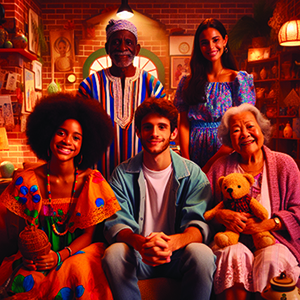
Are we looking at these new compositions? When exploring the concept of family with artificial intelligence, with a simple command - 'Create the image of a family' - we observe that in all requests there is racial diversity, but the man-woman composition, one or two children, remains. Drawing a parallel with the representation of family and homes in advertising, the scenario is even less representative of reality. Most advertisements still portray white families, with two children, usually a boy and a girl. The images below were also generated by artificial intelligence, in the Ipsos Facto tool, reflecting how this social issue is still viewed:

| 
|
There is still a gap between the real world and advertising
The lack of representation in advertising still perpetuates stereotypes and makes a significant portion of the population invisible worldwide, including in Brazil. Ignoring Brazilian diversity means alienating potential consumers and missing out on the opportunity to create a true connection with the public.
What now?
The descriptions of a new demographic, social and family composition presented here reveal a scenario that is much newer – and different – than what institutions have recognised.
Governments, social organisations, economic agents, companies and brands do not seem to foresee this shift that is already becoming a reality. There are implications in all aspects of people's lives. New forms of socialisation, urban composition and the role of cities, education and preparation of new generations, economic models exclusively focused on growth, social norms, consumer relations, innovations and services. The challenges and opportunities are many, and they have not yet been fully absorbed or even recognised.
The sooner we, as brands and society, see and prepare for a new reality, the greater the chance that the possibilities will be embraced, with freshness and openness. The permanence of models – mental and economic – in an outdated reality, even if resistant in the imagination, can bring significant social conflicts.
It is time to have more empathy and understanding, with a more granular view, to recognise the people who make up the country, and respect their individualities and identities in a more genuine and legitimate way.
Table of contents:
- An introduction to Flair Brazil 2025 - Movements under the surface: tectonic tensions and real opportunities
- Basic rights denied: Brazilians' concerns as a reflection of society
- The people of Brazil: A new approach to understanding context, homes and the new Brazilian family
- Are they really that liberal and progressive? How the complexity of Gen Z challenges market understanding
- Corporate reputation: ESG, polycrisis and polarisation
- A new work model: the role of employees and purpose in organisations
- A new concept of beauty: how AI is transforming image standards
The author(s)
-
 Marcos CalliariCountry Manager, Ipsos in Brazil
 -