

A new work model: the role of employees and purpose in organisations
Understanding the context
The dynamics of the current job market and the expectations, needs and interests of employees show that we are in a new work model, which has been shaped and modified in recent decades. Over the years we have seen a generational change: before, we had a generation more focused on ‘having’ (houses, cars, money, starting a family, providing for their families), whereas today, the younger generations is focused on ‘being’ / ‘feeling’ (living experiences, traveling, seeking belonging and purpose to be part of a group). In line with this, there is a growing concern with social inequality and environmental issues – the latter, in fact, gaining increasing relevance due to its more direct impact on the life of society in general, even generating a new effect called “environmental anxiety”. These behavioural movements even help to explain the increased relevance of the ESG agenda.
Although these effects mentioned occur in a granular and slow manner, in recent years, a factor has occurred that has intensified these and other behavioural changes: the Covid-19 pandemic. The need for social distancing, due to the virus, brought forward a movement that could have taken decades: the consolidation of remote work as a reality. Based on this new model, adopted due to the pandemic, the practice of having a ‘home office’ in a city different from that of the employee's company office became increasingly common. Thus, we saw the beginning of an urban exodus from large centres to coastal and inland cities, in search of a better quality of life. In this way, the pandemic also impacted the increase in the supply and variety of jobs for qualified workers. This trend had already been happening in recent decades, as globalisation intensified, and people had increasing access to jobs and vacancies in more companies, and in different places.
The impact of the work model can already be seen in a recent study by Ipsos, conducted in four Latin American countries, with 2,400 employees from different areas. The survey revealed that 57% of workers want to work less from offices and more from their homes. In this same study, more than half of the respondents who work remotely or in a hybrid format believe that the modality is the second most important factor in finding a new job.
Therefore, we can say that generational effects, globalisation/pandemic and the increased relevance of ESG issues have caused employees to become increasingly demanding and critical of the quality of life and sense of belonging that their jobs and employers offer. The truth is that what employees are looking for in a company today goes far beyond traditional salary and benefits. Flexibility has become essential, with hybrid or remote work options being highly valued. Wellbeing is no longer a ‘differentiator’ but a basic requirement, including mental and physical health and work/life balance. In other words, simply paying employees more no longer seems to be enough to retain and/or attract talent, especially after the market has recovered and reopened following the Covid-19 pandemic. According to data from a survey conducted and shared by LinkedIn, three quarters of job candidates would apply for an opportunity if the employer actively worked on its brand image. In this same study, another fact stands out: 87% of women and 67% of men interviewed say they would not accept a job opening if the company had a bad reputation in the market. It is no wonder that companies are increasingly investing heavily, both publicly and internally, in their image.
As such, it is crucial to ensure that the company culture and the employee experience are in tune.
Of the HR professionals interviewed in this same survey, 86% believe that, over the years, the recruitment process has become increasingly similar to marketing/advertising campaigns, that is, it is necessary to ‘sell’ the company to attract an interesting candidate.
Main challenges
In this scenario, we see qualified professionals increasingly seeking purpose in their careers, questioning the ‘why’ of working at a particular company. This change in mentality impacts the relationship between employee and company, making it crucial to understand the concept of EVP (Employee Value Proposition). EVP encompasses a set of measures that offer competitive advantages to employees, aiming to attract and retain talent. Benefits such as attractive salaries, career plans, a good work environment and development opportunities are examples of how organisations can become more attractive to professionals.
EVP is the unique value that the company can offer to existing and potential employees. It is its competitive advantage in attracting, engaging and retaining the best talent. Investing in EVP, through actions such as training leaders and managers, is essential for companies to stand out in the market and be able to attract the best talent.
Benefits of an effective EVP:
- Strong attractiveness: 43% reduction in hiring costs
- Greater engagement: 28% increase in employee recommendations
- Lower attrition: 69% reduction in employee turnover
According to Ipsos Karian and Box, these are the main challenges that HR departments are finding more difficult to deal with in the post-pandemic period:
- 58%: Attracting talent
- 57%: Meet salary expectations
- 56%: Maintain team seniority
- 55%: Retain talent
Understanding the impacts
A sense of belonging increasingly contributes to employee engagement with their jobs. Ipsos Karian and Box analysed around 50 global companies and found that almost all (92%) had a question about ‘pride’ in working at the company in their employee engagement metrics.
All of these points are critical to implementing an effective employee experience (EX) program. Although it is not an easy task, the results show that the better the EX, the higher the revenue for companies.
Connecting employee experience with customer experience
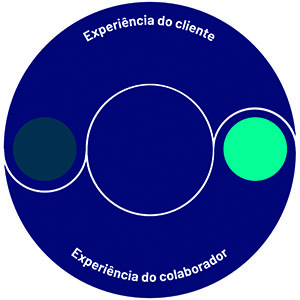
Employee experience must be connected to customer experience for brands/companies to be successful.
Therefore, companies need customer experience (CX) to also be aligned with EX, which is where the hard part comes in. Many companies are focused on CX and not very focused on EX, and vice versa. Few companies are concerned with developing aligned CX and EX strategies. But when this happens, the benefits are countless.
To make things easier, we already know that the emotional forces that control a company's CX and EX are the same and are universal.
Many of the most successful leaders and companies have understood that employees are the company's main asset. As Steve Jobs, for example, said in an interview with Fortune magazine in 1998, "It's not about the money. It's about the people you have, how you lead them."
But we're not talking about theory here. Throughout this article, we've shown the impacts of a good employee experience not only on employee engagement and satisfaction, but also on HR metrics, such as turnover and attracting new talent, and even on the company's business metrics, such as revenue, costs, and profit.
Therefore, companies need to understand the current context in which we live, of greater criticality and demand from employees, not only seeking a good benefits package, but also seeking flexibility, purpose, and values that they can reflect. By doing so, they will better understand the expectations, desires and wishes of their employees, so that they can then act and create a solid EVP that retains and attracts the best people, not only with attractive benefits packages, but also with the flexibility, autonomy and support that employees desire, and with the purpose and values that convey pride and fulfilment. Not only that, they also need to offer an employee experience aligned with the customer experience, because as we have seen, both concepts go hand-in-hand, and the companies that are able to achieve this goal are the ones that will have the greatest competitive advantage.
Table of contents:
- An introduction to Flair Brazil 2025 - Movements under the surface: tectonic tensions and real opportunities
- Basic rights denied: Brazilians' concerns as a reflection of society
- The people of Brazil: A new approach to understanding context, homes and the new Brazilian family
- Are they really that liberal and progressive? How the complexity of Gen Z challenges market understanding
- Corporate reputation: ESG, polycrisis and polarisation
- A new work model: the role of employees and purpose in organisations
- A new concept of beauty: how AI is transforming image standards