The Recovery Canadians No Longer Believe Is Possible
It’s difficult to read a news article these days without encountering references to the rising cost of living, affordability pressures or inflation. Interest rates have started rising again in Canada, while conflict-driven increases in global oil prices are keeping gasoline and other energy costs elevated. It feels as if Canada – like much of the world – is trapped in a perpetual cost of living crisis.
Ipsos has termed the current environment The Endurance Economy, based on our belief that many of the forces shaping Canada today, such as affordability pressures, housing challenges, productivity concerns, demographic change and declining confidence are structural rather than temporary. This leaves Canadians adapting to a new reality as prolonged constraint permanently reshapes expectations, behaviours and decision-making processes.
In this Ipsos Point-of-View, we take a closer look at the affordability pressures component of the Endurance Economy, using Ipsos’ global Cost of Living Monitor, which has been tracking global perceptions of people’s financial situation, the causes of rising prices and expectations of how the economy will perform in the future since 2022. The Endurance Economy is more than just cost of living pressures, but they are an essential component for understanding how Canadians are feeling and what the future holds.
Zeroing in on the Canadian findings in the report, we find that Canada’s household economy has stabilized more than public perception may suggest. Fewer Canadians report acute financial difficulty than in 2023, and Canadians are somewhat more financially comfortable than the global country average.
Yet consistent with the Endurance Economy, we also find that expectations have deteriorated. Most Canadians expect inflation and unemployment to rise, few expect their disposable income or standard of living to improve, and an overwhelming majority believe inflation will not return to normal soon, if ever.
Improved coping without restored purchasing power demonstrates that households can stabilize while remaining worse off relative to their expectations. As this condition persists, conventional signs of recovery become less credible as evidence that household life will materially improve.
In effect, we find that while Canadians are faring somewhat better, that present stability no longer creates confidence in future improvement. A lower inflation rate is insufficient in itself to create the recovery Canadians long for because it does not reverse the accumulated price increases or restore lost purchasing power. And so, the numbers back the core thesis of the Endurance Economy: households are adapting to constraint, while losing the confidence that adaptation will eventually lead back to the level of advancement they previously expected.
Canada looks more stable than it feels
It’s useful to start with how Canadians are feeling today. We find that while 43% say they are financially comfortable, or “doing alright,” a quarter (24%) say they are finding things difficult. Despite eighteen months of Trump, tariffs and turmoil, financial difficulty has declined slightly from 28% in 2023 to 24% in 2026, and Canadians report somewhat greater financial comfort than the global average.
By these measures, Canadian household finances have not uniformly deteriorated, as many households have adapted, absorbed shocks, and found ways to manage. Of course, there are significant demographic differences. Boomers are the most stable, with 61% reporting they are comfortable or doing alright, compared to only 32% of Millennials who fell the same. In fact, Millennials are the only generation in which the proportion finding it difficult slightly exceeds the proportion comfortable or doing alright. Unsurprisingly, stability rises with income, and married Canadians report higher levels of stability than those who are not married.
But if Canadians are managing somewhat better, why do so few believe that better times are coming?
Defining a Conventional Recovery
Traditional economic cycles follow a predictable recovery pattern. When inflation rises, governments tighten monetary policy, to moderate inflation. Then, interest rates stabilize or decline, household purchasing power recovers and consumers start spending, expecting better times ahead.
The current Endurance Economy requires much more than tightened monetary policy and tamping down inflation to create the conditions for a recovery and optimism about the future. In addition to essential goods becoming more affordable, Canadians may be looking for a recovery in housing costs and supply, wage adjustments and confidence that living standards will improve. It is on that last point that we find, despite modest improvements in perceived financial situations, that Canadians remain pessimistic about the future.
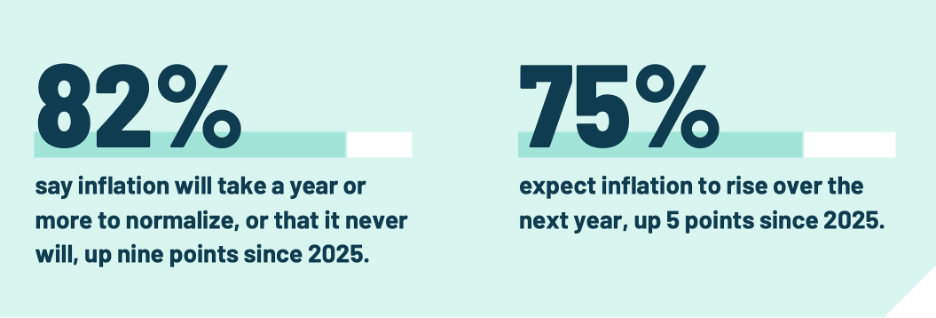
Looking at Canadians’ results in the Cost of Living Monitor, we find considerable expectations of future cost of living increases, regardless of what current data show to be happening now. This sentiment is highest in the grocery category, where 80% expect grocery costs to increase over the next six months, 10 points higher than the global average. Three quarters (75%) expect inflation overall to increase, and 65% expect unemployment to increase. While price expectations for most categories remain flat since 2023, expectations of grocery price increases are on the rise.
There is one bright spot, as less Canadians (36%) believe that mortgage or rent costs will increase in the next six months, compared to 39% in 2025 and a high of 45% in 2024. Housing costs are often presented as a key component of the affordability crisis, and on this measure, Canadians are feeling better than they have since tracking began.
While Canadians are expecting price increases, they are not expecting to do better themselves. Only 20% expect their disposable income to increase, while 36% expect it to decline. Likewise, just 20% expect their standard of living to increase, while 27% expect it to decline. This reflects a broader North American pattern in which more people expect the living standards to fall than rise.
All of this points to a concerning trend: while Canadians’ perceptions of their present position on the cost of living - apart from grocery costs - has stabilized or even improved in terms of mortgage or rent costs, their expectations of the future are worsening.
“Normal Inflation” No Longer Means Normal Life
Inflation is at the core of cost-of-living concerns, and expectations about it may go some ways to explaining why Canadians do not feel optimistic about their future prospects. Less than two-in-10 Canadians (18%) now say they expect inflation to return to “normal” within the next year or sooner, and 30% think it will never return to normal. Since 2023, the number of Canadians who expect inflation relief in the next year or sooner has dropped over 10 points. This reflects the reality that Canadians increasingly experience affordability pressures as a lasting feature of an Endurance Economy, one where they do not see an end coming soon.
The Bank of Canada has a measured target inflation rate of 2%, within an operational target range of 1% to 3%. In 2024 and 2025, Canada’s actual, measured inflation rate was within the target range, while it was just outside of it at 3.1% as of September 2026.
But normal is a contested term and it means different things to different people. While the measured inflation rate remains around or within the Bank’s target, Canadians’ perceptions are increasingly negative about the future. This suggests the “public benchmark” for recovery may have shifted, and that a lower or declining inflation rate is no longer sufficient to account for “normal” if perceived standards of living have not caught up.
Canadians are doing better than they feel, but not necessarily better than before
Canadians’ perception of their current fiscal situation is relatively stable. Fewer report financial difficulty than in 2023, and Canada compares favourably with global averages on these measures. But even as current circumstances stabilize, future expectations continue to diminish. In an Endurance Economy, a household can successfully cope with current pressures without believing those pressures will ease or that its living standard will improve. That is exactly what we see happening. The ability to endure may partly explain why aggregate household conditions look more stable than the public mood. Canadians have adapted, but adaptation should not be mistaken for restoration.
This loss of confidence is far from uniform though. We see in our polling data the same patterns economists see in economic data: some Canadians are doing better than others at enduring. Baby Boomers continue to enjoy the strongest fiscal position, but even they have high expectations that inflation will continue to rise. They worry about the future, even if they, themselves, expect to be ok. We might expect them to protect their accumulated security and guard their purchasing power.
What’s Missing
This report measures perceptions of the cost of living and future expectations. It does not measure, nor can it consider the impacts of current federal government policy to expand trade relationships and build more readily, nor the impacts of the tariff war with the U.S. These global events will all have an impact on sentiment over the next year, and we might find that if some of these uncertainties are resolved, Canadian sentiment about a return to “normal” may rapidly improve.
What it Means
Consumers who expect no meaningful recovery behave differently than those who think they are temporarily waiting out a downturn, and the Cost of Living Monitor demonstrates that most Canadians are in the former category at present. While perceptions of current circumstances are indeed improving or stable since 2023, the future looks bleaker now than it did when we started tracking.
For government, this means that pointing at lower inflation will not persuade households that affordability has improved, and macro-economic indicators are increasingly divorced from lived experience in the Endurance Economy. The public will judge progress not merely by whether conditions have stopped deteriorating – as they arguably have – but on whether households can once again advance. Many Canadians do not believe they will in the foreseeable future.
Claims that things have “returned to normal” may be particularly counterproductive, and we already see the federal government acknowledging this. In October 2025, Prime Minister Carney said that “it will take sacrifices and some time” for Canada to recover, and our polling suggests that is exactly how most Canadians feel right now, over a year later.
While sentiment is a poor substitute for actual economic conditions, it tells you how people are feeling, which can be an useful predictor of future behaviour. We expect Canadians will continue to endure, and we will know that we are coming out of this pattern of pessimism when measures about the future start to improve. Today, despite present stability, the idea of future improvement remains far off on the horizon, just as we would expect it to be in an Endurance Economy. It will indeed take some time before the public begins to see the future as anything but uncertain.
For more data, download our Cost of Living Monitor Canada report here.