
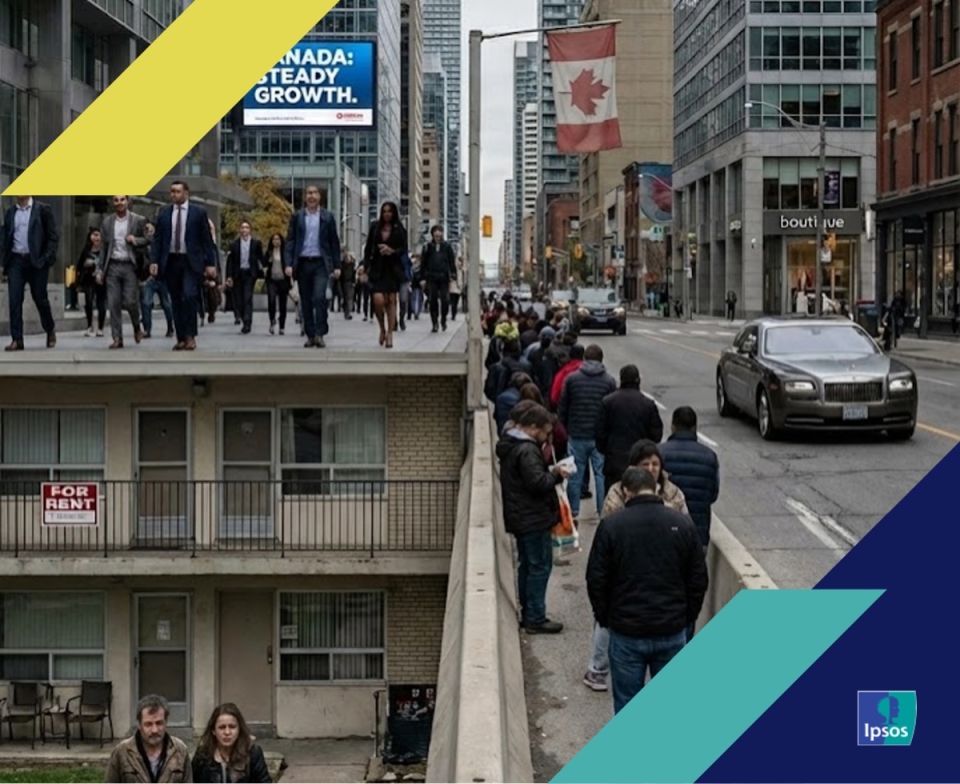
United in Division
How the Endurance Economy fuels both Canadian unity and a new crisis of division.
The Endurance Economy is a pattern in the Canadian mindset that is easy to miss if you only look at the macroeconomic headlines. Traditional indicators like headline inflation, employment rates and GDP growth all suggest stability. But our data suggest the ground-level experience of Canadian households looks different, with constant strains on budgets, persistent anxiety about housing, and splitting discretionary spending between essentials and luxury items. The headlines also mask a complicated reality in Canada today: a country at once more united, while specific fractures within it are deeper than they have been in decades.
Think back to late 2019. The federal Liberals had just won a minority government but were completely shut out of Alberta and Saskatchewan. Talk of a “Wexit” quickly emerged, inverting Preston Manning’s “the West wants in” campaign from the early 1990s. In 2019, Ipsos found a country divided, with six in ten (59%) Canadians agreeing that “Canada is more divided than ever” in polling done just after the election.
In January 2026, that number, among all Canadians, dropped slightly (55%). Still high, but trending in the right direction. More interesting, is the decline in Alberta, which was significant (from 79% to 68% today), while Quebec stayed statistically the same (54% to 57% today). Yet, we see widespread media coverage of a re-awakening sovereignty movement in Quebec and the emergence of one in Alberta. It seems that even as the country might be coming together in the face of tariff threats and a desire to build, pockets of it are instead pulling apart. The Endurance Economy can help explain why.
For a primer on the Endurance Economy, click here or visit the Endurance Economy hub.
Absent the lens of the Canadian Endurance Economy, separatism and unity look like contradictions. However, once applied, we can see how these are actually two different responses to the same underlying conditions: perceived scarcity, lowered trust, and shorter time horizons.
When Canadians experience ongoing affordability issues, we need to change the descriptor from “crisis (which connotes a short period of time) to a “chronic condition. Under this diagnosis, politics becomes more transactional, more regional and a question of “who gets what.” External threats such as tariffs and indeed, President Trump’s aspirations to make Canada the 51st state, can create situational unity.
Think of “the enemy of my enemy is my friend,” or the way Canadians came together in the aftermath of Trump’s election and his threats, to “Buy Canadian.” This can compress partisan and regional differences and produce high-level cohesion. Indeed, our tracking showed an improvement in social cohesion at the peak of Trump’s threats in June 2025, moving into positive territory for the first time in over two years.
Our year-long tracking of Canada-U.S. tensions showed Canadians’ “Buy Canadian” resolve cooling over time, but attitudinal shifts like distrust and desire to diversify partnerships stayed remarkably stable. That pattern of behavioural normalization and hardening beliefs is useful to understand social cohesion more broadly.
But sovereignty is an easy answer to hard questions. Our top issues polling consistently shows that lived daily stressors like affordability, healthcare and the economy, not to mention the things people face every day like rent, services, taxes and crime, are persistent concerns. Blaming government, high levels of immigration or external factors provides a more internally satisfying answer than “we simply must endure.” These endurance conditions amplify political messages and play well into partisan attempts and slogans. “Axe the tax,” “stop the crime,” or a belief in “a sovereign Alberta within a united Canada” are simple ways to describe a problem and a solution.
Here’s the problem, here’s the solution, and the individual need only wait for someone else to execute it.
Threating to leave can be as much a demand for change as an actual threat. That fits the Endurance Economy pattern we see in our data.
Symbolic leverage becomes rational when people feel stuck. The threat of exit is the bargaining power, used to demand attention, resources or policy change from Ottawa without a genuine desire to pay the costs. We saw this in our Confederation Stress Test that found as much as half of support for sovereignty in both Alberta and Quebec was symbolic, or a cry for help.
This explains the polling paradox : even as the number of Albertans who feel the country is 'more divided' has decreased, the political rhetoric around separation has intensified. The goal for many isn’t to leave, but to use the threat of leaving to secure a better deal within Canada.
From the Endurance Economy emerges what we might call Endurance Politics: a political environment where long-term national projects are sacrificed for short-term, transactional gains, and where symbolic battles become proxies for real economic struggle. This tension is on full display as Prime Minister Carney seeks to force longer-term thinking through new allies beyond the U.S. and investment in national projects, including an Alberta pipeline. But such assurances are insufficient for some in the province, who believe, simply, that Alberta can solve all its problems by divorcing itself from Ottawa.
The argument is that the future will be better if Alberta, or Quebec, are sovereign, and things won’t be so hard.
Endurance conditions make the fight more intense, as people search for a clean, causal story for why life “feels harder than it should.” In that context, political actors like the Alberta separatist movement can offer simplified explanations.
So can governments, as Danielle Smith’s UCP demands that Ottawa curtail immigration and re-open the constitution to address issues like Senate reform that are nowhere near the top of the list of priorities for Canadians. Smith’s referendum gives people a simple explanation for why their anger is real, and a voice, via the referendum, to express it. Basically, it’s not their fault.
Coupled with these factors is a changing media landscape where truth has become subjective and it is increasingly difficult to tell what is true from what is not. Lying is normalized, itself masked by “alternate facts,” and this behaviour is driven from the very leaders people have elected. Media fragmentation has allowed two competing narratives: Carney’s “hard truths” and the separatists “easy answers” to coexist and harden within different population segments, and reinforce existing divisions.
That’s why Prime Minister Carney’s Davos speech resonated with many. He was credited with laying out the costs and telling people they would indeed need to endure. He told people they would require longer timelines, and called for Canadians to trust him. This hard truth approach united many Canadians, even as the message was bleak. But those seeking to break Canada up are doing the opposite. They are reacting in the here and now, saying that “enough is enough,” that action is needed immediately, and they are seeking to reduce trust in others (such as the federal government) as their response. It’s always much easier to blame someone or something else, sowing disunity in the process.
That response is neither endurance nor resilience. But it’s a lot easier to understand, and it helps explain the divisions present in Canada today.
The Endurance Economy has created “two Canadas”, something we also see when we look at the generations. Both Canadas are currently coexisting in an uneasy truce. One is united by external threats and a top-line narrative of stability, as articulated in speeches at global forums like Davos. The other, experienced at the household level and among certain segments of the population, is transactional, anxious, and increasingly drawn to the simple, causal stories of regional and separatist politics. The paradox is that both are real.
The critical question is which narrative will define the country's future. Will the situational unity prompted by external pressures be enough to hold the country together, or will the internal, grinding reality of the Endurance Economy inevitably pull it apart at the seams? Premier Smith’s proposed referendum questions aside, the answer lies not in grand constitutional debates, but in whether the daily economic struggles of Canadians are acknowledged and addressed by governments, citizens and corporations.

![[WEBINAR] Ipsos Reputation Council 2026: Life After Predictability](/sites/default/files/styles/list_item_image/public/ct/event/2026-09/thumbnail-templates%20demo_1.png?itok=wgA7L90n)

![[WEBINAR] Ipsos Global Trends 2026: The Canadian Edition](/sites/default/files/styles/list_item_image/public/ct/event/2026-08/thumbnail-gt-26.png?itok=kAF_s5h8)