Beyond AI: The Quiet Rules Shaping Automotive Research Partnerships
Something has quietly changed in how automotive clients across Southeast Asia work with their research partners. As technology becomes increasingly embedded in the research process, what clients value from those partnerships is evolving too.
AI itself is no longer the differentiator it once was. Across the research industry, automation, dashboards and AI-assisted analysis are increasingly familiar parts of the research toolkit. What distinguishes one client-research partnership from another lies beyond the technology itself. It is quieter than that, and often comes down to what is built around it.
It is a pattern we have seen taking shape across our automotive work in Southeast Asia over the past year. It shows up in three moments, each revealing something about what clients increasingly need from their research partners, and where automotive research in the region may be heading next.
1. AI got us the data. It did not get us the foresight.
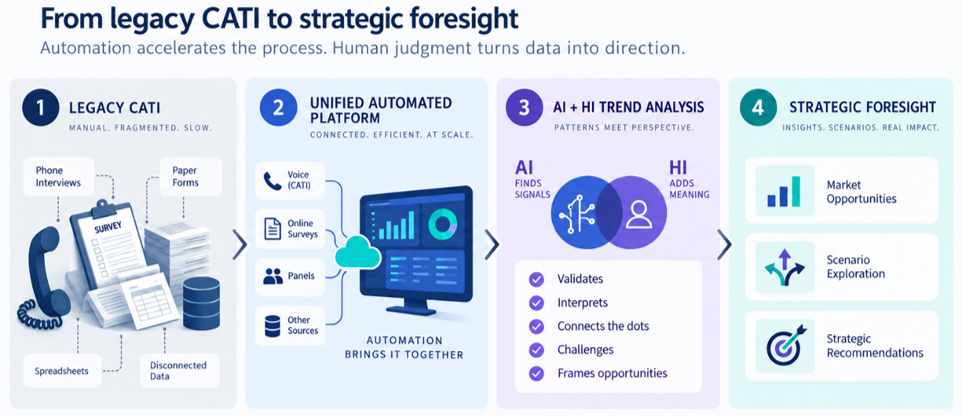
For one automotive brand’s regional operation, a legacy CATI-based CSI/SSI programme had created several challenges: survey fatigue on one side, slow and manual reporting on the other, leaving dealers without the timely insights they needed to act with confidence.
The fix was never as simple as "digitise it." It meant unifying satisfaction tracking onto a single automated platform, moving to lighter-touch channels respondents actually engage with, and building role-based dashboards so a regional HQ analyst and a frontline dealer team could work from a consistent, near real time view of the customer experience.
But here is the quiet rule this case actually reveals: automation alone would have simply produced faster reports. What made the difference was pairing it with AI-assisted, human-verified analysis that did not stop at "what happened" but helped identify emerging patterns, what they could mean and where attention may be needed next.
Patterns across customer verbatims could be surfaced at greater scale, then interpreted and contextualised by the research team and translated into forward looking recommendations. The result was more than a satisfied or not scorecard: it gave the client a clearer view of where attention may be needed next. AI supplied the scale. Human judgement supplied the foresight. Neither alone would have been enough.
What is worth dwelling on is not any single metric, but the pattern behind them. Annual coverage expanded several times over. Satisfaction indices climbed by a meaningful, double-digit margin, not just at flagship sites, but across the entire network. And that improvement was recorded even as the programme scaled significantly in volume.
The client's own reflection said it best: the transformation did not just save time, it "made insights accessible enough to reach frontline teams". Ultimately, insight only creates value when it can reach the people who need to act on it.
2. Trust was never pitched. It was built over time, quietly.
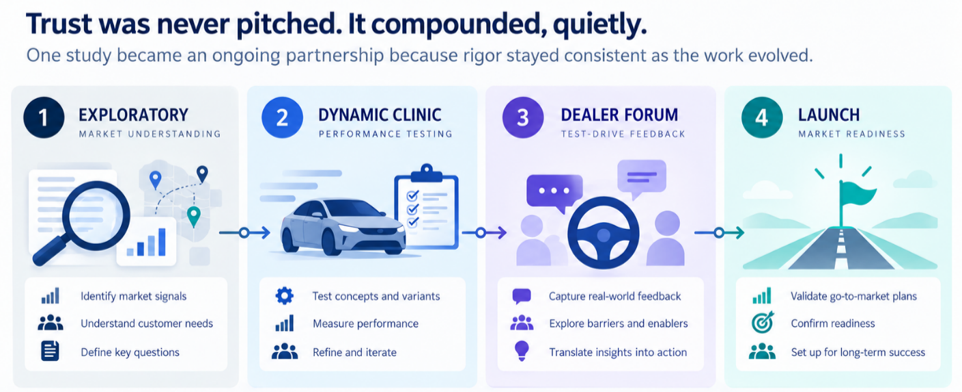
The second story begins with a single pre-launch study. It ends somewhere altogether different: with the research relationship extending into the next model launch, built through everything that happened in between.
What built that trust was not deliverable quality alone, though that mattered plenty. It was consistency across a brief that kept evolving: a market exploratory study assessing positioning and launch readiness, followed by a dynamic clinic that moved beyond static evaluation into genuine performance testing, including slalom and wet-surface handling under simulated extreme conditions, and finally a dealer test-drive and strategic feedback forum that converted first-hand consumer reaction into decisions the client could act on with confidence before launch.
No two phases looked remotely alike, with different objectives, formats, and stakeholders each time. What held steady was showing up with the same rigour regardless of format, adapting in real time without compromising design integrity, and perhaps more importantly, staying focused on what the client needed to decide, not merely what the brief technically asked for.
That is the quiet rule here: trust is rarely built through a single piece of work. It simply compounds across decisions, moments and stages of the journey.
3. The rule that rarely makes it onto a capability slide
The third shift has less to do with method, and more to do with how the work is actually delivered when a client sets out to understand a market that is not their own.
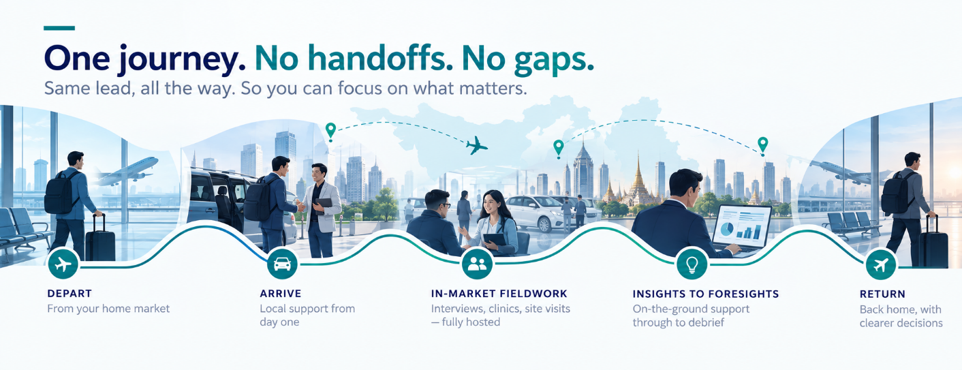
Increasingly, the brief is not "run this study in Market X." It is "help us understand this region". That means clients entering in unfamiliar markets need the research experience to feel as connected and seamless as it does at home. In practice, that can mean a single regional client lead travelling with the client rather than coordinating from a desk, connecting local market visits, fieldwork and on the ground support throughout the journey.
The value here is not the logistics themselves. It is what removing that friction frees the client to focus on instead: the insight, the decision, the opportunity in front of them, rather than the mechanics of getting there. That is what "global capability, local execution" is meant to deliver in practice, a rule so quiet it rarely makes it onto the slide, yet it can be one of the things clients remember most.
What these rules have in common
None of these are really stories about technology, a single client relationship, or travel logistics. They are one pattern showing up three ways: as AI becomes more embedded across the research industry, speed, scale and automation are becoming increasingly accessible.
What increasingly shapes the strength of a client research partnership is what gets built around those ingredients: foresight layered on top of data, trust built over time, and friction reduced so clients can stay focused on the decisions in front of them.
These are three patterns we have seen up close, and there are likely others still emerging. None of them tells the whole story on its own, but together they point to how expectations of automotive research partnerships are evolving across the region.
So we would genuinely welcome the conversation. Where are you seeing this play out, and where does the gap still feel wide open? We would be glad to compare notes on how these shifts are playing out across automotive research in the region.
The author(s)
-
 Thomas TanAutomotive Lead, Ipsos in Malaysia