
Labour party more liked than Starmer but both reach historic lows - Ipsos poll
New findings from Ipsos’ latest Political Monitor, with fieldwork carried out from the 22nd – 27th January 2026, reveals likeability figures for political parties and their leaders, and how the two interact.
Key findings
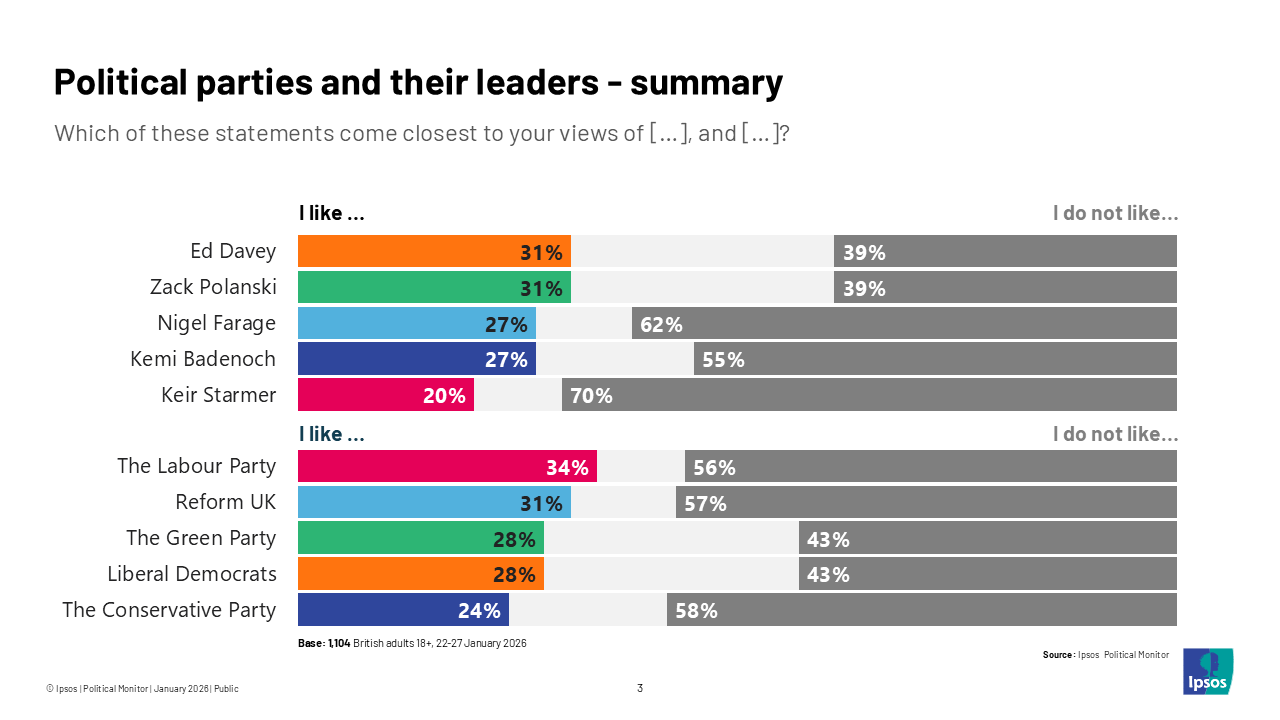
Likeability of party leaders
- Overall, Ed Davey and Zack Polanski are currently the most liked among the main UK political leaders, with 31% of Britons each saying they like them, and 39% disliking each (though 3 in 10 and 4 in 10 respectively say they don’t know enough about them).
- Conservative leader Kemi Badenoch and Reform UK leader Nigel Farage follow behind with 27% liking each, but with majorities saying they do not like either of them (55% Badenoch, 62% Farage).
- Keir Starmer has the lowest likeability ratings, with 20% saying they like the Prime Minister and 70% who do not.
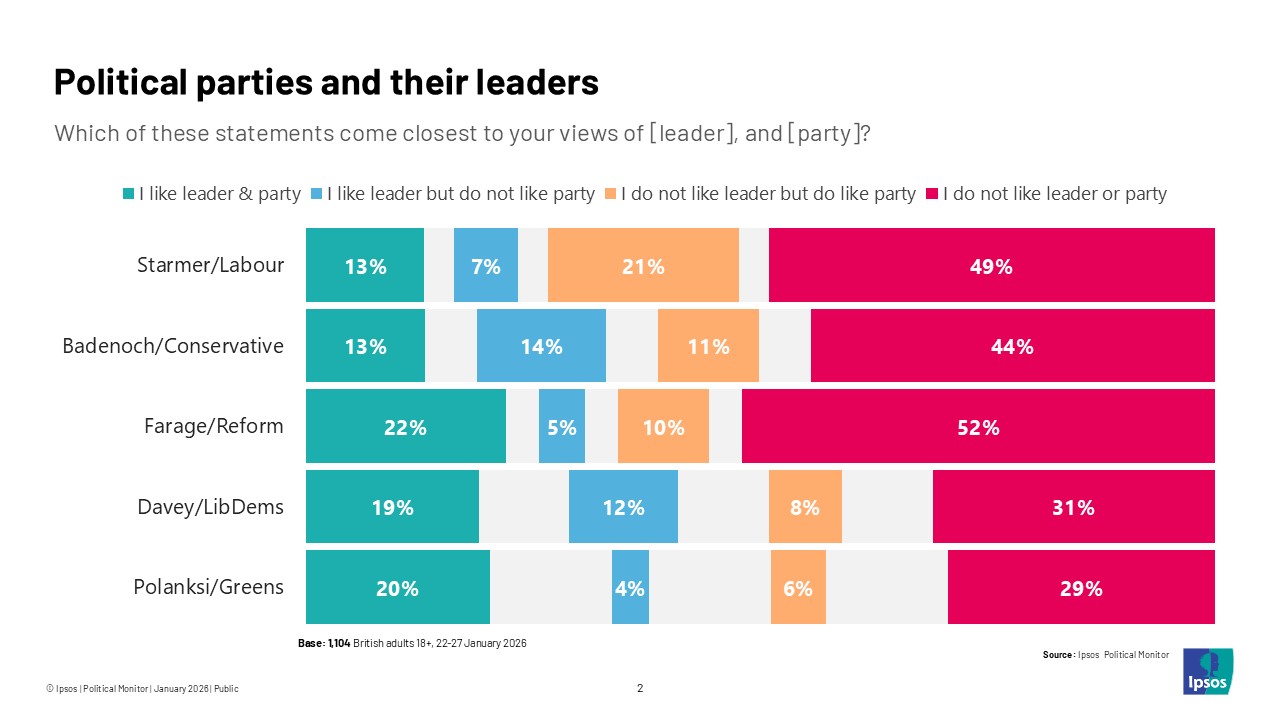
- Keir Starmer’s likeability rating of 20% is down from 34% in June 2024, and his net score of -50 matches the lowest recorded by Ipsos for a Labour party leader since the trend began in 2007 (Jeremy Corbyn also recorded a net likeability score of -50 in November 2019 when 23% said they liked him and 73% did not).
- Kemi Badenoch’s likeability rating of 27% also matches the previous low recorded by Boris Johnson in June 2022, though he recorded more dislikes at 67% meaning his net score of -40 remains the lowest recorded by a Conservative party leader (compared with Badenoch’s -28).
- Nigel Farage’s net likeability rating of -35 is slightly down on his score of -29 in November 2019, but not quite at his previous low of -40 in November 2019. Ed Davey’s net rating of -8 is marginally down from -5 in June 2024, though not at Nick Cleggs -34 in October 2012. Zack Polanski’s net rating of -8 is slightly down from Carla Denyer and Adrian Ramsay score of +1 in June 2024.
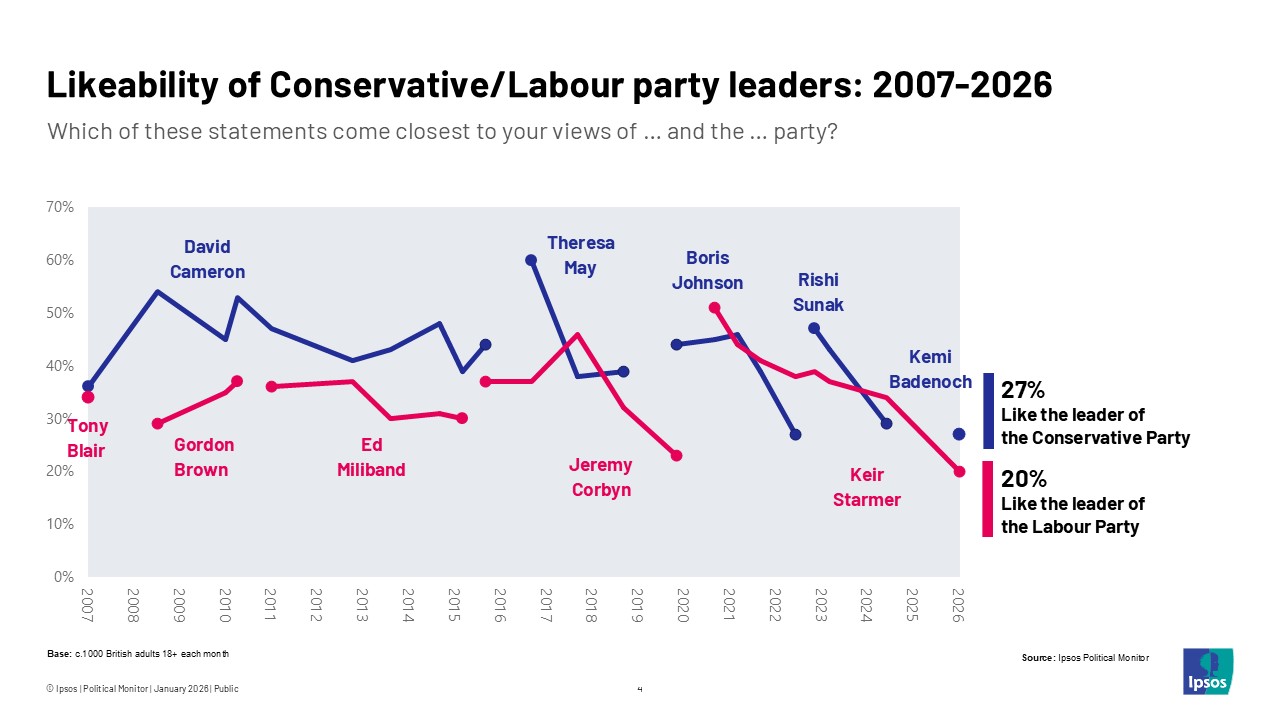
Likeability of parties
- The Labour Party is the most liked party, liked by 34% of Britons but disliked by 56%. This is worse than June 2024, when 50% liked the party and 41% disliked it, and the net score of -22 is the lowest Labour has received in the Ipsos trend going back to 2007 (the previous low was in January 2010 when 39% liked the party and 57% disliked it, giving a net score of -18).
- 31% say that they like Reform UK, compared with 57% who do not, slightly better than June 2024 when 27% liked the party and 62% did not.
- 28% each like the Green Party and the Liberal Democrats, with 43% each saying they do not like these parties, a fall for both since June 2024 when 38% liked the Greens and 35% the Liberal Democrats.
- The Conservative party continues to be the least liked party, with 24% saying they like the party and 58% disliking it. The party’s worst score was in June 2024, when the same number, only 24%, said they liked the party, but even more (72%) said they disliked it.
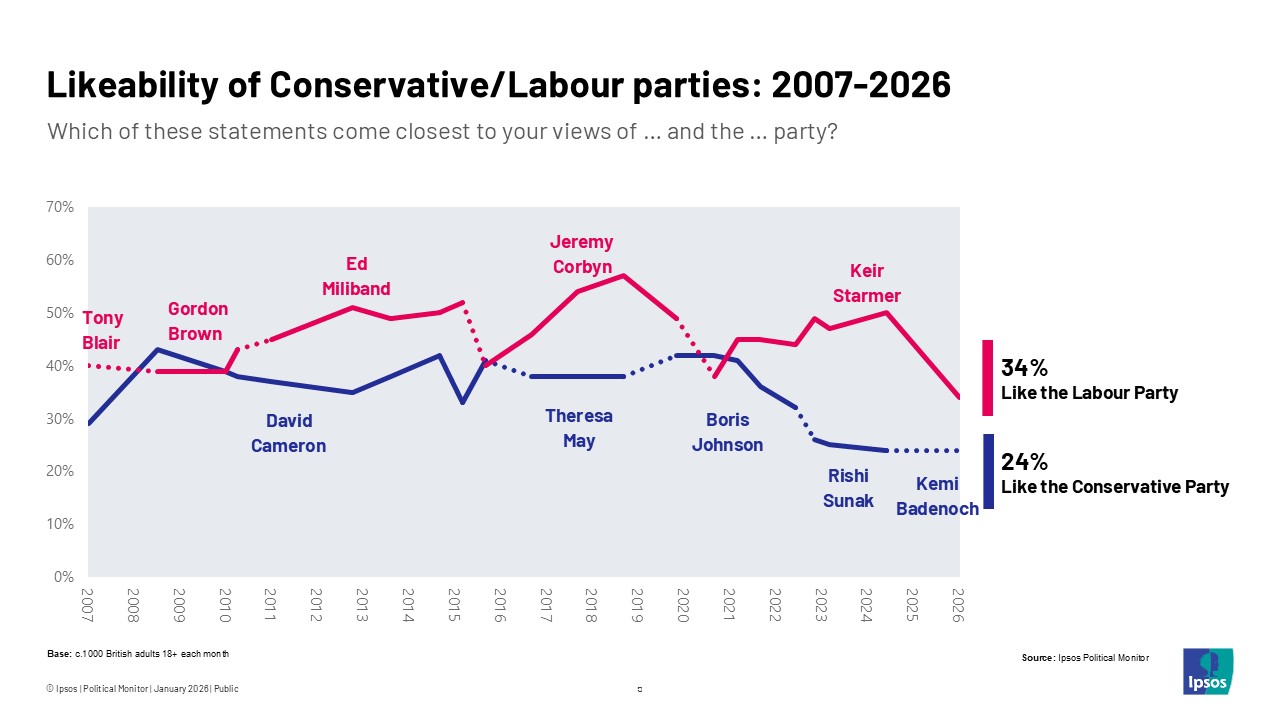
How do party and leader image ratings interact?
- Labour has the biggest gap between ratings of the party and the leader – 34% say they like the party but only 20% Keir Starmer, a difference of 14 points. Indeed, 21% say they like the party but not the leader, three times as many as the 7% who say they like the leader and not the party. This reflects a longstanding pattern for Labour where the party is often more liked than its leader, with the biggest gap coming in November 2019 when 49% liked the party but only 23% liking its then leader Jeremy Corbyn.
- Reform UK is the most polarising with less distinction between party and leader, with 22% saying they like both the leader and the party, and 52% saying they dislike both the leader and the party.
- The long-term pattern for the Conservatives is different than that for Labour, with Conservative leaders generally (but not always) being slightly more liked than the party, with the biggest gap at the start of Theresa May’s time as leader in September 2016 when 60% liked her and 38% the party. Now there is much less difference between the leader and the party, although Kemi Badenoch is marginally more liked by 27% to 24%.
Gideon Skinner, Senior Director of UK Politics at Ipsos, said:
Our latest Ipsos Political Monitor shows that Keir Starmer is grappling with a significant likeability deficit, with a mere 20% of Britons backing the Prime Minister, the lowest for any party leader, compared with 34% who like the Labour party. It is actually fairly common for Labour leaders to be less liked than their party, but the difference this time is that both are now in trouble, with Jeremy Corbyn being the only Labour leader to be disliked this much, and the party’s likeability even lower than its previous nadir under Gordon Brown after the financial crash. Any potential rival to the PM would need to demonstrate not just how they personally would be more liked, but how they could bring the party’s reputation up too.
The one comfort for Labour is that even though their party is receiving a historically low likeability score, it is still more liked than the other parties, reflecting the fragmented political scene. The Conservatives remain the least liked party, albeit has shed some of the actively dislike it received before the election, while Reform UK tend to divide opinion with their own supporters very positive about both party and leader but other party supporters disliking both too. Meanwhile the Greens and LibDems are not as disliked but have large proportions of don’t knows too. This all suggests that Britons, pessimistic about the state of the country, also lack confidence in any of the parties at the moment.
Technical note:
- Ipsos interviewed a representative probability sample of 1,104 British adults aged 18+, via the Ipsos UK KnowledgePanel. Data was collected between the 22nd-27th January 2026. Panel members are recruited via random probability sampling, by sending letters to randomly selected addresses, which invites them to join an online panel. This approach means every household in the UK had a known and non-zero chance of being selected to join the KnowledgePanel. Those who are digitally excluded are provided with a tablet and free, restricted data connection. A sample of 2,301 adults aged 18+ were invited to take part in the survey. The sample was stratified by nation, age, qualifications and vote at the 2024 general election (as collected immediately after the election). The achieved sample was weighted in two stages:
- Design weights were applied to correct for the unequal probabilities of a person being selected for a survey, notably residents in smaller households have a higher chance of being selected.
- Calibration weights were applied through rim weighting to correct for differential non-response. Data was weighted to the adult population profile on age and gender, Government Office region, ethnicity, qualifications, work status and work sector (public sector/other), social grade (office coded), number of cars in household, constituency type, and newspaper readership (print and digital). Population targets were obtained from the 2021/22 Census, ONS population estimates and other large-scale probability surveys.
- All polls are subject to a wide range of potential sources of error. On the basis of the historical record of the polls at recent general elections, there is a 9 in 10 chance that the true value of a party’s support lies within 4 points of the estimates provided by this poll, and a 2 in 3 chance that they lie within 2 points. This is especially important to keep in mind when calculating party lead figures.
- Note that this is a new methodology implemented since June 2025. It involves a new form of data collection (online random probability panel instead of quota telephone survey), an updated voting intention (which involves prompting for Reform UK), and an updated weighting scheme. This is based on our learnings during and since the 2024 General Election. This means that comparisons with previous waves need to be made with caution.


